
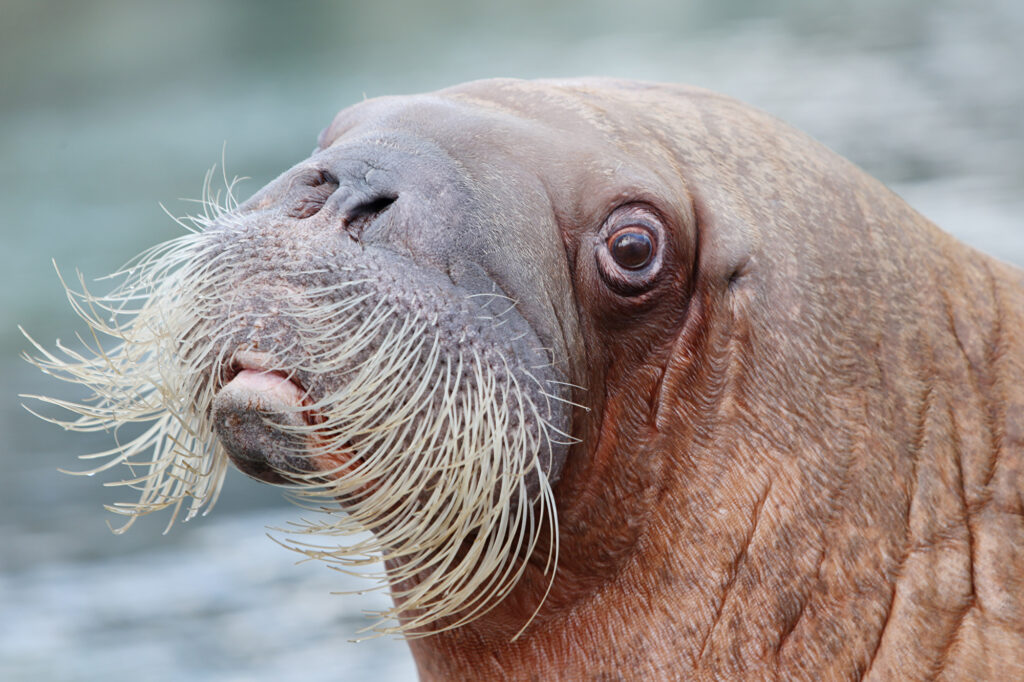
On November 18, a significant agreement was signed between the Conservation Fund, a nonprofit environmental organization in the United States, and the Cully Corporation, a Native corporation based in Point Lay, Alaska. This collaboration aims to protect nearly 50,000 acres of land in the vicinity, including barrier islands, establishing it as a permanent refuge for Pacific walruses. This initiative particularly focuses on preventing resource development activities that could impact walruses and their habitats due to human interference.
In return for this protective measure, the Cully Corporation will receive funding intended to support the economic stability of the local community, as well as to preserve their traditional ways of life.
Larry Selzer, the President and CEO of the Conservation Fund, emphasized the necessity for larger habitats for large animals to thrive. He pointed out that Pacific walruses are no exception, stating, “These majestic creatures require expansive environments for breeding and survival.”
Selzer lauded the protection model adopted in this agreement as “very effective,” as it ensures that the land will not only be utilized for economic benefits but also serves to safeguard critical wildlife habitats.
Willard Neakok, the Chairman of the Cully Corporation’s board, remarked on the positive implications of this partnership. He noted that it would provide opportunities and help preserve the cultural heritage of the Inupiaq people. Neakok stated, “We have a deep respect for our land, traditions, history, and culture, and we pursue these actions for the sake of our descendants.”
Historically, Pacific walruses have relied on the sea ice of the Bering Sea for their habitat during winter months, utilizing the Arctic’s enduring ice as a platform. Male walruses typically remain in the area while females migrate northward with their young to forage, rest, and breed in the shallows of the Chukchi Sea. However, the human-induced phenomenon of global warming, primarily through fossil fuel combustion, has dramatically eroded these vital sea ice formations.
With the ongoing ice melt, around 200,000 Pacific walruses gather each autumn near the sandbars close to the village of Point Lay, forming an unprecedented spectacle. The congregation is so vast that the walruses appear tightly packed together, creating an astonishing sight of brown, blubbery bodies, interspersed with white tusks.
This phenomenon began in 2007 with just a few thousand females and their pups; however, the population swelled rapidly over the years. Presently, nearly all Pacific walrus females and their young, which total approximately 200,000, rely on this particular habitat for survival.
John Wros, the Alaska Director for the Conservation Fund, highlighted that this area is recognized as the largest walrus haul-out site in North America.
Chelsea Koch, a marine scientist at American University, outlined the alarming trend of disappearing sea ice over the past two decades, which has forced walruses to seek terrestrial habitats along the Chukchi Sea coastline. She remarked, “This is a response of the animals to changing conditions, but it does not mean that land can fully substitute for the habitats they are losing.”
Anthony Fischbach, a wildlife biologist with the United States Geological Survey (USGS), noted that while the walrus population has remained relatively stable, the “new normal” stemming from vanishing sea ice poses a grave threat to their survival.
In Point Lay, one of the most significant dangers to walruses is the risk of stampedes. These large creatures, which can weigh up to two tons, are easily startled. Even slight disturbances can trigger them to flee towards the ocean, often resulting in tragic outcomes. Wros reported, “There are often mass mortality events, where hundreds of juvenile walruses are trampled to death.” Although polar bears can sometimes cause panic, human activities, such as low-flying aircraft, busy boat traffic, or even eager cruise ship tourists seeking to observe the animals, are usually the culprits.
Point Lay is situated at the edge of the National Petroleum Reserve in Alaska, an area that straddles the crossroads of resource development, including fossil fuel extraction.
The new protection agreement seeks to mitigate disruptions from commercial activities and tourism while ensuring that local residents have access to natural and financial resources without being pressured to sell land for oil and gas activities.
Selzer commented on the significance of the decision for the village’s elders, stating, “For the elders in this village to say, ‘We will permanently forfeit certain rights’ is an enormous decision.” He indicated that this is one of the reasons why the planning process took ten years to come to fruition.
The Conservation Fund has not disclosed the payment amount to the Cully Corporation, nor have they clarified which donor or foundation the funding originates from.
Koch expressed optimism about the approach, saying, “Supporting local management while protecting critical walrus habitats is a promising strategy.” She hopes that as sea ice continues to diminish, this new refuge can provide walruses with a chance for survival.
However, she added a note of caution, emphasizing that the success of such conservation methods in other locations hinges on local community involvement and support. She questioned, “Are local residents able to participate in decision-making? Are their rights to live and participate protected? Will the local monitoring and management efforts receive long-term support?”