
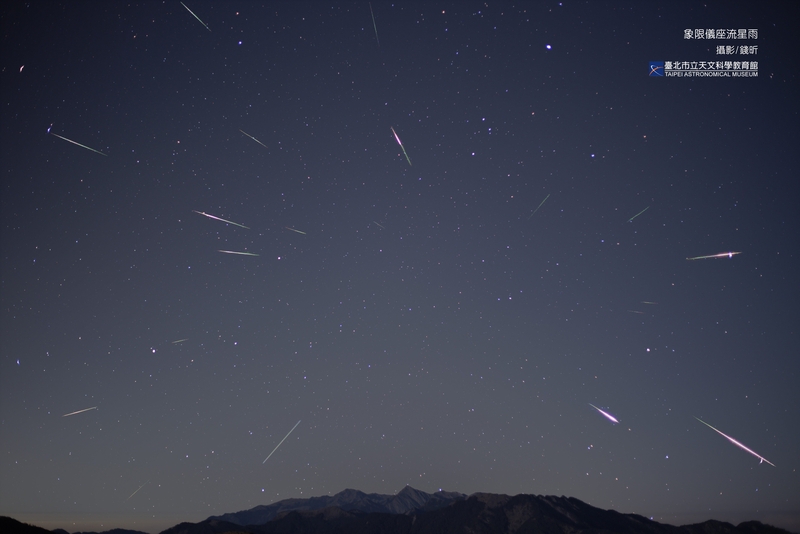
The Taipei Astronomical Museum has released the “Significant Celestial Events Calendar for 2027,” showcasing a variety of exciting astronomical phenomena that will occur throughout the year. According to their calculations, numerous breathtaking events are set to take place, such as the Quadrantid meteor shower in January, the Western elongation of Venus, the opposition of Jupiter, and the opposition of Mars in February, as well as the Eta Aquariid meteor shower, the conjunction of Venus and Saturn in May, and the opposition of Saturn in October, followed by the conjunction of Mars and Venus in November.
On November 17, the Taipei Astronomical Museum announced the highlight calendar revealing several meteor showers capable of producing over 50 meteors per hour at their peak, known as the Zenithal Hourly Rate (ZHR). The meteor showers to watch for include the Quadrantid meteor shower on January 4, the Eta Aquariid meteor shower on May 6, the Perseid meteor shower on August 13, and the Geminid meteor shower on December 14. Among these, the Quadrantid meteor shower, with an estimated ZHR of about 80, and the Eta Aquariid meteor shower, with a ZHR of approximately 50, present the best viewing conditions.
In terms of planetary events, the museum noted that Mars will reach opposition on February 19, with Jupiter following just eight days earlier on February 11. Notably, this opposition of Mars will be the farthest recorded since 1950, surpassing the proximity experienced during the close approach of Mars in 2018 by 57%. Furthermore, Saturn will reach opposition on October 18, and due to the increased tilt of Saturn’s rings, this observation will provide a more stunning view than in previous years.
Additionally, the Taipei Astronomical Museum highlighted several eye-catching planetary conjunctions. Among these, the conjunction of Mars and Venus on November 25 is particularly noteworthy, as they will come within just 0.31 degrees of each other, marking the closest view of the two planets since 2017. This celestial phenomenon will be observable shortly after sunset with both planets setting closely together in the western sky.
Furthermore, on the evening of November 30, a unique spectacle will unfold with the conjunctions of Mars and the Moon, as well as Venus and the Moon occurring simultaneously. Venus, Mars, and a crescent Moon will align within a tight triangle measuring only 2.5 degrees across, creating a stunning visual display for stargazers.
For those interested in staying updated on these astronomical events, the public can visit the Taipei Astronomical Museum’s official website or their Facebook page “Taipei Astronomical Communication” for the latest information and viewing tips. The museum invites everyone to take advantage of these opportunities to witness the wonders of the universe in the coming year.