
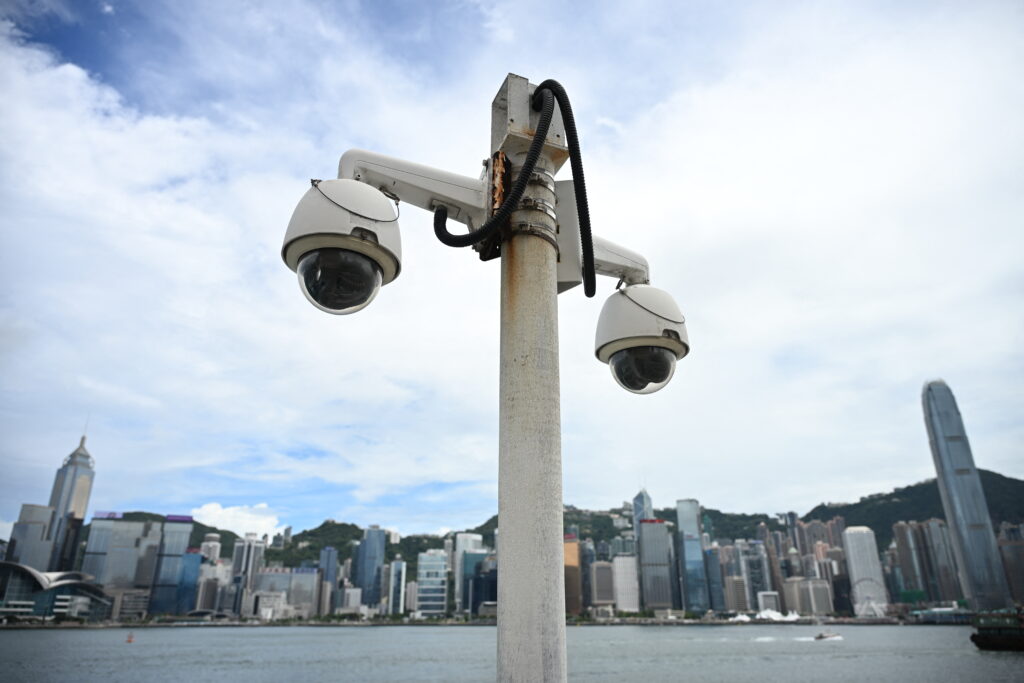
On November 16, the Hong Kong police officially activated their AI facial recognition system, integrating it into the extensive surveillance network across the city. Plans are underway to deploy approximately 60,000 cameras by 2028. Human rights organizations have expressed deep concerns that the authorities may leverage this system to intensify tracking of political dissidents in the wake of the National Security Law’s implementation.
The newly launched system, named “SmartView,” connects CCTV footage from various government departments and public institutions to the police network. Since the end of last year, over 10,000 surveillance cameras have been gradually installed throughout Hong Kong.
With the AI facial recognition feature now operational, the head of the Hong Kong Police Force, Chow Yung-ming, announced that the technology would assist in searching for suspects and at-risk missing persons during specific investigations, as well as identifying vehicle license plates.
When questioned about the system’s ability to recognize individuals wearing masks, Chow refrained from disclosing technical details, citing concerns that certain individuals might exploit this information to evade detection.
One of the significant privacy concerns raised is the duration for which data will be stored. The Human Rights Foundation (HRF), a New York-based organization, stated in its latest newsletter on “Artificial Intelligence and Personal Rights” that while ordinary CCTV footage is retained for a maximum of 31 days, images generated by the AI facial recognition system—along with data on shooting locations, dates, times, and facial features—will be retained for as long as 180 days, nearly six times longer than standard footage.
The police clarified that the facial recognition system will not conduct constant surveillance through all cameras simultaneously. However, under certain circumstances, specific cameras may be activated for 24-hour identification. This means that during targeted investigations, the police can utilize footage from various locations to search for individuals of interest.
The surveillance scope is also starting to extend into private commercial spaces. Reports indicate that at least four shopping malls, including Ocean Terminal, Tuen Mun Town Plaza, Kwai Chung Plaza, and Fanling Crest, have agreed to connect their CCTV systems to the police network. According to the law, malls equipped with CCTV surveillance must display notifications to inform the public that monitoring is in progress.
However, the Department of Justice had previously suggested that whether these malls disclose their connections to the police system should be voluntary and not require mandatory signage. This implies that even if the public is aware of the presence of cameras in these locations, they may remain uninformed about whether the footage is being fed into a police surveillance network.
The HRF warned that the combination of AI facial recognition technology and a large-scale surveillance network could make it easier for the authorities to identify and track political dissenters. Previously, the police had to manually sift through substantial amounts of footage; now, they can use AI to zero in on specific individuals, thereby reducing the costs associated with tracking.
In official documents, the Hong Kong police have identified maintaining national security as one of the main purposes of the “SmartView” system, which also encompasses crowd management during large public events.
The HRF expressed concern that after the implementation of the National Security Law and the National Security Regulations, surveillance technologies might be used not just for criminal investigations, but also for monitoring political activities. While there is currently no evidence that the police have systematically utilized the new system to track dissenters, concerns persist regarding data use, access permissions, and the lack of transparent external oversight mechanisms.
The controversy surrounding surveillance equipment on the streets of Hong Kong began during the anti-extradition protests in 2019. On August 24, during a demonstration in Kwun Tong, protesters dismantled several smart lamp posts installed by the government, speculating that the devices were involved in facial recognition and the Chinese government’s “Skynet” project.
One of the devices, the SPLD01 Bluetooth locator, raised suspicions when its supplier, TickTack Technology, temporarily linked the product to a Shanghai-based smart lighting control system. The government denied that the smart lamp posts possessed facial recognition capabilities, and the supplier also refuted any connection or ownership relations with the Shanghai firm.
Shanghai Sansi, a contractor for China’s Skynet project, is responsible for numerous smart lamp posts and surveillance operations on the mainland.
Moreover, in a report from Bloomberg in October 2019, it was revealed that the Hong Kong police had acquired facial recognition software from the Australian company iOmniscient as early as 2016. Numerous officers underwent training related to this software, which could scan CCTV footage and match faces and license plates against police databases to identify individuals within crowds. At that time, it was unclear whether the police used this technology during the anti-extradition protests.
Following the protests, the Hong Kong police publicly launched the “SmartView” project in 2024, which initiated the installation of cameras in public areas and integrated footage from other government departments. With the current activation of AI facial recognition capabilities, the surveillance abilities have advanced from merely recording public space images to actively searching for specific individuals.
The Chinese mainland’s “Skynet” and “Sharp Eyes Project” utilize extensive camera networks, AI recognition, and police databases to establish trans-regional surveillance networks. Research by the Brookings Institution indicates that the Chinese government has further expanded its surveillance reach by integrating data from different sources, including government and private cameras.
The Hong Kong police plan to increase the number of surveillance cameras to about 60,000 by 2028, with an additional 6,500 set to be installed in the Northern Metropolitan area. From the controversies sparked by smart lamp posts on the streets in 2019 to the current integration of commercial footage into police networks, Hong Kong’s public surveillance system continues to evolve significantly.
While the Hong Kong police have yet to confirm the direct adoption of the complete technological platform used in mainland China’s Skynet, the characteristics of networked surveillance, cross-agency video integration, and AI facial recognition show notable similarities.