
Following the outbreak of the Korean War in 1950, the United States dispatched the Seventh Fleet to assist Taiwan and began a secret collaboration with the government of the Republic of China (ROC). This partnership aimed to contain the military forces of the Chinese Communist Party (CCP) and alleviate pressure on the front lines of the Korean conflict. Starting in 1952, the ROC Air Force, in cooperation with the Central Intelligence Agency (CIA) of the United States, undertook covert operations against mainland China, which eventually led to the formation of the “Black Bat Squadron.” This elite unit engaged in nighttime low-altitude reconnaissance missions, electronic intelligence gathering, and aerial supply drops. Tragically, many squadron members lost their lives during these operations, leaving their families with enduring sorrow.
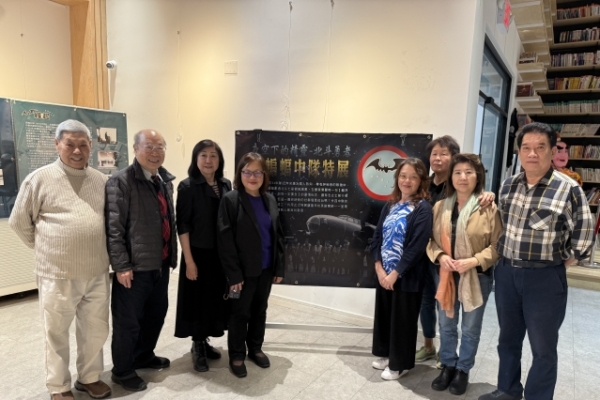
To honor these unsung heroes of the air force, the Taiwanese Association of New York held a special exhibition titled “Spirits Under the Night Sky—Brave Warriors of Beidou: The Black Bat Squadron” from November 13 to 15 at the Chinese Cultural Service Center in New York. The exhibition featured historical photographs, documents, documentaries, and lectures to bring to light this little-known chapter of history.
The Black Bat Squadron was established in 1953 at a base in Hsinchu. The unit’s missions were always executed during the dark hours of the night, drawing parallels to the way bats use echolocation, which is similar to radar electronic detection principles. As a result, in 1958, the squadron officially adopted the bat insignia, thereby earning the name “Black Bat Squadron.”
The special event held on November 14 attracted attendees from all age groups within the Taiwanese community. Display panels provided insights into the squadron’s background, secret missions, and the aircraft types utilized, which included reconnaissance planes such as the B-17, B-26, and C-123, alongside various operations known as “Operation Fox Hunt,” “Operation South Star,” “Operation Qilong,” and “Operation Golden Whip.” Attendees paused to view the historical photographs and lists of team members, gaining an understanding of the life-threatening experiences these airmen faced.
Originally, former Black Bat Squadron member Mr. Li Guorui was invited to share his experiences, but due to his health issues, he was unable to attend, resulting in an extended screening of related films instead.
Li Jiewei, president of the Taiwanese Association of New York and vice president of the National Taiwanese Association, opened the event by sharing her personal connection to this history—she is the daughter of Li Zhiping, a navigator with the Black Bat Squadron, which deepened her emotional connection to these historical events.
She recalled the intense secrecy surrounding her father’s missions, noting that the family was typically unaware of the dates or details of his operations. Squadron members often departed late at night and returned at dawn, each mission fraught with danger, leaving families anxiously awaiting the safe return of their loved ones.
“Our family was fortunate,” Li Jiewei remarked, “because our father came back to us and was able to be present as we grew up.” However, she poignantly pointed out that 147 members of the Black Bat Squadron sacrificed their lives for their country, leaving their families to grapple with deep, unhealable wounds.
Through this exhibition, she expressed her hope that more people would come to understand the sacrifices made by these air force heroes during the Cold War, as well as the pain and sacrifice endured by their families.
Former president of the Taiwanese Association of New York, Li Jieqing, shared insightful remarks during an interview, highlighting the perilous nature of the Black Bat Squadron’s missions, which required flying at extremely low altitudes at night to evade enemy radar detection. “Every time they went out on a mission, the commander would ask them to sign their wills,” she recalled. “My father once said that the documents they signed the most were their wills.”
Historical documentation reveals the sobering fact that among the more than 300 members of the Black Bat Squadron, 147 lost their lives, making the toll on the unit particularly severe.
In addition to the inherent dangers of flying missions, the squadron members also endured the psychological pressures of enemy warfare. Li Jieqing mentioned that when the pilots flew over mainland China, the enemy would even broadcast recordings over the radio, featuring the voices of the pilots’ relatives calling out to them in an attempt to disrupt their focus during missions.
Beyond the historical photo exhibitions and film screenings, former chairman of the Chinese Consolidated Benevolent Association Yu Jingshan recounted past experiences and his friendship with Li Guorui, while Fu Hemei, a director with the Taiwanese Association of New York, provided explanations about the historical facts of the Black Bat Squadron. Taiwanese diaspora commissioner Chu Yuemei expressed her reflections during the event, and seasoned media figure Zhou Yunzhi also shared his thoughts during the gathering. Additionally, numerous stories from fellow air force children were exchanged, alongside attendance from friends whose family members served in both the Black Bat Squadron and the Black Cat Squadron.
Li Jieqing emphasized that the purpose of the exhibition was not only to restore historical memories and commemorate the fallen heroes but also to foster a deeper understanding among the public, especially the younger generation, of the hardships faced to secure Taiwan’s current freedoms and safety, all thanks to the sacrifices made by countless anonymous heroes and their families.