
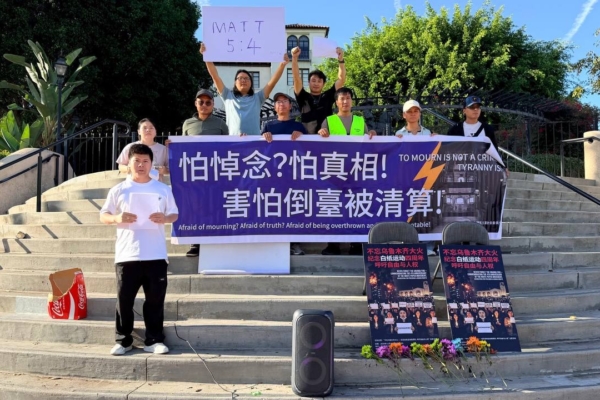
On November 15, a memorial gathering took place in Los Angeles, marking the upcoming fourth anniversary of the White Paper Movement. Dozens of members of the Chinese community assembled near Union Station, directly across from the bustling transportation hub, to honor the victims of the tragic fire that occurred in Urumqi, Xinjiang, on November 24, 2022. The attendees expressed their concerns regarding the crucial issues of freedom of speech and fundamental human rights for the people of China.
Standing on the steps in front of the train station, the demonstrators held blank sheets of paper in their hands, symbolizing the protests initiated by young people in China four years ago during the White Paper Movement. The scene was adorned with flowers and memorial posters, which carried messages that read “Never forget the Urumqi fire,” “Commemorating the fourth anniversary of the White Paper Movement,” and “Calling for freedom and human rights.” Among the various forms of expression displayed, a large banner was unrolled, stating “Afraid to commemorate? Afraid of the truth!” This visually articulated the participants’ concerns regarding the repression faced by Chinese individuals when attempting to openly mourn and seek the truth about the tragedy.
On the evening of November 24, 2022, a fire broke out in a high-rise residential building located in the Jixiangyuan community in Urumqi’s Tian Shan District. The residents of the building, comprising 156 households, had been subjected to an extended pandemic lockdown imposed by the authorities since August 10. Accounts from informed netizens revealed that, during the blaze, escape routes and unit doors were blocked. Videos that emerged from the scene depicted unit doors secured with wires, preventing residents from fleeing.
Fire trucks were hindered from accessing the community, which severely hampered their ability to reach the flames. The fire escalated from the 15th floor to the 17th floor, while thick smoke engulfed the building up to the 21st floor. A Uyghur exile disclosed to the Associated Press that he learned about the deaths of his aunt and her four children in the inferno.
Residents indicated that the death toll exceeded 20, with many succumbing to asphyxiation due to a lack of oxygen. Additionally, a resident from Shanghai informed the Epoch Times, “In reality, 44 people died, according to information leaked from the hospital.” However, the Chinese Communist Party’s official announcement reported only 10 fatalities and 9 injuries. The authorities denied allegations that the unit doors had been locked, claiming that the images circulating online were altered, while also criticizing some residents for their inadequate self-rescue abilities.
In the aftermath of the fire, candlelight vigils were held by the citizens of Shanghai on Wulumuqi Zhonglu. Protests erupted in various cities, including Beijing, Wuhan in Hubei, and Lanzhou in Gansu, as well as numerous universities across the nation. Dissatisfaction over the extreme pandemic control measures implemented by the Chinese Communist Party fueled these demonstrations. Protesters held up blank sheets of paper to decry censorship and voiced calls for freedom of speech. Soon after, many participants in the White Paper Movement were arrested.
Four years later, the participants in Los Angeles once again lifted blank pieces of paper, bringing their remembrance of the fire’s victims and their calls for freedom of speech to the public eye. This commemorative event raised crucial questions left in the wake of the White Paper Movement: When a public tragedy occurs, are families and the general public permitted to mourn openly, to inquire about the circumstances, and to freely express their criticisms of the authorities?
The event was organized by the West Covina branch of the Chinese Democratic Party, with the collaborative efforts of individuals including Qu Chengsong, Li Wei, Yang Xuehua, and Yang Yinhua.