
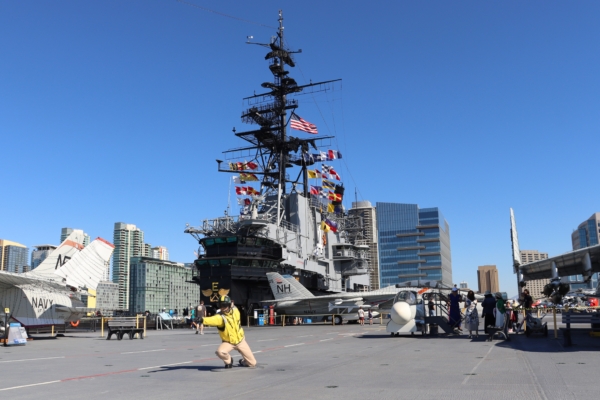
In a recent exploration of the USS Midway (CV-41) aircraft carrier, which has been repurposed as a museum since its opening to the public in June 2004, visitors can often encounter veterans who once served aboard this historic vessel. Once the largest aircraft carrier in the world prior to 1955, the USS Midway also played a significant role during the Gulf War in 1991. Within its first year as a museum, it welcomed approximately 880,000 guests.
The guided tour, led by Ted Krohne, highlights the remarkable efficiency and precision of flight operations aboard the carrier. One of the most impressive facts is that aircraft can take off from the deck in just 2.4 seconds. Within a mere distance of 249 feet (approximately 76 meters), planes must accelerate to an astounding 160 miles per hour, relying solely on steam power for launch. Under normal circumstances, it takes about 90 seconds for a catapult launch, but experienced personnel can shorten this time to as little as one minute. By alternating between two catapults, a maximum of 16 aircraft can be launched within 12 minutes.
The flight deck is a hub of coordinated activity, where staff members wear vests of various colors to denote their specific responsibilities. For instance, the green vests signify personnel responsible for connecting the launch mechanism and guiding planes to their launch positions. Each aircraft has a uniquely colored and shaped launch bar to prevent mistakes during operations, regardless of day or night. Before takeoff, green-vested personnel raise a “weight board” to confirm the aircraft’s weight with the pilots, ensuring accurate steam injection for thrust. Red vests represent armament checkers, while white vests are worn by safety inspectors.
The operational philosophy for naval aircraft carriers emphasizes the importance of keeping mission-capable aircraft on the flight deck at all times, necessitating the design of folding wings to maximize space. Once the aircraft is at the catapult position, pilots must verify that wings are fully extended and that no destroyers are crossing ahead before launching from the tumultuous sea with the ship’s bow angled upward.
When everything is ready, the yellow-vested catapult officer inspects the runway for any obstacles before signaling to the pilots. The pilots advance their engines to maximum military power, swiftly check their instruments, and then salute the officer. The officer crouches and gestures forward, prompting the green-vested personnel to press the launch button. It is crucial for the person activating the launch to be a qualified pilot, usually serving for no more than two years before returning to a flying position.
Central to the carrier’s operations is the main control room, which stands about four stories high. Former pilot Bob described this area as the “Flight Control Center.” Both the Mini Boss and the Air Boss positions require extensive experience and a background commanding carrier-based squadrons. During air operations, these officers work long hours, approximately 12 to 14 hours each day, ensuring the safe takeoff and landing of aircraft.
Behind a rotating transparent “Launch and Recovery Status Board,” unassigned pilots monitor the flight operations. One pilot uses a marker to write down the takeoff and landing statuses in reverse, allowing the commanding officer to read them as direct text. Each pilot on board is an expert in a specific aircraft type. If the Air Boss calls out, “Hornet, come in!” the F/A-18 Hornet pilot will arrive with an operations manual to discuss details with the commander.
Additionally, Bob mentioned that the ship is equipped with a 1,500-foot-long arrestor wire, which aids in aircraft landing. Certain personnel are assigned to monitor the “arresting gear control panel,” as different types of aircraft require varying levels of arresting force; too much force could damage the aircraft, while too little may cause it to overshoot the landing area.
Veteran Pat McMahon noted the path known as “Vultures’ Row,” which leads to the Navigation Bridge that accommodates roughly 20 people—the core command and control center of the aircraft carrier. Pilots and sailors often gather in this area to observe flight operations, resembling a line of waiting vultures from a distance. From this vantage point, one can see the active nuclear-powered aircraft carriers, USS Carl Vinson (CVN-70) and USS Abraham Lincoln.
The ship’s captain is one of the most crucial figures aboard the vessel. The USS Midway operated from September 1945 until its retirement in April 1992 under the command of 40 different captains, the first of whom was Captain Joseph F. Bolger and the last, Rear Admiral Joseph Prueher.
McMahon emphasized that commanding an aircraft carrier with a crew of around 4,500 is a considerable responsibility, with the captain typically spending 14 to 16 hours daily on the bridge. The captain must be a highly skilled and experienced pilot, commonly referred to as “The Old Man,” “Skipper,” or “Commanding Officer.” Other key figures include the Navigator, who manages navigation duties, and the Officer of the Deck, usually a naval lieutenant authorized to command the bridge.
On the bridge, there is also a transparent board used for tracking unidentified naval vessels within a 20-mile radius. A young sailor, typically aged 19 or 20 and possibly lacking even a driver’s license, handles the wheel of this massive warship. Behind him stands the Bosun’s Mate of the Watch, who is responsible for maintaining order, communicating orders, and disseminating announcements.
Among the visitors was a veteran displaying a sticker reading “I Served,” accompanied by a few friends. He shared that he had served on the USS Midway years ago and was finding it challenging to navigate the newly designed one-way visitor pathways, relying on directional signs to guide him through the ship. Staff indicated that there are abundant exhibits, dining options, and interactive experiences available onboard, making it quite common for guests to spend several hours exploring this remarkable floating museum.