
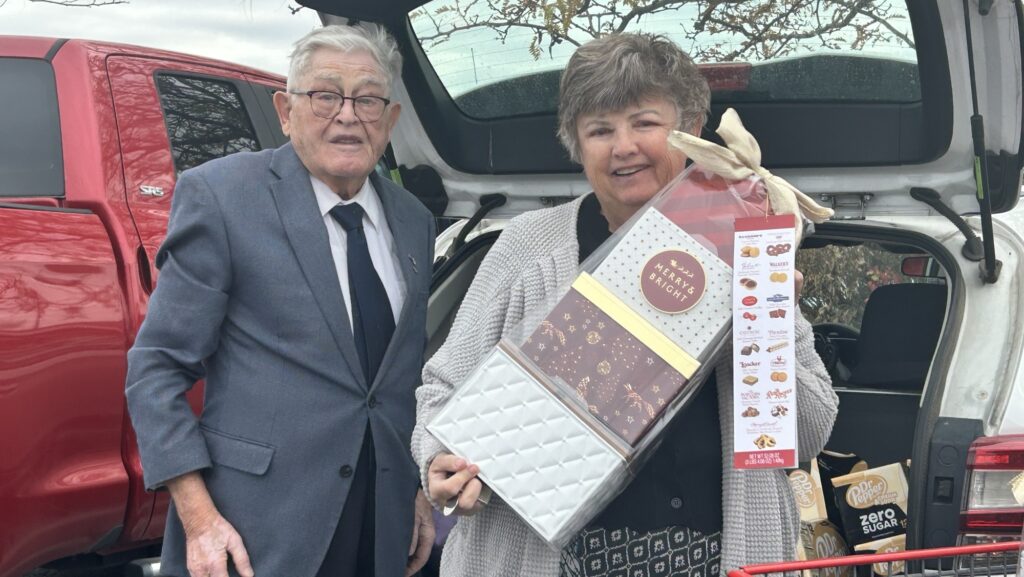
On Black Friday afternoon in November 2026, the skies were overcast, and the distant mountains were dusted with the season’s first snow. In the Costco parking lot of Bountiful, Utah, Joy held a large, ribbon-wrapped Christmas gift in her arms while standing next to her 94-year-old father, dressed in a suit and tie. The father-daughter duo had ventured out to find Christmas gifts for their grandchildren.
Joy herself doesn’t participate in the shopping frenzy that comes with Black Friday. “I don’t like going into stores; I only shop online,” she shared. Most of her gifts are handmade; Joy creates painted glass art, and this year, every child in her family, along with her friends, will receive a glass ornament she made herself.
Recently, Joy had traveled to Asia, visiting places like Taiwan, Japan, and Vietnam, and she spent two weeks exploring various cities in China. The trip opened her eyes to a notable contrast with her own country.
“Our homes are filled with things we don’t need or want, yet we still keep them,” she reflected. “When I visited friends in Asia, I noticed they don’t have these large, cluttered homes. Unfortunately, that’s just how we are.” After saying this, she let out a self-deprecating laugh.
When asked why Americans love shopping so much, Joy paused and succinctly replied, “I think we just like to shop.”
The National Retail Federation (NRF) projects that retail sales during November and December this year will increase by 4.2%, reaching an impressive $1.013 trillion—marking the first time the figure surpasses the trillion-dollar threshold.
Online shopping is also setting records. According to data from Adobe, Americans spent $7.1 billion online on Thanksgiving Day alone, exceeding the company’s earlier forecast of $6.9 billion. Adobe anticipates that online sales on Black Friday will hit $12.9 billion, while Cyber Monday could soar to $15.1 billion, marking the first time single-day online purchases in the U.S. eclipse $15 billion.
However, much of this spending is financed through debt. The New York Federal Reserve revealed on November 10 that U.S. credit card balances reached a historic high of $1.29 trillion in the third quarter of this year, while total household debt climbed to $19.1 trillion.
Americans are spending money while simultaneously complaining about financial constraints. A survey commissioned by PayPal and conducted by Morning Consult found that nearly 60% of Americans are more concerned about their finances as the holiday season approaches, yet 64% expect to spend as much or more than they did last year.
While interviewing shoppers at the Costco location in Bountiful on Black Friday afternoon, various opinions were expressed: some scoffed at the idea of waiting in lines for deals, others admitted to overspending each year, and some attributed the phenomenon to “herd mentality.” So, why do Americans keep buying?
Joy noted that items in her home that are no longer needed are often given away. “I’ve donated a lot,” she said.
She is not alone in this practice. Just two days before Thanksgiving, a visit to a thrift store in Utah revealed a long line of cars awaiting to drop off donations. Each vehicle was packed with an array of items, including toys, furniture, clothing, and skiing equipment.
Deseret Industries, a thrift store chain run by a church in Utah, reported that its 46 locations receive an average of over 2 million donations each year. According to a 2025 report released by the church, the chain processed approximately 82.93 million pounds of unsellable items in a single year. Nationwide, the Goodwill network received a staggering 5.9 billion pounds in donations in 2024.
The items that can’t be donated often end up in landfills. Data from the Environmental Protection Agency (EPA) indicates that, on average, each American generated 2.7 pounds of trash daily in 1960, a figure that rose to 4.51 pounds by 2017. Clothing is a prime example of the waste issue: the EPA estimated that in 2018, the U.S. generated 17 million tons of textile waste predominantly from discarded clothing, with a recycling rate of only 14.7%. The U.S. Government Accountability Office (GAO) noted that textile waste increased by over 50% between 2000 and 2018, largely attributed to the fast fashion industry.
A Chinese American youth named Vincent recently visited a landfill to dispose of a broken mattress and other items unsuitable for donation; it was his first visit there. He remarked, “Seeing so many people throwing things away, while everyone continues to buy, really shows how wasteful Americans are.”
By 4 AM on Black Friday, long lines had already formed outside a Target in American Fork, with some people even pitching tents. By noon, however, shoppers outside Costco in Bountiful appeared largely indifferent to the chaos of the shopping frenzy. Among them was Kaysha Herfel, a young woman from Centerville, Utah, who expressed her disbelief.
“They’re crazy, really crazy,” her husband commented, asserting that the discounts weren’t worth the hassle. He succinctly summed up the situation as “herd mentality.”
Kaysha laughed in agreement, noting, “Everyone thinks they are saving money, so this whole trend is just about the discounts; it’s a bandwagon effect.” They both have never queued up early in the morning, believing that the hours spent waiting were not worth it.
Terree Chisum, who drove from Elko, Nevada, to shop at Costco wearing a Harley Davidson hoodie, was even more straightforward. She stated she had never engaged in Black Friday shopping at a physical store. On one occasion, she accompanied a friend but remained in the car while her friend waited for hours, only to be knocked to the ground during the rush into the store.
“I don’t want to be trampled by someone else trying to grab something I want, while also waiting in line with thousands of people,” she declared.
But abstaining from lining up does not mean refraining from spending. Terree mentioned that she had already bought quite a few Black Friday deals online over the past two weeks, including a pair of jeans that saved her $80.
Joy also only shops online. The battleground for bargains has shifted from storefronts to smartphone screens, yet physical stores are not experiencing a downturn.
Later that evening around 5:30 PM, a passage through the shopping center in Farmington revealed bustling crowds and busy parking lots, much more lively than the midday atmosphere at Costco.
Juliet Schor, a sociology professor at Boston College, pointed out in her 1998 book, “The Overspent American,” that Americans’ tendency to “keep up with the Joneses” has undergone a transformation. In the 1950s, “the Joneses” represented neighbors with similar incomes; over time, however, comparison shifted to colleagues who might earn five times as much or to those depicted on television leading upper-middle-class lifestyles. As a result, many people “own more but feel poorer.”
Does this perspective still hold two decades later? In response to email inquiries, Schor emphasized that her book highlighted the phenomenon of individuals using television as a reference point, as the lifestyles depicted have become increasingly affluent; “In recent years, social media has taken its place, and the urge to compare remains unchanged.”
Data supports this viewpoint. A survey conducted by social media management platform Sprout Social in August among 2,286 social media users in the U.S., U.K., and Australia revealed that 46% of consumers look for gift ideas on social media, a figure equivalent to those who visit physical stores; among Generation Z, the percentage rises to 54%.
Jessica, an immigrant from Argentina and mother to four children, shared her experience shopping at Costco on Black Friday for food, snacks, and pet supplies. She had initially hoped to find more bargains but was somewhat disappointed.
When asked if she had a holiday budget, she chuckled, “We probably should have one. We try to, but every holiday season, we end up exceeding our budget a bit.” In her words, gifts for her four children include “many necessities, along with plenty of wants.”
Rising prices have made it more challenging to stick to a budget. “Now, $100 doesn’t get you as much as it used to,” she lamented.
Kaysha agreed, noting that due to higher prices, many people wait for Black Friday just to make their spending seem more worthwhile.
Data from the Bureau of Economic Analysis (BEA) indicates that the personal consumption expenditures (PCE) price index increased by approximately 3.8% year-on-year in October, well above the Federal Reserve’s 2% target. This also implies that the NRF’s trillion-dollar consumption forecast is not adjusted for inflation, meaning that Americans paying more does not necessarily equate to buying more.
Terree disagrees with this notion. “They love to shop, yet they’re always complaining about how they can’t afford things and how expensive prices are!” she exclaimed. “In the end, they blow through the money they have, and even spend money they haven’t earned yet.”
“Money they haven’t earned yet” refers to credit cards and various loans. The Federal Reserve estimates that by 2025, about 82% of adults will have credit cards, with the current average credit card interest rate hovering around 21%.
Matt Schulz, chief consumer finance analyst at the financial comparison website LendingTree, stated in a 2023 interview with National Public Radio (NPR) that the U.S. economy relies on consumer spending, and in this country, carrying credit card debt is almost the norm. According to a LendingTree survey, 37% of Americans racked up debt during the holiday spending season last year, averaging $1,223—the highest figure since 2022; nearly half had planned to borrow money for the holidays.
An even more “painless” option than credit cards is the “buy now, pay later” (BNPL) scheme. A survey commissioned by financial website NerdWallet found that 38% of holiday shoppers plan to use BNPL, and among that group, 38% expect to struggle with making on-time payments.
With increased spending comes reduced saving. BEA data reveals that the personal savings rate in the U.S. was only 3.8% in September, marking the lowest point since October 2022. This means that for every $100 of after-tax income earned, American households are saving less than $4.
The entire American economy is built on this consumption model. By 2025, personal consumption expenditures are expected to account for 68.1% of U.S. Gross Domestic Product (GDP). The NRF noted that nearly 80% of GDP growth over the past four quarters has been attributed to consumer spending. NRF President and CEO Matthew Shay even dubbed consumers the “unsung heroes of the American economy.”
Yet, to Jessica, who migrated from Argentina, holiday shopping isn’t just about spending money. Speaking of Americans, she used “they” to describe them: “They really enjoy giving gifts. It’s also a way to spend time with family.” She mentioned giving family items that she appreciates, which they also enjoy, and highlighted the abundance of charitable activities during the season, “you can buy items to donate.”
An elderly woman, who preferred to remain anonymous, shared with a reporter that shopping brings her happiness and serves as a therapeutic activity for her.
Her sentiments are partially reinforced by psychological studies. Americans often refer to “retail therapy,” implying that shopping can lift one’s spirits during times of distress. A study published in the Journal of Consumer Psychology by Scott Rick, a professor of marketing at the University of Michigan’s Ross School of Business, discovered that making shopping decisions can alleviate sadness. Researchers explain that sadness often stems from the feeling of being unable to control one’s circumstances, and the process of selecting and making decisions can restore a sense of control. However, Rick also cautioned that shopping doesn’t help with anger or other internal conflicts.
This might explain why Americans seem to shop more in the face of economic uncertainty. During times of rising prices and unpredictable futures, purchasing a small item is one of the few decisions people can make for themselves.
Tim Kasser, a psychology professor at Knox College who specializes in studying materialism, issued a warning. In an interview published by the American Psychological Association, he stated that “compulsive consumption” is when one feels unable to control their urge to spend, often as a means to fill a void or alleviate anxiety. He also pointed out that research shows that the more people watch television, the more their values become materialistic; a study comparing American and Arab adolescents found that increased social media usage correlates with higher materialistic tendencies.
However, not every American is swayed by consumerism. Kaysha has set personal rules for gift-giving: a limit of “no more than $50 each” for siblings and other family members. Terree never uses credit cards and prefers to pay with cash. Most of Joy’s gifts are the handmade glass ornaments she meticulously creates.
In Utah, living within one’s means has deep cultural roots. Amanda Christensen, a certified financial consultant and professor at Utah State University Extension, suggests establishing a total budget for gift-giving and carefully considering what to buy. She also quotes financial planners, recommending that holiday spending should not exceed 1.5% of one’s income; for instance, a family with an annual income of $50,000 should aim to keep their holiday spending under $750.
Spending more does not necessarily equate to greater happiness. The American Psychological Association journal previously cited research by psychologist David Myers, indicating that while Americans have become significantly more affluent over the past 40 years, their subjective well-being has not improved accordingly. The research also found that it isn’t money itself that brings dissatisfaction but the relentless pursuit of wealth.
Kasser pointed out that academic literature links materialism with lower levels of happiness.
Joy’s shopping list is brief: gifts chosen for her grandchildren with her father and small gifts she brought back from Asia for friends. Other than that, she’s mostly creating handmade items. This Christmas, her grandchildren will each receive a painted glass ornament. It won’t appear on any Black Friday sale list and certainly won’t factor into that trillion-dollar holiday spending total.
“I think we just like to shop,” Joy concluded. Yet when homes are filled with unnecessary items, it may be worth asking: what is it that we truly cherish?