
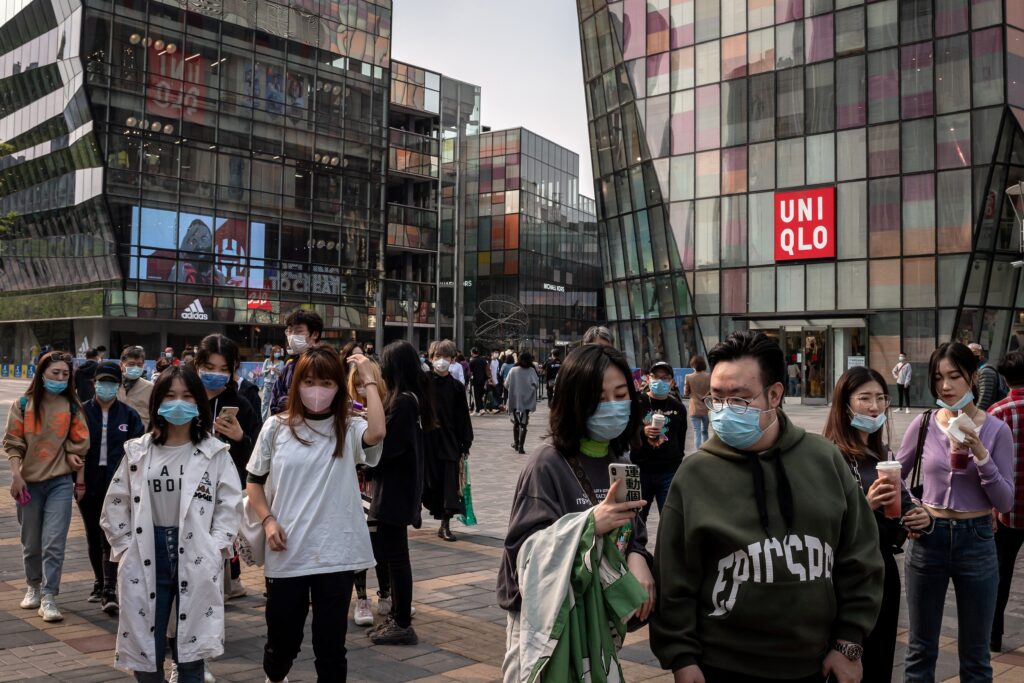
The winter season has officially arrived in the Northern Hemisphere, prompting a rush among Chinese consumers to purchase budget-friendly down jackets. Amid ongoing economic challenges, garments priced below 500 yuan (approximately $69 USD) are witnessing a remarkable surge in sales.
In mid-November, a down jacket priced at 399 yuan, which contained 90% goose down, caught widespread attention on social media and quickly sold out online. According to the app of Sam’s Club, a subsidiary of Walmart, a women’s down jacket from the American brand Rokka&Rolla, priced at 499.9 yuan, has also sold out.
This trend reflects a significant shift in consumer behavior in China, where shoppers are becoming more price-sensitive. For a long time, the Chinese market had been characterized by a tendency to guide consumers towards more luxurious and expensive clothing options.
A report by Reuters on November 28 indicated that a research organization known as iiMedia found that over the past decade, the average price of down jackets in China has more than doubled, surpassing 1,000 yuan in 2025. However, a survey released this month revealed that the most favored price range among consumers is between 401 and 600 yuan.
The ongoing slump in the real estate market, coupled with stagnant wage growth and concerns over job stability, has led many middle-class consumers to be more cautious about non-essential expenditures. They are now questioning whether they are willing to pay a high premium for the sake of purchasing high-end outerwear.
Mark Tanner, founder and managing director of the Shanghai-based consulting firm China Skinny, commented on the situation, stating, “I believe that the down jacket offerings at Sam’s Club accurately capture consumer demand.”
On the Tmall platform, it was reported that after the launch of the “Double 11” promotional event on October 20, Uniqlo’s sales on Tmall exceeded 100 million yuan within just 24 minutes; one of the brand’s lightweight down jackets, typically retailing around 500 yuan in the Chinese market, emerged as one of the platform’s hot-selling products.
A 27-year-old employee working in a factory in Shanghai, identified as Lv Jiaming, expressed, “I would absolutely not buy a down jacket priced over 1,000 yuan again.” He pointed out, “To me, there isn’t much difference between jackets in the 500 to 600 yuan range and those over 1,000 yuan. Unless the quality is exceptional, you really don’t feel any distinction between the two.”
The challenges are becoming increasingly clear for brands striving to move further into the high-end market. This month, Bosideng, China’s largest down jacket manufacturer, launched its third collection in collaboration with British designer Kim Jones. However, some high-priced items in their flagship Tmall store exhibited lackluster sales performance. Data revealed that a blue down jacket featured in ads by singer and actor Wang Leehom, priced at about 2,278 yuan, sold only 16 pieces within a 30-day period ending November 13.
Bosideng has yet to respond to requests from Reuters for comment on this matter.
Historically, the Chinese market has been a major growth engine for the luxury goods sector. However, recent years have seen a downturn in China’s real estate market, coupled with sluggish stock market performance, which has weakened domestic demand. This downturn has transformed the Chinese market into a significant drag on luxury goods sales.
LVMH, a leading player in the industry, announced on October 12 that third-quarter performance fell short of expectations, primarily due to weakened consumer spending in the Greater China region. This led to a 5% drop in sales across Asian markets, excluding Japan, during the third quarter. Nevertheless, robust performances in the United States, Europe, and Japan partially offset the impact of the soft Chinese market.
Hermès reported on October 22 that its third-quarter revenue grew by 4.3% year-over-year at constant exchange rates, marking the lowest growth rate since early 2020. Revenue growth for the Asia-Pacific region (excluding Japan), which includes the Chinese market, was stagnant. The company’s chief financial officer acknowledged that China remains Hermès’ largest single market, but mentioned that the current market environment is “very difficult.”
Despite this slow down in the luxury sector, Moncler’s Chief Corporate and Supply Chain Officer, Luciano Santel, stated last month that the brand continues to perform excellently against the backdrop of a slowing Chinese luxury market.
The market dynamics reflect a broader trend of diversification within China’s consumption landscape. With economic uncertainties placing pressure on middle-class households, many consumers are increasingly gravitating towards more affordable options or pursuing products that offer high value for their price. Meanwhile, wealthier consumers continue to purchase items they perceive as high-quality, high-performance, or status-signifying.
Tanner of China Skinny noted, “Like all luxury brands, they must work harder than ever to make consumers feel that their high prices are justified.”