
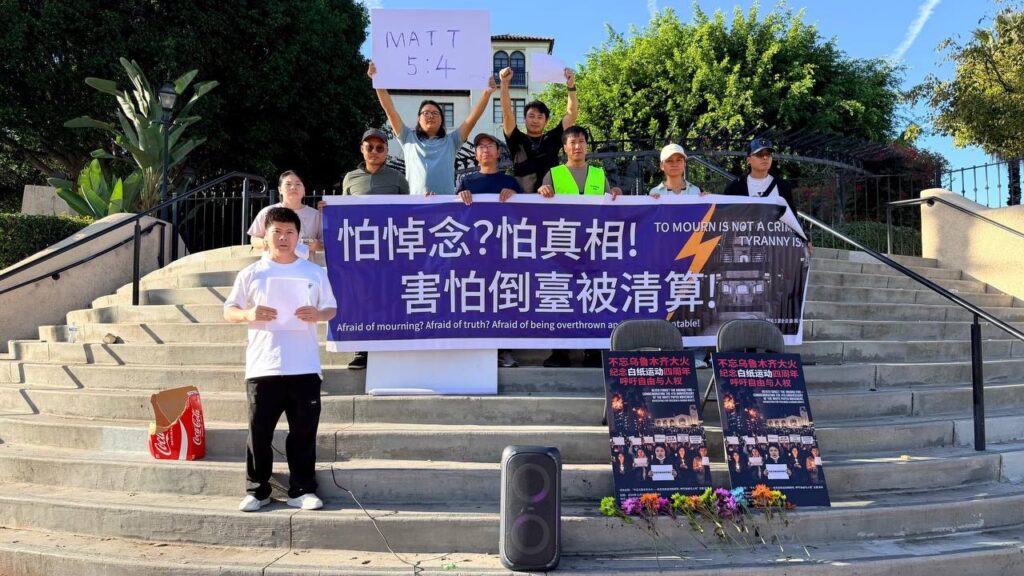
The White Paper Movement, also known as the White Paper Revolution, has now reached its fourth anniversary. On the historic grounds of the anti-lockdown protests in Shanghai, security measures are tighter than ever, while commemorative events continue overseas.
On November 24, 2022, a high-rise residential building in Urumqi, Xinjiang, tragically caught fire, resulting in the official report of ten fatalities. Authorities attributed the deaths to a lack of awareness among the public about evacuation procedures. However, this claim met widespread skepticism among citizens, who argued that the government’s lockdown measures had obstructed escape routes. This prompted the emergence of a nationwide movement, beginning at Nanjing Media College, characterized by protests defined by the symbol of blank sheets of paper to oppose the strict zero-COVID policies.
One of the most significant locations for these protests was Urumqi Middle Road in downtown Shanghai. In the early hours of November 26, hundreds of young people gathered along this street, carrying flowers and candles to pay tribute to the victims until police intervened for the first time in the early morning of November 27.
The youth protesting against the government rallied with slogans calling for the overthrow of Xi Jinping and the Communist Party. Ultimately, this wave of protests swept across numerous regions of the country, compelling the Communist Party of China (CPC) to abandon its nearly three-year-long “dynamic zero” COVID policy.
Following these events, the CPC undertook a campaign of retribution against the participants of the White Paper Movement and those who documented it, with many forced into exile abroad. Notably, student Li Kangmeng from Nanjing Media College has remained missing; documentary filmmaker Chen Pinlin was sentenced to three and a half years in prison for his work on a film titled “Urumqi Middle Road,” and he is still incarcerated; and Nankai University associate professor Wu Yanan was reportedly forcibly committed to a psychiatric hospital, with his status unknown for four years.
Reports from BBC Chinese on November 26 indicated that four years later, the formerly significant gathering points like Urumqi Middle Road in Shanghai now feature heightened street security and regular checks, where even taking photos or walking with flowers can invite scrutiny.
In addition to the constant presence of police patrols in these areas, convenience stores often see security personnel in vests. One individual who experienced the White Paper Movement noted feeling as though they were under constant surveillance while passing through these neighborhoods, even when simply stepping out to buy cigarettes, an experience that left them feeling tense and exposed.
Many participants of the White Paper Movement and scholars studying social movements in China have expressed concern that spaces where young people can gather and build connections with strangers are rapidly vanishing. For example, Chang Le Road, once a primary protest site, began a demolition process at the end of 2024 that abruptly closed all bars overnight, with the demolition work yet to commence, effectively blocking access to the street.
Throughout November 2026, in commemoration of the fourth anniversary of the White Paper Movement, Chinese communities abroad, students, grassroots organizations, and human rights institutions launched various memorial activities, including street protests, thematic discussions, documentary screenings, and both online and offline support initiatives.
On the night of November 25, to mark the anniversary, an initiative called “Light Over the Road,” organized by “China Action,” commenced a global projection relay at Chinese consulates in multiple cities.
On November 22, a memorial event in front of the Chinese Consulate in Los Angeles featured Henan resident Yin Shuangmiao sharing her painful memories of visiting Wuhan just before the city entered lockdown. She remarked, “Why does a blank sheet intimidate those in power? There’s not a word on it, but in a place where even public mourning requires courage, holding it is enough to remind us of that winter. Four years have passed, and we mourn the victims of the Urumqi fire while also remembering those who took to the streets and helped bring an end to the dynamic zero policy.”
On the afternoon of November 15, numerous Chinese individuals gathered at Union Station in downtown Los Angeles to honor the victims of the “1124” fire in Urumqi, Xinjiang, and call attention to the rights to freedom of speech and basic human rights in China. Participants stood on the steps of the station, holding blank sheets of paper, reenacting the scene of young people participating in the White Paper Movement four years earlier. Flowers adorned the scene, and memorial posters displayed messages like “Never forget the Urumqi fire” and “Call for freedom and human rights.”
A documentary short film titled “I’m Sorry, I Recorded,” directed by student filmmaker Zhou Zijie, was screened at the New York Independent Film Festival on November 15, capturing investigations tied to the White Paper Movement and the experiences of those involved.
The independent magazine “Mang Mang,” created by overseas youth at the end of 2022, marked the fourth anniversary by making its sold-out first issue, “Left Blank for Freedom,” available online for free, preserving first-hand accounts and memories of the protestors from that time.
On November 7, the Asian Democratic Solidarity Council hosted a themed talk in Tokyo’s Bunkyo District entitled “Four Years of the White Paper Revolution and the Current Status of Democratization,” which reviewed the historical background of the 2022 protests and explored the confluence of grassroots forces and their developments.
International organizations such as Amnesty International and the Human Rights Foundation released articles and statements between November 24 and 26, reflecting on the national White Paper Movement sparked by the Urumqi apartment fire and denouncing the authorities’ repression of peaceful demonstrators while calling for the release of individuals detained for participating in or documenting the movement.
Scholars and observers generally recognize this movement as the first cross-regional and cross-class protest sweeping across dozens of cities and hundreds of universities in China since the events of June 4, 1989. Although it has not formed a tightly-knit organization in the short term, its symbolic significance and collective experiences are likely to leave a lasting mark on subsequent social and cultural discussions within the public sphere.