
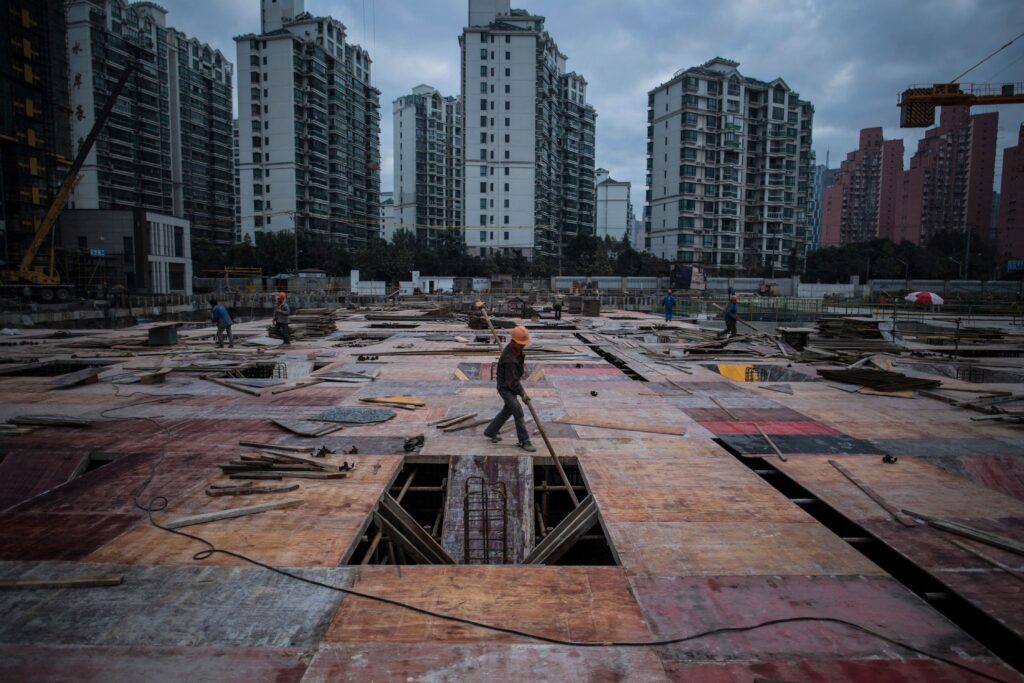
The current situation in China’s real estate sector is critical, with housing inventory levels reaching an equivalent of five years’ worth of sales. This oversupply presents significant challenges for market recovery, exacerbated by debt defaults, rising credit risks among real estate companies, and plummeting stock prices, which have led to several companies facing delisting warnings.
According to recent reports, several stocks, including those of Kinte Group and *ST Huaxing, are now under delisting alerts. Although some companies have quickly announced plans to buy back shares via concentrated bidding in the secondary market to stabilize their stock prices, they have yet to achieve a return to safe valuation levels.
The “Stock Listing Rules” state that companies listed on the Shanghai Stock Exchange that exclusively issue A-shares will have their listings terminated if their daily closing prices fall below 1 yuan (RMB) for 20 consecutive trading days. This falls under mandatory delisting criteria for trading securities.
Recently, a new wave of A-share listed real estate companies has seen their stock prices dip below this crucial threshold. For example, as of November 20, the stock of Huaxia Happiness closed at 0.85 yuan per share. On November 17, this stock registered a closing price of 0.92 yuan, marking its first-ever closing under 1 yuan since it was listed.
On the evening of November 18, Huaxia Happiness issued a notice regarding its stock’s price fluctuations, highlighting a cumulative decline of 20% over three consecutive trading days (November 16 to 18). The company clarified that no undisclosed significant information existed that could explain this abnormal trading volatility.
Publicly available information reveals that by the end of 2025, Huaxia Happiness had negative net assets of -17.7 billion yuan, with consistent losses reported over the past three fiscal years. The auditing agency issued a report containing significant uncertainty. The company had already been flagged with delisting risk warnings, combined with other regulatory cautions.
Another major real estate player, Rongsheng Development, which had initially flourished around the outskirts of Beijing, is facing similar predicaments. On November 17, Rongsheng’s stock closed at 0.90 yuan per share, further emphasizing the precarious state of the sector.
A growing number of companies are also raising delisting alarms, as numerous real estate firms have already exited the market. Data from the China Index Academy (中指研究院) indicates that over 30 real estate companies have been delisted from A-shares and H-shares combined since 2022. Many of these firms listed in Hong Kong faced prolonged trading suspensions for failing to timely disclose annual reports, ultimately leading to delisting. In the A-share market, falling below a face value of 1 yuan is one of the most common triggers for delisting in recent years.
Liu Shui, the director of corporate research at the China Index Academy, noted that according to the A-share delisting rules, many real estate firms currently exist in a “danger zone.”
“The common issues among these firms include debt defaults, high leverage, asset devaluation, and insufficient sales recovery,” Liu stated. He expressed concern that companies’ sales have shown minimal signs of recovery, their assets continue to depreciate, liquidity remains constrained, and debt repayment pressures persist. In the context of existing home sales and heightened capital regulations, the requirements for accessing funds have intensified, making it increasingly challenging for at-risk companies to survive.
Mizuho Comprehensive Research Institute estimated that by the end of 2025, China’s housing inventory could reach approximately 4 billion square meters, equivalent to 5.6 times the annual sales area of newly constructed homes, which translates to more than five years of sales volume.
Naoki Tsukada, the chief economist at Mizuho Comprehensive Research Institute, indicated that it might take between 5 to 10 years to fully digest this overwhelming inventory. The massive surplus puts real estate companies in a dilemma: significantly reducing prices could further compress house prices in the short term, impacting the overall market; however, avoiding price cuts while holding onto unsold properties threatens to exacerbate cash flow issues and the ability to meet debt obligations.
In parallel with burgeoning debts, the sector is experiencing rising credit risks. A recent case involves Huafa Group, a large state-owned enterprise under the Zhuhai municipal government, which has been embroiled in a liquidity crisis. This company has developed various residential and commercial projects across mainland China, including landmark edifices like the world’s largest indoor ski resort, “Qianhai Ice and Snow World” in Shenzhen.
Recently, Huafa Group encountered delays in payouts for funds raised through a trust company and has sought to extend loan repayment deadlines with banks. While it has managed to secure short-term funding temporarily avoiding defaults, doubts about its ability to manage debt continue to loom.
According to statistics from China Huachuang Securities, Huafa Group’s outstanding bond obligations amount to a staggering 115.6 billion yuan, with approximately 46 billion yuan due by 2027. The group reported a nearly 30% year-on-year decline in revenue during the first half of 2026, plummeting to 67.4 billion yuan, resulting in a transition from profit to loss with a staggering deficit of 3.4 billion yuan. As of June 30, its interest-bearing liabilities escalated to 404.7 billion yuan.
JPMorgan emphasized in its China Real Estate Credit Report released on November 16 that the liquidity crisis faced by Huafa has triggered substantial sell-offs in high-yield real estate bonds, raising questions in the market about the resilience of state-owned enterprises in the face of defaults and the extent of government support for these entities.