
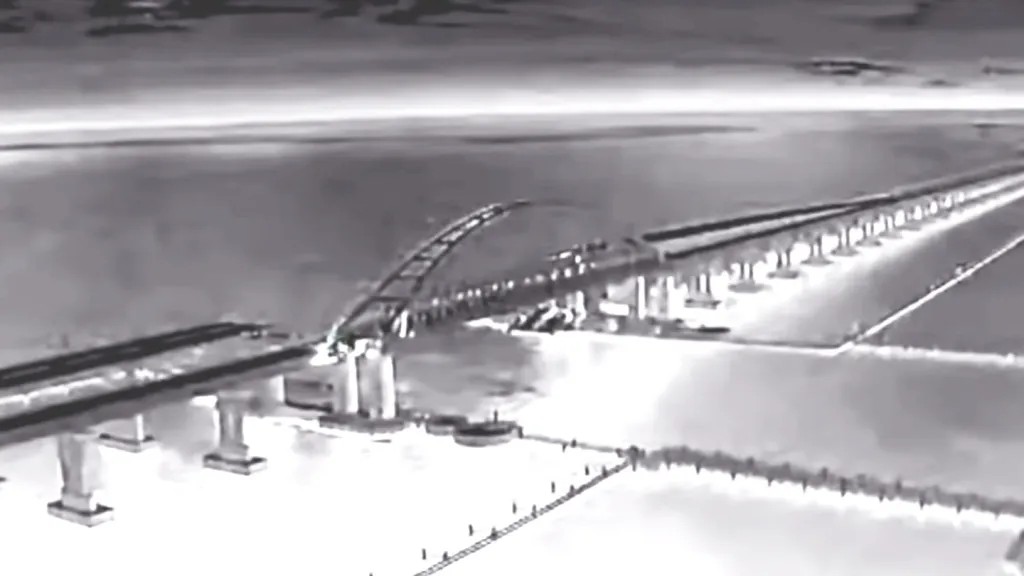
The recent collapse of the Kerch Strait Bridge, alongside significant damage to the Ilsky oil refinery, is likely to compel Russian military forces to shift their supply routes for Crimea and the southern front entirely toward a land corridor along the northern shore of the Sea of Azov. This corridor is currently facing the dual pressures of overcapacity and firepower threats. Consequently, the critical rail hubs and oil depots along this route may become primary targets for subsequent strikes following the bridge’s collapse.
From November 15 to 17, 2026, the Ukrainian Defense Forces launched a fresh wave of attacks on the Kerch Strait Bridge. Following an extensive preparation period of several weeks, Ukraine has reported that this latest long-range strike operation resulted in the complete collapse of the road section of the Kerch Bridge while inflicting severe damage on portions of the railway bridge. The massive supporting arches of the road bridge, along with large segments of its concrete deck, fell into the sea, obstructing the narrow passage that connects the Sea of Azov to the Black Sea. This blockage has rendered it impossible for large commercial vessels and naval ships to transit through the area.
Ukrainian President Volodymyr Zelensky stated on November 17 that Ukrainian forces employed the “Palianytsia” cruise missile drones to target the roadway of the Kerch Bridge, while also utilizing “Neptune” cruise missiles, “Ruta” missiles, and FP-5 “Flamingo” cruise missiles to strike its railway section. Previously, Ukrainian forces targeted the Kerch Bridge directly in attacks during October 2022, July 2023, June 2025, and most recently from November 15 to 17.
Zelensky indicated that the attack on November 17 represented the seventh phase of a sustained Ukrainian operation over several weeks. He elaborated that this operation included drone and missile strikes against Russian air defense systems, radar units, electronic warfare assets, and other systems responsible for securing the area, thereby paving the way for the final assault on the bridge.
The Ukrainian Unmanned Systems Forces (USF) reported using communication relay equipment to assist in the terminal guidance of missiles targeting the bridge. The Ukrainian military confirmed that during this operation, they did not utilize SpaceX’s satellite internet service; instead, they relied on drone relay signals to maintain communication and operational control over the missiles as they approached their targets, ensuring the successful execution of the mission. Ukrainian operators controlled the missiles and cruise missile drones from over 250 kilometers away from the front lines, successfully striking critical areas of the Kerch Bridge.
According to Ukrainian sources, this attack demonstrated advancements in technology, improved operational planning, interdepartmental collaboration, and precise coordination, underscoring its strategic significance in undermining Russia’s vital transport links from its mainland to Crimea.
In a report from the General Staff of the Armed Forces of Ukraine, it was disclosed that the Ukrainian military simultaneously struck several key locations on the night of November 15. These locations included the Ilsky oil refinery in the Krasnodar Krai, approximately 357 kilometers from the front lines, an oil storage facility operated by Shining Energy (LLC) in the Rostov region, roughly 225 kilometers distant, a Russian military supply depot in the occupied region of Rivnopil in Donetsk, and an equipment aggregation area for Russian forces in the occupied district of Berdiansk in Zaporizhzhia. The Ilsky refinery, heavily damaged during the strikes, had a refining capacity of 6.6 million tons per year.
With both of these critical petrochemical hubs suffering extensive damage and following the Ukrainian military’s previous long-range strikes on the TAIF-NK refinery complex in Tatarstan, the fuel supply crisis in Russia’s southern military district is expected to worsen significantly.
Russian forces in Crimea and the Kherson direction have relied heavily on the Ilsky refinery for fuel supplies transported either via the Kerch Bridge or by tankers traversing the Black Sea. Furthermore, Russian troops in the southern cluster around Sloviansk and Kostyantynivka– Druzhkivka, as well as those in the Zaporizhzhia area, depend heavily on the Azov Energy oil storage facility and nearby oil bases, situated approximately 225 kilometers from the frontline, to sustain their operations.
To address the shortfall of thousands of tons of diesel fuel and aviation kerosene daily, Russian logistics have no option but to redirect supplies from refineries located 1,500 to 2,000 kilometers away in the heart of Russia, using railways in Rostov for westward transportation.
Extending transportation distances by three to five times has increased the round-trip time for oil tank trains from the previous 2-3 days to over 10 days. This delay leads to significant congestion along logistical routes, exacerbating the supply chain challenges faced by the rail network for transporting weaponry, munitions, and supplies.
Since Russia’s full-scale invasion in 2022, the logistics supporting the Crimean Peninsula and southern fronts in Kherson and Zaporizhzhia have been maintained primarily through three main routes. The first route is the Kerch Strait Bridge, which directly connects mainland Russia to Crimea. The second is the maritime transportation corridor that connects the Kerch Strait ferry services with ports along the Sea of Azov and the Black Sea. The third route encompasses overland corridors that lead from Rostov, through occupied Donetsk and Zaporizhzhia, into northern Crimea.
Following the November 17 attacks, two of these three primary routes now sit in a state of paralysis or semi-paralysis. The road portion of the Kerch Bridge will not see any ground vehicles cross in the near future, and the damaged railway bridge’s supporting arches are unable to support normal military freight transport.
In fact, transport limitations had already affected the railway and road bridges prior to the bombing. Even more critically, the debris from the bridge that crashed into the Kerch Strait has effectively blocked the narrow waterway between the Sea of Azov and the Black Sea, causing the Sea of Azov to be rendered functionally an inland sea. Consequently, normal shipping routes have been disrupted, and the external maritime traffic to the ports of Mariupol and Berdiansk on the northern shore of the Sea of Azov has also been severed.
As a result, thousands of tons of military supplies, heavy equipment, and civilian goods that were once transported via ferries and bridges must now reroute through the already strained overland corridor connecting Donetsk, Zaporizhzhia, and Kherson.
With the Kerch Bridge’s road section severed, ground transport to and from Crimea relies solely on the R-280 highway, originating from Rostov-on-Don and traversing through Taganrog, Mariupol, Berdiansk, and Melitopol before reaching Crimea. This route has long been a key target for Ukrainian drone units.
According to statistics released by Ukraine in June of this year, the Russian troops stationed in southern Ukraine rely daily on hundreds of heavy trucks to maintain troop reinforcements and supply chains. The majority of these convoys travel along the R-280 highway westward towards Melitopol and Crimea, while another route heads north along the H-20 highway into Donetsk.
In 2026, Ukrainian drone units plan to implement a blocking strategy on these ground corridors, expecting to conduct up to 74,500 strikes against Russian logistics and frontline targets throughout the year—more than the total strikes carried out since the onset of the full-scale invasion.
Due to the narrow longitudinal depth of the land corridor along the northern shore of the Sea of Azov, both the R-280 and H-20 highways fall entirely within a 50 to 200-kilometer attack radius of Ukrainian drones.
Furthermore, the land corridor bordering Crimea at the Armyansk strait is a critical vulnerability. On November 17, Ukrainian military officials stated that the Chongar strait and Armyansk corridor in northern Crimea are currently under the threat of Ukrainian long-range artillery strikes. This development suggests that even if Russian forces attempt to transport supplies from Rostov through Donetsk and Zaporizhzhia to Kherson, their convoys could become stranded due to damaged bridges or ferry points.
According to an assessment from the Institute for the Study of War on November 16, Ukrainian forces have recently achieved tactical advancements in Zaporizhzhia, which may place the Tokmak railway station completely under the umbrella of Ukrainian precision-guided munitions, long-range artillery, and drone capabilities. The railway station in Melitopol, located in southern Zaporizhzhia, alongside its air defense coverage points, represents the intersection of Russia’s new coastal railway to Crimea. In April 2026, Ukrainian forces successfully destroyed the Kasta-2E1 low-altitude radar and Pantsir-S1 air defense systems deployed in Melitopol, along with successfully targeting Russian military trains.
The destruction of the Kerch Bridge significantly increases the logistical pressure on Russian southern formations, compelling them to rely increasingly on the land corridor for supplies. Whether this logistical pressure translates into a battlefield advantage ultimately hinges on the Ukrainian military’s ongoing capability to strike Russian supply lines, fuel facilities, and transit nodes.
Currently, the actions of the Ukrainian military have resulted in several key implications: Firstly, the Crimean Peninsula is transitioning from a supportive rear area for Russian troops to a burden on their air defense resources and logistical capacity. Secondly, this operation has demonstrated that Ukraine has developed an indigenous long-range precision strike capability, utilizing rockets, drones, and cruise missiles, even in adverse conditions. Thirdly, this development offers Ukraine political leverage.
This operation occurs just prior to a crucial meeting among leaders from China, the U.S., and Russia, potentially influencing diplomatic negotiations. At a minimum, it highlights a fundamental reality: Russia cannot protect its strategic assets and the lifeline to Crimea, rendering any attempts to compel Ukraine into unilateral concessions on sovereignty and security untenable against the backdrop of the actual military balance of power.
Russia continues to reject proposed security frameworks from the U.S. regarding NATO post-war arrangements, as well as suggestions for European involvement in peace talks. On November 17, Russian Deputy Foreign Minister Sergei Ryabkov stated that Ukraine’s NATO membership is “absolutely unacceptable” and that Europe will not be considered for future peace negotiations. Ryabkov’s comments are in direct opposition to proposals put forward by U.S. Envoy Whitehouse and President’s Senior Advisor Kushner while maintaining that Russia will not alter the initial demands laid out in 2021.
However, the collapse of the Kerch Bridge may symbolize a significant setback for Russia’s war objectives and could be the first ‘domino’ in a series of events leading to a loss of battlefield initiative for Russian forces, possibly culminating in their eventual collapse.