
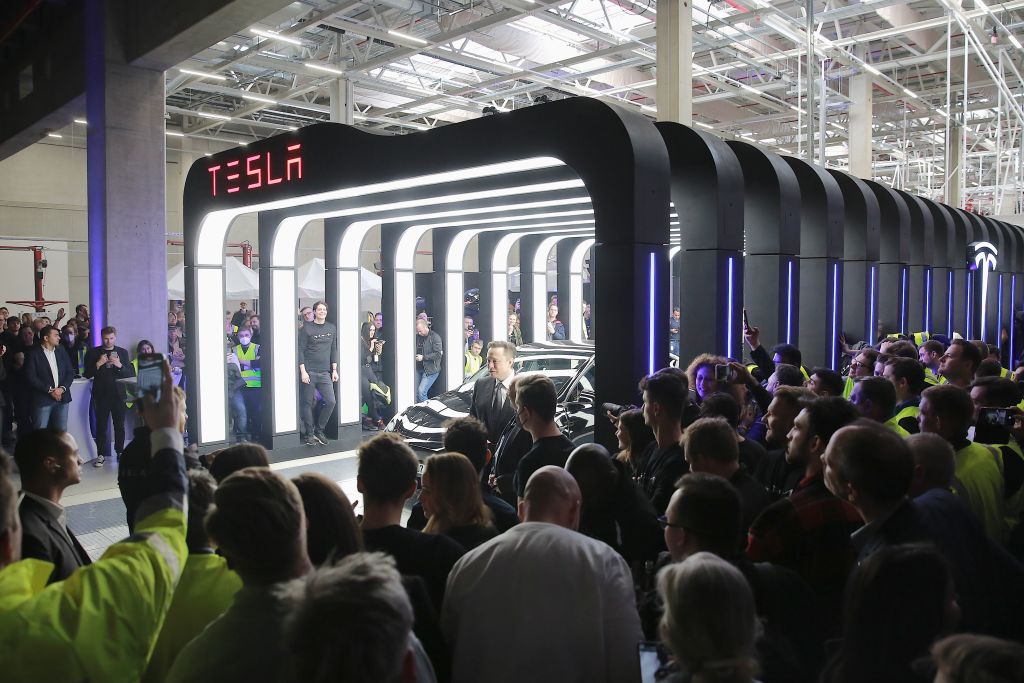
Tesla has made a significant announcement regarding its operations in Germany, revealing plans to invest €3 billion (approximately $3.31 billion) in its factory located in the outskirts of Berlin. This bold move aims to expand the company’s production capacity, even as local automobile manufacturers grapple with high production costs and stagnant market demand, prompting them to consider shutting down their domestic plants.
According to reports, Tesla, led by CEO Elon Musk, communicated via email that it intends to construct an additional production facility at its Gruenheide Gigafactory, which is the only vehicle manufacturing base Tesla has in Europe. The ambitious goal is to manufacture one million Cybercab autonomous taxis annually.
As part of this expansion, Tesla also announced plans to submit a request for a building permit for the overall project by the end of this year. The construction work for the factory expansion is scheduled to commence in the first half of 2027, with a targeted launch date for production set in 2029.
This initiative represents a striking business expansion against the current market trends and presents a stark contrast to traditional German automotive giants like Volkswagen and Mercedes-Benz. These companies are struggling with fierce competition from lower-cost manufacturers in China, coupled with high domestic manufacturing expenses, leading them to contemplate closures of their factories in Germany to cut costs.
Tesla has indicated that the expansion project at the Gruenheide factory will necessitate the recruitment of hundreds of new employees as part of the first phase of construction and production planning.
The Berlin Gigafactory officially began operations in March 2022, despite facing protests from environmental groups and navigating complex approval processes. Notably, the construction progressed at a pace much faster than the average timeline for large industrial projects in Germany. However, the factory has experienced ongoing friction in labor relations, as local management has repeatedly clashed with IG Metall, Germany’s most influential metalworkers’ union. The union has accused Tesla of suppressing union activities, while Tesla argues that IG Metall is merely seeking to advance its own interests.
In recent months, Tesla has been focused on ramping up production capacity for the Model Y SUV at the Gruenheide factory, successfully hiring over 2,000 new employees. Additionally, starting in mid-next year, Tesla has plans to initiate electric vehicle battery production at the facility, further enhancing the local supply chain.
Furthermore, just last Friday, Tesla announced that it would start inviting select customers to purchase Cybercabs for personal use, thereby pushing forward its initiative to promote fully autonomous vehicle models among individual consumers. This step highlights Tesla’s commitment to leading the charge in electric and autonomous vehicle technology while the rest of the automotive industry faces formidable challenges.