
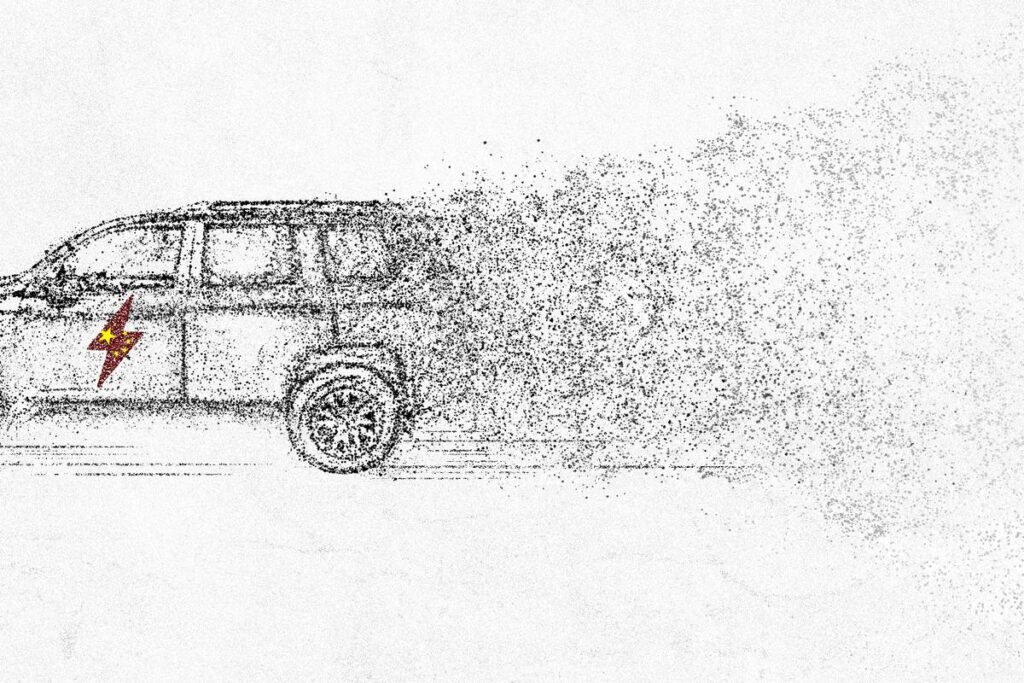
For many Americans, the phrase “Made in China” has long been synonymous with low prices. However, over the past two decades, Beijing has endeavored to associate “Made in China” with speed, aiming to redefine its global image.
This effort has seen considerable success, leading to the emergence of the term “China speed.” Chinese companies can develop new vehicles in about half the time it takes their Western counterparts. The export of Chinese electric vehicles (EVs) is booming, and Chinese AI models are now lagging behind their American counterparts by only a few months.
Yet recently, the world has gained insight into the unsettling truths concealed behind the so-called “China speed.”
In October, a test conducted by Chinese media revealed a critical flaw in the braking system of three Huawei-JAC Maextro luxury vans: the brake pedal mount broke apart, leading to a government investigation and the manufacturer’s promise to redesign the faulty component. Similarly, in Malaysia, a Chery Omoda 5 lost its rear axle, marking the second instance of such a failure involving Chinese vehicles in that country since April 2024.
The Chinese Communist Party itself has acknowledged these issues. On October 10, the Ministry of Industry and Information Technology, along with three other departments, released a draft of new regulations aimed at automakers that bring designs to market without adequate testing. The state-run People’s Daily supported this initiative, labeling vehicles developed through compressed R&D cycles and limited real-world testing as “crash-course cars.”
As of now, investigators have not disclosed the findings regarding the braking failures. Chery attributed the axle failure to insufficient weld integrity. However, the regulatory overhaul signifies that for some automobile manufacturers, achieving “China speed” has come at the cost of quality control.
In September this year, the U.S. safety authorities accused six leading Chinese AI companies of stealing technological capabilities from American models through a method known as “distillation.”
Analysts interviewed argue that China’s rapid development relies on two primary shortcuts: one, replicating the results of Western countries; and two, conducting minimal testing that meets regulations or even falls short of these requirements. In the face of issues, the Communist regime’s initial response typically involves obfuscating evidence.
Nicholas Eftimiades, a retired senior intelligence official who served in the CIA, State Department, and Defense Intelligence Agency for 34 years, commented that replicating products from other companies is a hallmark of the Communist business model. “This is why China has risen so fast and dramatically,” he remarked.
Eftimiades authored a book titled “Chinese Espionage: Operations and Tactics” in 2020 and has tracked at least 900 espionage cases involving the Chinese Communist Party.
For many years, these shortcuts were primarily confined to the domestic market, but today, China is exporting cars by the millions, raising regulatory alarms globally—even as nations like Canada welcome Chinese vehicles.
“To develop new cars as rapidly as China does relies heavily on virtual testing and shared components across the industry,” explained Sam Fiorani, vice president of global vehicle forecasts at AutoForecast Solutions, a consulting firm based in Pennsylvania.
“When these components fail, it affects a large number of vehicles on the road, which is evidenced in the axle, pedal, and other critical components’ inadequate installation integrity.”
Beijing often employs the term “overtaking on the curve” to describe its business paradigm. In motorsport, this refers to overtaking an opponent as they brake into a turn—a maneuver that any driver knows carries inherent risks.
This drive comes from the top echelons of the Communist Party. In 2014, Chinese leader Xi Jinping emphasized that new energy vehicles (NEVs) are the “path that must be taken” for China to become a global automotive power during a visit to a car manufacturing plant in Shanghai.
The Center for Strategic and International Studies (CSIS), based in Washington D.C., estimates that from 2009 to 2023, Beijing has invested at least $230 billion to support the NEV industry. However, according to its data, the amount of subsidies per sale has significantly decreased since the early stages.
Speed has become a point of pride for Chinese companies. In 2022, Yu Chengdong, Huawei’s automotive business leader, claimed triumphantly on state-run CCTV that while competitors typically require three years to produce a vehicle, Huawei and its partner Seres can produce three vehicles in just one year, with Seres handling hardware development and Huawei providing software, electronic components, and a sales network.
In fact, some of the sternest warnings have emerged from within China’s automotive industry itself.
In June of this year, Li Shufu, chairman of Geely (headquartered in Hangzhou, Zhejiang Province), warned that there are no shortcuts to vehicle production; each new model must undergo comprehensive reliability testing.
In 2016, Wang Binggang, a long-time electric vehicle advisor to the government, stated that this mentality reflects “petty cleverness,” designed to circumvent the most daunting engineering challenges. He also noted that electric vehicles represent a significant opportunity for China to close the gap with global automakers.
John Helveston, an engineering professor at George Washington University focusing on China’s automotive industry, asserted that speed isn’t entirely a matter of shortcuts. “Today, China’s advantages stem largely from improved production efficiency, as well as the depth and breadth of its battery and motor supply chains, which are currently the largest in the world,” he analyzed.
He stated that Chinese automakers can now develop a new vehicle in approximately 18 months, which is roughly half the time required by established manufacturers.
However, the quickest shortcut has consistently been to mimic the labor of others.
Chery, a state-supported automaker, became well-known for its QQ model, a budget microcar released in 2003 that bore a striking resemblance to the South Korean Daewoo Matiz. General Motors later used the QQ as the basis for its Chevrolet Spark in China.
In 2004, General Motors’ South Korean subsidiary, GM Daewoo, filed a lawsuit against Chery, accusing the QQ of copying the Matiz. Reports indicated that GM Daewoo even claimed Chery used a disguised Matiz to pass the government tests required for QQ sales. Chery denied the accusations, asserting that the QQ was developed independently, and the parties reached a settlement in 2005.
Huawei faced even stranger allegations in 2019 when the U.S. Department of Justice prosecuted two of its subsidiaries for stealing confidential information from T-Mobile’s robot, Tappy. Accusations indicated that an engineer had concealed a component of the robot’s arm in a laptop bag, smuggling it out of the lab.
The prosecution further claimed that Huawei incentivized employees to steal proprietary information relating to mobile phones. Huawei denied any wrongdoing, contending that the allegations pertaining to Tappy were part of a broader extortion case currently before a federal court in New York.
When asked about the incentive program, Eftimiades commented, “This isn’t rare, and they have emails to prove this, clearly indicating the boldness with which they approached this.”
He emphasized that the rewards for plagiarism stem from its efficacy: “This encourages copying as a business model, which proves to be very effective because it allows you to level the playing field without spending a dime.”
Similar accusations have also surfaced amid the fervor of China’s AI development, with shortcuts applicable in the realm of digital software assets.
On September 8, the National Security Agency (NSA), Federal Bureau of Investigation (FBI), and Cybersecurity and Infrastructure Security Agency (CISA) accused six Chinese AI companies, including DeepSeek and Moonshot AI, of training their models by exploiting the answers from American models—a technique known as distillation—conducting “industrial-scale” operations to extract capabilities.
These agencies stated that such copying constitutes the “core—not merely a supplement—of their AI construction” and was likely occurring with the knowledge of the Communist regime. Last year, a U.S. House committee discovered that DeepSeek might have employed illicit model distillation techniques, with its applications sending data on American citizens back to China.
U.S. company Anthropic, the developer of the chatbot Claude, further claimed that Moonshot AI discreetly forwarded nearly 30 user queries to Claude and presented Claude’s responses as its own within a brief ten-day window. The Chinese Ministry of Commerce dismissed the allegations from U.S. agencies as unfounded.
The pursuit of speed also translates to conducting fewer tests. The Huawei-supported luxury business vehicle, the Maextro V800, exemplifies this trend.
In 2024, Yu Chengdong, then the chairman of Huawei’s Smart Automotive Solutions, proclaimed that the luxury brand Maextro, co-created with state-owned JAC Motors, would position itself far above Germany’s Mercedes-Maybach and Britain’s Rolls-Royce Phantom.
The Maextro made its debut in 2025 with its first sedan, the S800, and its initial luxury van, the V800, was launched in August 2026, priced around $114,000.
On October 8, the Chinese automotive review site Dongchedi released a video showing three V800s performing emergency stops at a speed of 62 miles per hour (approximately 100 kilometers per hour) in a controlled environment.
The results highlighted a critical flaw: the plastic supports securing the brake pedals on each vehicle fractured upon testing. In fact, the last V800 tested was purchased to verify the tests of the first two; it had only recorded a mileage of about 2 miles (3.2 kilometers) when its foot brake also failed during a second full-force stop.
Helveston pointed out that the issue stemmed from “compressing the testing timeline to meet the release date.”
According to AlixPartners, a consultancy tracking the global automotive industry, much of the testing conducted by Chinese manufacturers occurs on computers, pushing real-world testing to the final stages.
They often release new vehicles without fully maturing all parts, relying on software updates to refine products—a practice the company labels as intentionally abandoning a zero-defect mindset.
Helveston believes this approach may apply to coding but not to parts manufacturing. “Some companies also rely on remote updates to rectify post-market issues, which works well for software, but hardware problems like brake mount or door handle failures cannot be resolved through software updates,” he noted.
Chinese automotive commentators reported that the V800’s brake pedal is installed on a fiberglass-reinforced plastic mount. After the video’s release, Maextro claimed on October 8 that the review site’s test conditions were extreme and “non-standard.”
Five days later, Maextro referenced a lab report stating that the component met Chinese industry standards. However, a staff member from the lab clarified that the report only covered samples submitted by the company and did not pertain to mass production.
“Simply stating that we’ve passed our tests doesn’t prove anything,” remarked Michael Brooks, executive director of the Center for Auto Safety in Washington. “You must personally inspect the parts produced from your factory and assess their integrity.”
Maextro described its corresponding corrective measures as a “free upgrade,” informing Chinese media that this was “not a recall,” and that owners of delivered vehicles must apply proactively for the upgrade. On October 15, three government agencies launched a joint investigation, with no results disclosed as of early November.
Brooks asserted that in the U.S., such a situation would almost necessitate an immediate recall. “The brake pedal falling off is undoubtedly a defect.”
Official Chinese media paint a broader issue. The People’s Daily highlighted remarks from a leader of a joint venture of Hyundai in China, indicating that some brands skip testing, turning customers into “test drivers.” The paper also reported that an unnamed electric vehicle manufacturer conducted real vehicle tests on only one-fifth of the door handles, with the remainder relying on simulated testing.
The rapid rollout of driving assistance systems has also raised concerns.
In March 2025, three Chinese college students tragically lost their lives after a Xiaomi EV, the Xiaomi SU7, crashed into a concrete barrier at around 60 miles per hour during a construction zone en route to an exam, igniting upon impact.
Xiaomi claimed that at the time of the incident, the vehicle was in driving assistance mode, which had issued a warning about obstacles, yet the driver failed to avoid the barrier when taking control and applying the brakes.
By September 2025, Xiaomi recalled nearly 117,000 SU7 vehicles—about 34% of those sold—to address defects in the driving assistance system via an over-the-air software update.
Post-release, the brake test video encountered rapid scrutiny online. The morning after it was published, it became inaccessible across several Chinese platforms. Notifications on WeChat indicated that the video was removed due to alleged violations of platform rules following complaints.
The official WeChat account for the Xinjiang Uyghur Autonomous Region government previously criticized Maextro for responding to safety questions with extensive industry standards. This post was hidden shortly after exceeding 100,000 views. A statement from Maextro that was published by Xinhua News Agency was also deleted.
Citizens in China have observed government officials attempt to suppress news stories in the past.
In 2011, two high-speed rail trains collided near Wenzhou, resulting in 40 fatalities. Following the incident, workers used an excavator to smash one of the train cars and buried it at the scene. Officially, no signs of life were found, and search efforts ceased. However, by the next afternoon, rescuers discovered a little girl who had survived.
The Chinese Ministry of Railways stated that burying the train car was intended to assist in rescue efforts. “Believe it or not, it’s up to you,” said a spokesperson, who was later dismissed from their position.
Local residents were suspicious that officials were destroying evidence and concealing the actual death toll. Two days later, workers excavated the train wreckage and removed it.
Today, similar instincts afford protection to Chinese auto manufacturers. In September 2025, Chinese internet regulators and five other agencies launched a campaign against “chaos” in the automotive industry, claiming to conduct thorough investigations into paid smearing and misleading appraisals.
The agencies later penalized various accounts, including those accused of “hype” surrounding accidents and publishing automotive test reports that resulted in “misleading conclusions.”
The same regulatory body is now involved in the investigation of the Maextro V800. On October 15, it, together with industry and market regulators, initiated an inquiry into the luxury business vehicle.
Brooks remarked that American regulators would respond quite differently to the handling of the V800 video. “If a video surfaced in the U.S. showing a vehicle’s brake pedal breaking three times, the National Highway Traffic Safety Administration (NHTSA) would act within days, demanding information, and may very well require the manufacturer to recall that model,” he noted.
The pace of China’s vehicle exports is unprecedented. In the first nine months of this year, China exported 8.2 million vehicles—a 66% year-over-year increase—surpassing the total for the previous year, while domestic sales plummeted by over 20%. According to company data, Chery currently exports approximately 70% of its vehicles abroad.
Abroad, it becomes more challenging to conceal issues. On October 6, a Chery Omoda 5 experienced a rear axle failure on a road in Johor Bahru, Malaysia. Following the spread of the incident video, Malaysian authorities suspended the model’s type certification and new vehicle registration until risks were confirmed to be addressed.
Five days after the incident, Chery attributed the failure to insufficient welding strength in the rear axle and issued an apology through its Malaysian branch, recalling 8,878 vehicles. In 2024, Chery had previously attributed the axle fault of the same model to improper calibration of the welding equipment from its supplier.
On November 6, Chinese market regulators announced Chery would recall 53,882 Omoda and Tiggo 5x models in China due to similar welding issues involving the rear axles.
Fiorani indicated that concerns regarding quality prompt governments to have justifiable reasons to minimize the import of such vehicles. “Tariffs and other trade barriers are the first line of defense, but if the quality of Chinese cars raises doubts, governments might restrict these brands’ expansion on that basis,” he stated.
Other nations are also erecting barriers. In January, Mexico raised tariffs on vehicles from China and other non-agreement countries from 20% to 50%. In October, the European Union announced that China had agreed to impose export limits on hybrid vehicles, subsequently setting an annual import cap of 350,000 units—less than half of the anticipated volume for this year.
The measures taken by Washington are the most severe. In 2024, the U.S. raised tariffs on Chinese electric vehicles from 25% to 100%. A regulation from the U.S. Department of Commerce prohibits the use of Chinese software in connected vehicles starting with model year 2027 and forbids manufacturers associated with China from selling cars—even if manufactured within the U.S. The regulation allows companies to apply for specific authorizations for trades previously prohibited.
In June of this year, the U.S. Department of Commerce denied Geely’s permission for its Polestar brand to continue selling new cars in the U.S. starting with the 2027 model year, despite the Polestar 3 being produced in South Carolina. Conversely, Volvo, also a subsidiary of Geely, received a sales permit in May. The Department of Commerce has not clarified why it treated the two companies differently.
Bipartisan legislation co-sponsored by Senator Bernie Moreno (R-OH) and Elissa Slotkin (D-MI) aims to further enshrine the prohibition on Chinese-linked automotive technology into law, banning the import, sale, and use of vehicles produced in China. Although this bill passed unanimously through the Senate Commerce Committee in July, Senator Rand Paul (R-KY) later blocked a fast-tracked vote.
Moreno remarked, “From any perspective, allowing Chinese cars into the U.S. would be a complete disaster.”
In contrast, Canada has adopted a vastly different approach. This year, Canada agreed to import up to 49,000 Chinese electric vehicles annually, with a tariff rate of 6.1%. This cap is set to rise to approximately 70,000 vehicles over the next five years. Chery has already established a subsidiary in Canada and plans to launch its Omoda and Jaecoo brands early in 2027.
Similar to the United States, Canada also relies on automakers to self-certify their vehicles. The Canadian Ministry of Transport informed that manufacturers must demonstrate compliance with Canadian safety standards, and recall notifications “are issued by the company and not by the Canadian Ministry of Transport.” The department can direct firms to inform owners and rectify flaws, imposing fines of up to CAD 200,000 per violation for non-compliance.
The Canadian Ministry of Transport has stated that they would not review new testing regulations or the V800 brake report, as they have not received reports of any related incidents in Canada.
Commenting on Ottawa’s decision, Moreno asked, “Imagine if you were a Canadian citizen and your government tells you they do not care at all—first allowing the Chinese to destroy your domestic auto industry and then, worse still, not caring at all about your safety?”
However, Fiorani indicated that Chinese brands face a significantly demanding consumer base in North America. “If vehicles present serious flaws, American and Canadian buyers will not forgive easily,” he noted.
He added that any brand that leads to a significant number of breakdowns among owners will see its reputation “quickly and severely damaged,” and any newcomers “should confirm that major vulnerabilities are addressed before launching for sale.”
The House Select Committee on the CCP believes the regulations proposed by Moreno and Slotkin should become law. A spokesperson for the committee stated in July, “Unlike departmental regulations, laws ensure that policies do not change with presidential transitions.” This position remains applicable today.
“Eftimiades asserted, “Tariffs and threats of sanctions are merely a step, and just a trivial one at that.” He added that U.S. officials “cannot resolve the current predicament through arrests but must risk addressing something Beijing values dearly: the Communist Party’s grip on power and its economic interests.”
Beijing is currently racing against time to establish previously overlooked export regulations. However, the strictest testing requirements (still in draft form) will only apply to newly declared models starting in 2027. Models with innovative designs that have gained approval must complete the necessary documentation by July 1, 2027.
Eftimiades stated that before this deadline, Chinese automakers, pressured by a saturated domestic market, are “trying to slash costs significantly, and when they do, someone inevitably pays the price.”