
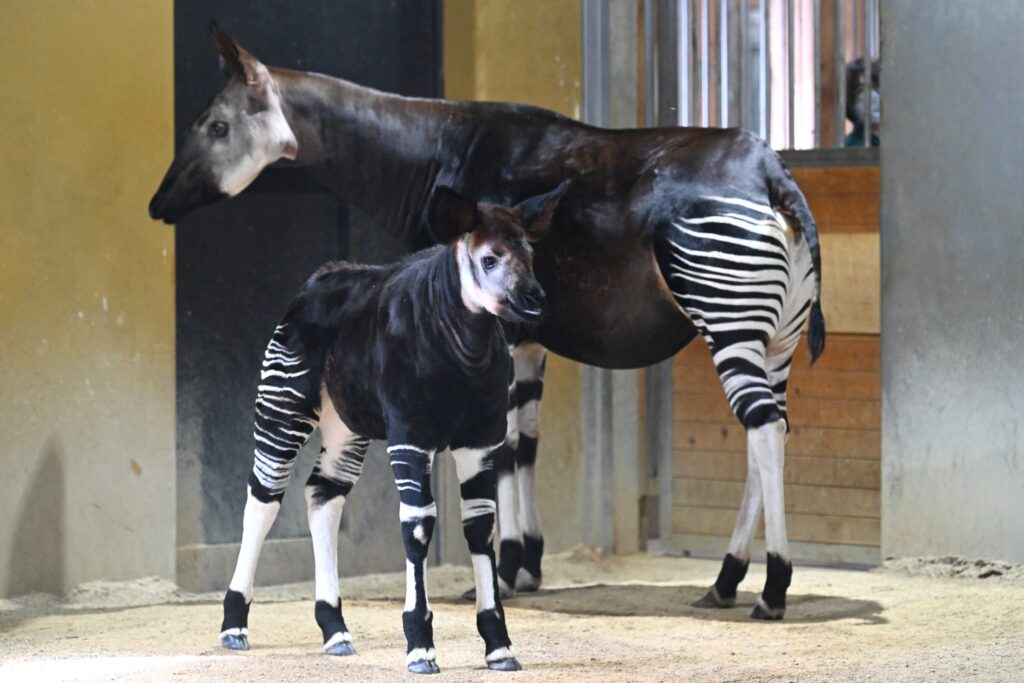
Recently, Yokohama Zoo Zoorasia celebrated a significant milestone with the birth of a female okapi calf. The zoo officially opened its doors to the public for limited viewing of the newborn on November 9th. This marks a noteworthy moment for the zoo, as it successfully bred this rare species after a two-year interval since the birth of its last calf, named Furaha, in 2024.
According to various media reports, the female okapi calf was born on September 3rd and is the offspring of 11-year-old mother Lala and father Bakari. This brings the number of Lala’s offspring to three, with Furaha being her older sister, born in July 2024.
At birth, the calf weighed approximately 18 kilograms, and by the time she reached one month old, her weight had nearly doubled to around 42 kilograms. She is described as lively and curious, exploring her surroundings with enthusiasm. In addition to nursing from her mother, the calf has already begun to use her long tongue to grasp and eat tree leaves. Notably, she still exhibits the distinct “crest” characteristics associated with her youthful appearance.
The zoo management is currently hosting an event for the calf’s first public appearance and naming contest. They have presented four names, each with a meaningful connotation: Jema, meaning “beautiful”; Asha, meaning “life”; Amani, meaning “peace”; and Heri, meaning “happiness and blessings.” Visitors to the zoo between November 9th and 23rd can participate in the naming process by scanning a QR code located on a sign in the okapi indoor exhibit area.
The okapi, belonging to the giraffe family, is the only remaining relative of giraffes that has not gone extinct. Originating from the tropical rainforests of the Democratic Republic of the Congo, the species has been classified as endangered.
The physical appearance of the okapi is particularly unique; it possesses a long neck and long tongue akin to that of a giraffe, while its hindquarters and legs are adorned with striking black and white stripes reminiscent of a zebra. However, there is no genetic relationship between okapis and zebras.
Yokohama Zoo is noteworthy for being the first zoo in Japan to introduce and publicly showcase okapis. Currently, only Yokohama Zoo and Kanazawa Zoo in Japan are home to this endangered species, which is regarded as one of the “world’s three rarest animals,” alongside the giant panda and the pygmy hippopotamus.