
Beijing has implemented new regulations for the management of drones, starting on November 15. These regulations not only enforce a comprehensive ban on flying, selling, and transporting drones within the city but also further prohibit the possession and storage of drones and their core components in Beijing. The latest measures significantly expand the scope of regulation from aerial activities to ground storage and transport, effectively sealing off nearly all avenues for private drone use in the capital.
The new restrictions, which were introduced on March 27, were framed as a response to challenges regarding the safety of low-altitude airspace over the capital. This has led to the emergence of the most stringent drone management regulations ever seen in the region, making Beijing the first city to essentially prohibit individuals from flying, buying, or transporting drones. The new rules went into effect on May 1.
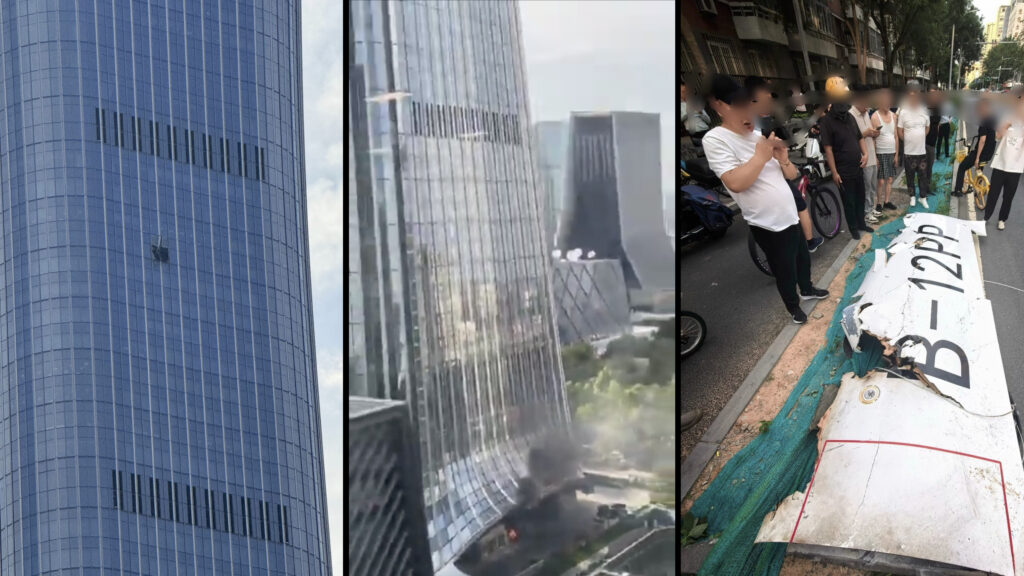
On June 26, a light aircraft collided with the CITIC Tower, a prominent skyscraper located in the central business district of Beijing, resulting in the death of the pilot and injuries to 13 other individuals not on board the aircraft.
In September, further amendments to the regulations were made, which reinforced the “comprehensive storage ban” principle. As of November 15, the new regulations put forth that the entire administrative region of Beijing is designated as a controlled airspace for unmanned aerial vehicles. This means that all drone flight activities are prohibited within the city’s limits, and the holding, storing, and transporting of drones and their core components is also banned. In addition, individuals and organizations are barred from establishing drone storage facilities or temporary storage points within Beijing unless stipulated otherwise by law.
Violating these regulations can lead to severe penalties. In addition to the confiscation of drones and their components, individuals may face fines ranging from 500 to 5,000 yuan, while organizations may incur penalties between 5,000 and 50,000 yuan.
Beijing authorities have provided three channels for residents to either sell, scrap, or transport their drones out of the city, allowing citizens the option to leave with their equipment. However, compensation for on-site buybacks does not correspond directly to the original purchase price.
The infamous incident on June 26 involved a single-engine, two-seat light sport aircraft that crashed into the CITIC Tower, commonly referred to as the “China Zun.” This tower, standing at 528 meters tall with 108 floors, is the highest building in Beijing and is positioned within the central business district, approximately six kilometers from the Forbidden City and near Zhongnanhai, the headquarters of the Chinese Communist Party.
After the crash, the glass on the upper floors of the CITIC Tower was shattered, leaving visible damage from the impact. Photographs from the scene indicated that debris fell from the building following the crash, and smoke was seen billowing from the base of the structure.
Reports from several foreign news outlets at the time noted that police prevented the press from capturing images of the incident. A Reuters journalist at the scene observed multiple roadblocks set up by authorities, along with a heavy presence of police and fire trucks. In addition, officers prevented some bystanders from photographing the incident and demanded that others delete any images or videos they had taken of the site.
In the aftermath of the crash, law enforcement presence in the area was heightened. Social media platforms saw a crackdown, with posts related to the incident being swiftly censored.
According to a report from the South China Morning Post, a senior aviation analyst disclosed that following the collision with the CITIC Tower, authorities tightened low-altitude aviation regulations within a 300-kilometer radius of Beijing and mandated comprehensive background checks for pilots. This distance roughly covers the operational range of most small aircraft.
Four individuals with knowledge of the situation revealed that early investigative findings concluded that “the pilot deliberately crashed the aircraft,” designating the incident internally as a terrorist act.
The Chaoyang District Government in Beijing confirmed the airplane crash only the day after the incident but has not publicly disclosed specific reasons for the collision.
By July 2, authorities reported that the aircraft involved was an Aurora SA60L, a single-engine, two-seat propeller plane, registered under the number B-12PP. The pilot, a 66-year-old resident of Beijing, had obtained a sport pilot’s license in 2021 and a private pilot’s license in 2024.
On the day of the accident, the pilot took off from a general aviation airport in the Pinggu District of Beijing, initially participating in both follow-me and solo flying activities. During a period of independent flying, the aircraft deviated from its designated airspace, and communication with the airport was lost before colliding with the high-rise building, resulting in the pilot’s immediate death.
Investigations also revealed that the pilot had long suffered from insomnia and anxiety, with journal entries mentioning his desire to “end his life.” Authorities concluded that these personal issues led to a public safety hazard, though skepticism about this conclusion prevails among external observers.
The aircraft was registered to Dongshi Shuangyue, a company that is part of Dongfang Shifang Flight School, the first publicly listed flight training institution in mainland China, headquartered in Daxing District, Beijing.
Yuan Hongbing, a scholar based in Australia, had previously informed reporters that operating a flight school in Beijing requires a profound background within the central and party-government-military spheres. This flight school was ostensibly established to cultivate dual-use aviation talent for both military and civilian purposes and serves as a reserve for authorities in terms of pilot training, featuring personnel from the ranks of the Communist Party elite and their families.