
The upcoming 2026 local elections in Taiwan, specifically the nine-in-one municipal elections, are set to take place on the 28th of this month. As the campaign for the position of Mayor of Taipei reaches its crucial final stretch, the Shin Ming Association has recently released its closure poll results. The Democratic Progressive Party’s (DPP) candidate, Shen Boyang, holds a leading approval rating of 48.6%, while the current mayor from the Kuomintang (KMT), Chiang Wan-an, trails behind with a support level of 33.8%. This gives Shen an advantage of 14.8 percentage points over his opponent.
The closure poll was developed and conducted by the Shin Ming Association, under the supervision of polling expert Dai Lian, who was responsible for the design and analysis of the questionnaire. The survey was executed by Bicon Market Research through telephone interviews with a sample size of 1,072 respondents from Taipei City, all aged 20 and above. This polling was conducted from November 11 to November 13, with a maximum sampling error of ±3.0% at a confidence level of 95%.
According to the results shared by the Shin Ming Association, Shen Boyang’s support has seen a slight decline of 1.7 percentage points since October, where he had a rating of 50.3%. On the other hand, Chiang Wan-an’s support has increased modestly by 0.5 percentage points from his previous standing of 33.3%.
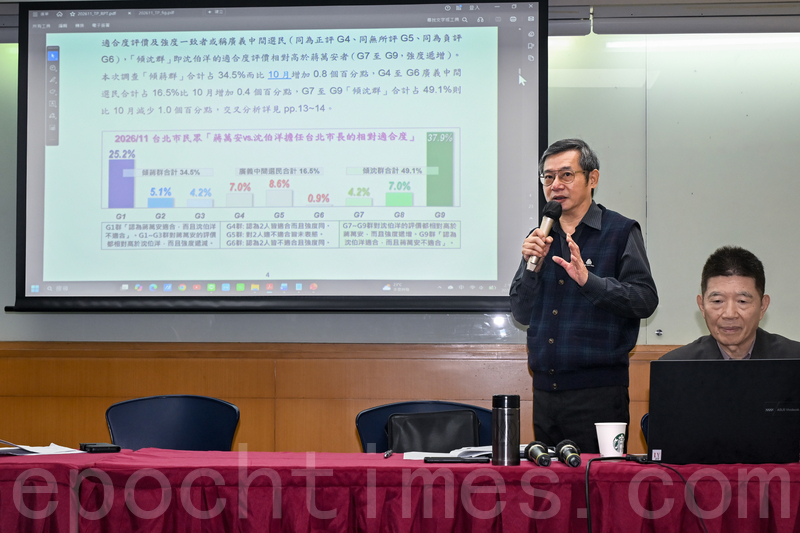
The survey also looked at the public’s perception of the candidates’ suitability for the role of mayor. The findings indicated that while suitability and support levels are interconnected, they do not equate to one another. Notably, 42.7% of respondents believe Chiang Wan-an is suitable for the position, whereas 45.5% view him as unsuitable. Although he experienced an increase of 1.5 percentage points in his suitability since October, the decrease of 1.3 percentage points in his unsuitability rating remains within the margin of error.
For Shen Boyang, 55.1% of surveyed individuals felt he was suitable to serve as mayor, while only 30.7% said he was unsuitable. These figures represent a slight decrease in his suitability and an increase in unsuitability compared to October, but both changes also fall within the margin of error. Among residents who affirmed they would definitely vote, 59.4% support Shen Boyang’s suitability, while 33.5% do not deem him fit for the role.
Regarding the current voting preferences, 48.6% of participants support Shen Boyang, a decrease from his previous standing, and 33.8% support Chiang Wan-an, which is an increase. The fluctuation is still within the sampling error.
The analysis highlights a stark division in support among various demographics. Notably, supporters from the People’s Party and a part of the pan-blue camp showed significantly more support for Chiang Wan-an, while other demographic segments, particularly women and voters from specific electoral districts, leaned toward Shen Boyang, with support exceeding 50%. Furthermore, among those who are undecided, approximately 25.3% indicated they would vote for Shen Boyang, while 21.3% supported Chiang Wan-an.
When asked whether to keep the KMT in charge or allow the DPP a chance at the mayorship, the results were revealing. Approximately 48.0% favored giving the DPP an opportunity to govern, a slight decrease from the 48.7% in October, while 32.1% opted to let the KMT continue in its role, an increase from 31.7%.
The sentiment toward who is more likely to be elected mayor has also shifted. About 40.8% of respondents expressed confidence in Shen Boyang winning, which is an increase from 37.7% in October, while confidence in Chiang Wan-an has decreased to 36.1%, down from 39.5%.
In terms of voter intention, a robust 91.9% of Taipei residents indicated they plan to cast their votes with 79.9% affirming they would definitely participate. These numbers reflect a slight decline from October. Voter engagement remains notably high across various demographics, although there is a concerning dip among younger and neutral voters.
The poll suggests that if a vote were held now, Shen Boyang could receive between 48% to 52% of the vote, while Chiang Wan-an could attract between 48.3% and 52.2%. This indicates a close race, with Shen Boyang potentially leading by up to 3.7 percentage points or Chiang leading by 4.2.
In analyzing these closure poll results, it becomes apparent that there are fluctuations compared to the end of October’s poll. Shen Boyang has seen minor declines in his ratings concerning qualifications, while Chiang Wan-an has experienced slight gains, possibly indicating a reaction to recent debate performances.
A prominent tactic employed by Chiang Wan-an has been to emphasize Shen’s lack of experience in municipal affairs, which has altered perceptions among neutral voters.
In the final stretch of campaigning, it is crucial for both candidates to engage voters effectively. For Shen Boyang, increasing voter turnout among younger demographics and those identifying as neutral or undecided may prove pivotal for success in the upcoming elections.
As the electoral atmosphere thickens with just days left until the vote, both candidates, particularly Chiang Wan-an, aim to mobilize their base while appealing to swing voters, setting the stage for a potentially competitive finish in the Taipei City mayoral race.