
On November 5, 2026, the High Court in Hong Kong issued a surprising ruling regarding pro-democracy activist Nathan Law, the former Secretary-General of “Demosisto.” Originally expected to be released in January 2027, Law has now been sentenced to an additional 10 years in prison on charges of “conspiring with foreign or external forces to endanger national security.” This decision has sparked widespread condemnation from the international community and activists around the world.
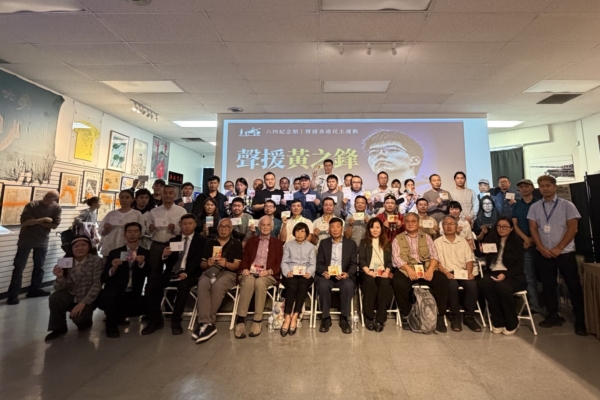
In response to the ruling, a solidarity event was held last Saturday, November 14, at the “Tiananmen Square Memorial Hall” in Los Angeles. During this gathering, participants protested against the Hong Kong authorities’ continued repression of Law under the guise of national security, citing political pressures as the motivating factor behind the harsh sentencing.
Cheng Hsiang, a former journalist from Hong Kong, addressed the crowd, asserting that the new sentence was not genuinely about “colluding with foreign forces.” Instead, he argued that the authorities were fearful of the influence Law might wield upon his release. “To prevent him from coming out too soon,” Cheng suggested, “the Chinese Communist Party (CCP) has found an excuse to impose a new sentence. By the time he is released, he will be 40 years old and perhaps less inclined to continue his fight.”
Nathan Law founded the youth activist group “Scholarism” to protest government education policies that sought to promote loyalty to the CCP. He later co-founded “Demosisto,” advocating for democratic self-determination for Hong Kong. His involvement in the Umbrella Movement earned him recognition as one of the 25 most influential people in the world by *Time* magazine. Law has frequently been targeted with new charges just as his sentences were nearing completion, with this latest ruling marking the most extended term yet.
Cheng expressed his disbelief at the verdict, questioning the rationale behind Law’s ten-year sentence. “After the enactment of the national security law in 2020, Law had limited activities; he merely shared posts from others. So why the ten-year sentence?” He perceived this as a tactic similar to the treatment received by other activists like Jimmy Lai, merely a ploy to extend their imprisonment.
His comments highlight a growing concern over the independence of Hong Kong’s judicial system. Cheng noted that while the legal framework might maintain some semblance of common law practices in economic matters, the political cases indicate a complete erosion of judicial freedom.
Ann Lau, the president of the “Visual Artists Association” in Los Angeles, expressed deep concern over the “collapse of the Hong Kong legal system.” Reflecting on Law’s upbringing in a Christian family, she recounted how he became active in social movements at just 14 years old, opposing educational programs designed to instill loyalty to the CCP. From a young age, he recognized that genuine patriotism cannot be enforced but must flourish from justice and mutual respect.
Lau further praised Law’s courage, noting that he chose to remain in Hong Kong despite the risks of arrest, showcasing his unwavering commitment to defending the freedoms of his fellow citizens. “High prison walls may confine the body, and unjust laws may silence the streets, but neither can destroy the conscience rooted in faith and love,” she asserted.
Young Chinese individuals have also expressed outrage at Law’s extended sentence, condemning the CCP for using the national security law and Hong Kong’s judicial system to suppress freedom and human rights.
Taiwanese anti-communist influencer Ba Jiong expressed these sentiments through a video, stating that Taiwanese citizens can still criticize the government openly, protest on the streets, and vote out disfavored politicians. “These are our accustomed freedoms. But for many Hong Kongers and young people in China today, these are dreams that feel far out of reach.” Ba lamented for Law, saying, “The prime of his youth has been unjustly locked away.”
He criticized the CCP for its continuous assertions of representing the people, while ordinary citizens are stripped of their right to voice criticism, often facing dangers when seeking recourse or simply expressing dissent.
Zhang Zhijun, an editor at the “Opposition Party” magazine, spoke at the rally, highlighting that the human rights situation in Hong Kong has become increasingly intolerable in nearly thirty years since the handover. He remarked that the harsh sentencing of Nathan Law illustrates the inherent evil of a communist regime.
Participants at the event also took time to write postcards of support to Nathan Law, thanking him for his contributions to the fight for democracy and freedom in Hong Kong.
The U.S. Consulate General in Hong Kong issued a statement asserting that Law has been “unjustly imprisoned since the end of 2020,” signaling Beijing’s relentless efforts to suppress individuals advocating for basic freedoms in Hong Kong. This statement was echoed by several foreign governments, including those of the UK, EU, Australia, Canada, France, Germany, Italy, Japan, the Netherlands, and New Zealand, all of which condemned the ruling as a violation of the Sino-British Joint Declaration, undermining the original freedoms, rule of law, and high degree of autonomy in Hong Kong.
Human rights organizations have also voiced strong opposition to the verdict. Amnesty International stated that this decision further demonstrates how the national security law has become a tool for punishing peaceful advocacy. Meanwhile, Human Rights Watch called on foreign governments to impose targeted sanctions on those responsible for the ruling. Additionally, overseas activist Nathan Law issued a statement, emphasizing that this verdict sends a clear signal of the CCP’s determination to quash any hopes for freedom and democracy.