
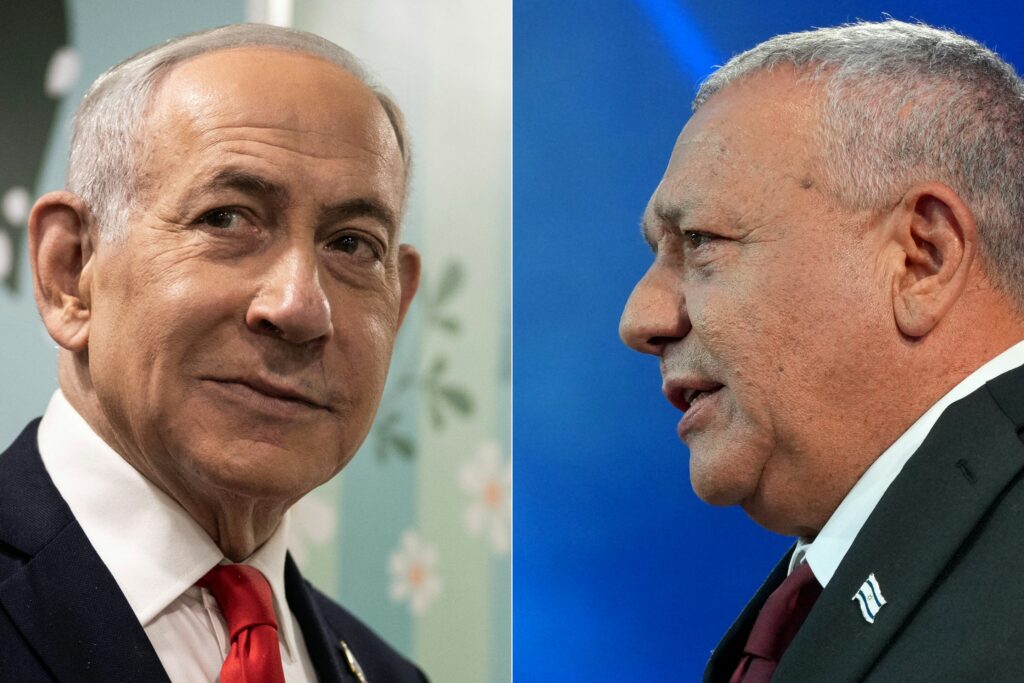
In the midst of a government formation stalemate, Israel’s caretaker Prime Minister Benjamin Netanyahu has proposed the establishment of a national unity government. He expressed a willingness to allow opposition leader Gadi Eisenkot to take the role of Prime Minister first, with both leaders rotating in power subsequently.
On Saturday, November 28, Netanyahu made a statement on the social media platform X, indicating his openness to reach a rotational Prime Minister agreement with Eisenkot, who leads the Yashar party, to form a coalition government together.
Netanyahu highlighted that his Likud party is the largest in Israel, having garnered approximately 250,000 more votes than Eisenkot’s party. Therefore, he believes he should ideally lead the coalition government or be the first in the rotational Prime Minister arrangement. However, he acknowledged the significant existential threats Israel is facing and the necessity for a new government to address these crises effectively. In light of this, he feels a responsibility to set aside considerations regarding party size and personal political ambitions, allowing Eisenkot to assumedly lead first, while he takes on the role of the designated Prime Minister during the initial period of this arrangement.
Furthermore, Netanyahu mentioned that on November 25, an amendment to an anti-terrorism law aimed at prohibiting the return of the bodies of terrorists was not passed during its preliminary vote in the Knesset. He criticized the Arab party members for voting against it and called on parties that support anti-terror policies to unite and prevent the country’s security policies from being weakened.
In response, Eisenkot released a statement on social media, inviting Netanyahu and his team to meet at the Dan Acadia Hotel in Herzliya to engage in direct coalition negotiations. He expressed his willingness to assess the sincerity of Likud’s intentions to push for a national unity government within 24 hours.
Subsequently, the Likud party announced that Netanyahu and Eisenkot had spoken by phone and agreed to meet in Herzliya on November 29 at 10 AM to discuss the formation of the national unity government.
As Netanyahu proposed the shared governance plan, Eisenkot was also actively seeking support for the coalition negotiations. However, divisions existed within the opposition regarding cooperation with the Likud party.
Eisenkot had previously reached a governance agreement with the Israel Home Party, led by Avigdor Liberman, and the Democratic Party, led by Yair Golan. If the United Party, led by Naftali Bennett, joins them, this alliance will hold 48 seats, still short of the 61 seats needed for a majority in the 120-seat Knesset.
Reports from Channel 13 of Israel, as cited by the Israeli Times, indicated that Eisenkot had contemplated seeking support from the extreme religious party “United Torah Judaism” and the Arab party “Unified Arab List” to form a government excluding Netanyahu.
The reports also suggested that Bennett had previously pressured Netanyahu to propose a rotational plan where Eisenkot would serve as Prime Minister first; otherwise, the United Party would ally with Eisenkot on a coalition agreement.
Bennett welcomed Netanyahu’s proposal but underscored the need to first confirm the intentions behind the negotiations. He cautioned against using the negotiation process to delay government formation.
Yair Lapid, the second in command of the United Party, along with Golan of the Democratic Party, both rejected this proposed arrangement. They argued that Netanyahu’s motives were intended to divide the opposition and obstruct the establishment of a new government.
Israel held parliamentary elections on October 27, but no single party emerged with the majority needed to govern independently. The Likud party secured 27 seats, becoming the largest party, while the Yashar party followed with 21 seats, placing them in second.
On November 8, Israeli President Isaac Herzog authorized Eisenkot to form a new government. At that time, 67 lawmakers recommended Eisenkot as Prime Minister, while 46 backed Netanyahu.
According to Israeli coalition procedures, Eisenkot must complete the formation of the government by December 6, with a possible 14-day extension if necessary. If he fails to succeed, the President may designate another political figure to attempt the formation, potentially granting Netanyahu another opportunity to lead.