
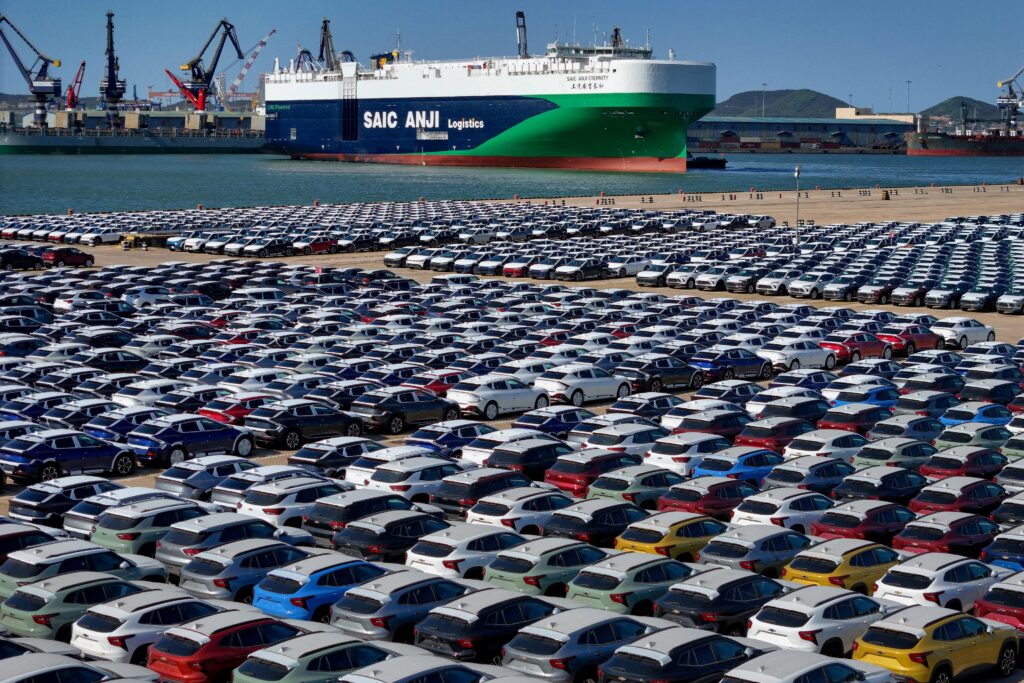
Electric vehicles (EVs) produced in mainland China have repeatedly faced quality issues that have raised concerns among consumers. Recently, a test driver responsible for quality assessment in the automotive industry revealed an unsettling practice known as “fast-track cars,” highlighting the trend of launching vehicles even while they are still undergoing testing. This insider admitted to advising friends and family against purchasing these vehicles due to quality concerns.
In the traditional automotive industry, the complete development cycle for a new vehicle model, based on an entirely new platform, typically spans over 36 months, from initial concept sketches to the official production line launch. However, the research and development (R&D) cycles for some “new energy” vehicles have been drastically compressed to just 12 to 18 months. This reduction in time means that environmental adaptability testing is often scaled back, durability mileage is estimated rather than empirically tested, and hardware and software calibrations may be incomplete when models are rushed to market. This phenomenon is what industry insiders refer to as “fast-track cars.”
On November 25, an exclusive investigative report brought to light the significant lapses in regulatory oversight within the process of manufacturing and testing electric vehicles in China. It detailed that the current state of quality assurance is alarming, with test drivers acting as de facto beta testers for new vehicles.
One test driver, Li Yuan, explained his typical duties involve driving unlaunched prototype vehicles on the road, reporting the problems he encounters. When asked whether the factory addresses these issues, he remarked, “We never know if the factory resolves them.”
Li further noted that many vehicles are delivered to customers before getting sufficiently “broken in,” indicating a “testing while launching” approach. He described the situation, stating, “Many vehicles aren’t fully tested and, when the market date arrives, they have to be delivered. It’s akin to having the car owners act as test drivers.” In instances where sold vehicles fail, manufacturers make adjustments based on customer feedback.
When questioned about whether he would purchase one of the cars produced by his own employer, Li candidly stated, “No, because the quality is concerning.”
Zhang Ke, an automotive graduate with experiences at both traditional joint ventures and several domestic “new energy” vehicle companies, emphasized the importance of ensuring the quality of the entire lifecycle of vehicles and components, from development to after-sales service. He shared insights on the significant challenges within his profession, elaborating that at a traditional car company, a new model could take up to three years from initial sketches to market launch. In contrast, the timeline for new energy vehicles has been reduced to an average of 15 to 18 months across multiple companies.
Zhang recalled an instance where a bumper’s durability test was required to run for 3,000 hours, but due to relentless market pressures, the development team was compelled to meet looming deadlines. During a project meeting, an R&D manager posed the question about potential issues arising from a specific component, inquiring if it was essential for safety or compliance. If it wasn’t, the team decided to proceed with the launch and tackle any problems later.
A recurring theme in these conversations reveals that if any quality issues arise, suppliers are dispatched to assist with rectification, but the interpretation of these problems ultimately lies with factory management. If a concern is labeled as “normal,” it may be dismissed entirely, and not categorized as a defect, but rather a minor flaw.
Reports indicate that in traditional automotive companies, a production line halt due to quality issues is treated as a major incident, necessitating accountability from department heads. Conversely, in the new energy vehicles sector, line halts have become common. To ensure timely launches, many temporary measures are adopted, such as manually smoothing components not yet fully completed, and adding extra manual inspections to problematic processes. Unfortunately, these ad-hoc solutions often become standard practices in subsequent production runs.
Before leaving his position in quality control, Zhang made a personal rule: he wouldn’t buy a new model for the first six months after its launch, nor would he recommend it to friends or family.
In recent years, the Chinese new energy vehicle industry has witnessed severe competition, prompting companies to launch new models rapidly to maintain market share. Data from the China Automotive News indicated that from January to May this year, the market saw the introduction of 542 new models, averaging 3.6 new releases daily. A particularly notable event occurred on July 16 when multiple new models were unveiled on a single day, dubbed “Mad Thursday.”
An industry insider commented that while companies previously took several years to develop a traditional fuel vehicle, new energy projects now demand completion within six months from inception to launch, leaving no room for thorough development.
Some incidents have drawn considerable public attention, such as the Xiaopeng X9 experiencing widespread malfunction due to extreme heat, prompting customers to question why such severe testing wasn’t conducted prior to launch. Furthermore, operational vehicles equipped with a particular battery type from the manufacturer Zhichuang Xinhang have reported battery failures, a situation believed to stem from rushed assembly processes in a competitive market landscape.
Recent economic downturns and intensifying competition have plunged the Chinese automotive industry into turmoil. To boost sales, companies have instigated price wars, leading to an unsustainable focus on fast-track production. This rush has not resulted in steady growth; instead, it has created a vicious cycle of increasing losses alongside accelerated manufacturing. In the first half of this year, the industry’s profits plummeted to 195.4 billion yuan, a 20% decrease year-on-year, with a profit margin of only 3.8%, indicating continued weakness in profitability.
Disturbing footage has surfaced depicting a domestic new energy vehicle at a repair shop, where its plastic components were found to be as brittle as cookies, raising concerns and prompting the repair shop to conceal the car’s brand to avoid legal repercussions.
Author Cui Chenghao has noted that current fast-track vehicles often focus heavily on their exterior appearances while cutting costs on crucial safety features, disregarding consumer safety. This practice is facilitated by powerful legal teams and supportive government stances, allowing manufacturers to operate without accountability, regardless of the harm inflicted on consumers.
Huawei has often been criticized for its ties to the government and its role in reaping “patriotic funds.” Public information shows that the Wenjie brand, created in collaboration with Seres, represents the core collaboration built on Huawei’s Harmony operating system. Over the past five months, the Wenjie M9 has consistently topped the sales charts for luxury vehicles above 500,000 yuan in China. However, the brand faced scrutiny in October when multiple fire incidents involving its electric vehicles sparked public outcry, leading some to refer to them as “mobile crematoriums.”
Huawei’s CEO Yu Chendong has publicly asserted his commitment to breaking industry norms by launching three vehicles in just over a year through collaborations with car manufacturers like Seres, contrasting sharply with the traditional three-year timeline for vehicle launches.
Recently, an incident involving a breaking brake pedal in the flagship Zunji S800 has fueled ongoing criticism of the Huawei brand, with many consumers asserting that the lack of rigorous development and testing in the fast-track vehicles they produce is a primary factor contributing to the quality problems plaguing domestic electric vehicles.