
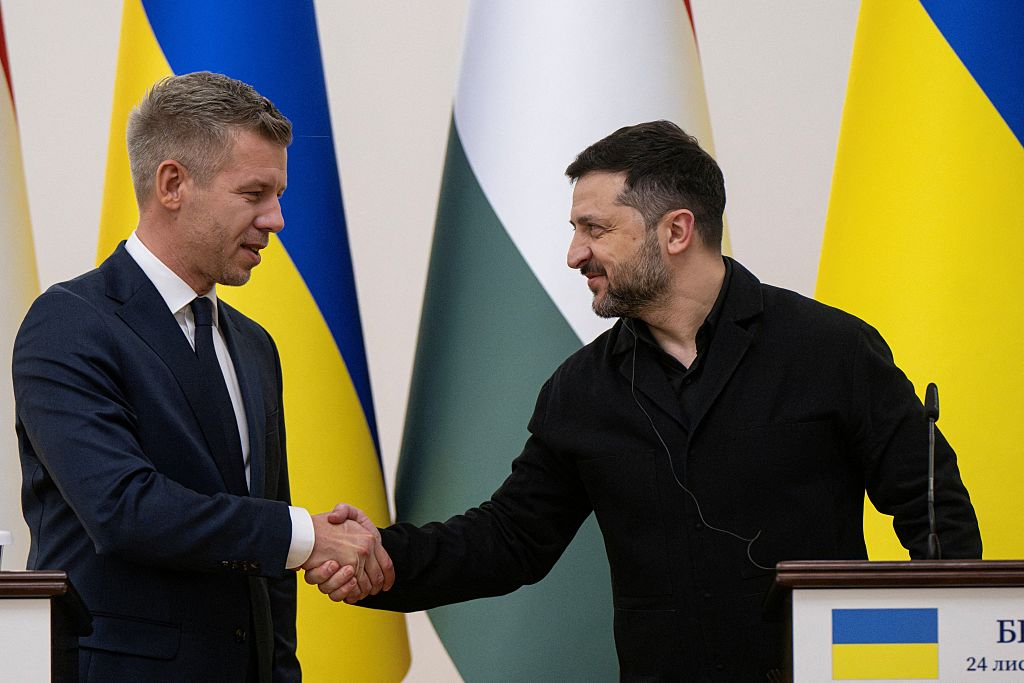
Hungarian Prime Minister Péter Magyar made an official visit to the Zakarpattia region in southwestern Ukraine on November 24, engaging in discussions with Ukrainian President Volodymyr Zelenskyy. This marked Magyar’s first visit to Ukraine since assuming office in May of this year. The talks primarily centered on various critical issues, including energy supply, cross-border transportation, and humanitarian assistance. Magyar expressed optimism that the relationship between the two nations could enter a new phase, but he emphasized the need for ongoing efforts to build mutual trust.
According to information released by the Ukrainian presidential office on the evening of November 24, the two leaders deliberated over topics such as the supply of natural gas and diesel fuel to Ukraine, as well as expanding the use of Ukrainian gas storage facilities by Hungarian companies. Infrastructure discussions involved plans to upgrade existing border crossings, establish new border points, and create new direct train routes between the two countries.
The Ukrainian presidential office indicated that specific agreements had been reached on these matters, urging each side’s teams to move forward with implementation. However, the announcement did not outline a comprehensive timeline for these measures.
As reported by Reuters, Magyar’s government has resumed the export of diesel fuel to Ukraine, which had been suspended under the administration of former Prime Minister Viktor Orbán earlier this year. During this latest meeting, the two sides further discussed increasing supply levels. Magyar also mentioned that the energy and agriculture ministers from both countries would hold talks regarding collaborative projects.
Beyond bilateral cooperation, Magyar also expressed a willingness to participate in the “Carpathian Eight” regional cooperation mechanism, launched in September in Ukraine. This initiative aims to enhance energy, logistics, and cross-border economic collaborations among countries in the Carpathian region.
The Zakarpattia region shares borders with Hungary, Romania, Slovakia, and Poland—four EU member states—and serves as a settlement area for the Hungarian ethnic community in Ukraine. The rights to language and education for the Hungarian community have long been contentious issues between Kyiv and Budapest.
In October, the Ukrainian parliament passed legislation to expand the rights of Hungarian language users and other minority groups to receive education in their native language. Following this, the Hungarian government withdrew its opposition to Ukraine’s negotiations with the European Union regarding internal market and competitiveness issues.
However, Hungary’s adjustment to its position on the negotiations does not imply a tacit agreement to expedite Ukraine’s accession to EU membership. According to Hungarian media outlet Telex, Magyar emphasized during a joint press conference that joining the EU must meet specific criteria, with no fast-tracking possible. He also called on Ukraine to accelerate measures to safeguard the rights of the Hungarian community.
During the visit, Magyar and Zelenskyy honored fallen soldiers by laying wreaths at a cemetery in Uzhhorod, commemorating those who have died in the conflict with Russia since 2014. Magyar condemned Russia’s aggression against a sovereign and independent European nation, asserting that the people of Hungary stand firmly against such acts. Zelenskyy expressed his gratitude for Magyar’s visit and condemnation of Russian actions.
Magyar reaffirmed Hungary’s stance on providing humanitarian and diplomatic support to Ukraine, while firmly ruling out the possibility of supplying weapons or deploying troops.
The two leaders also visited a local school, engaging in a volleyball match with students, and toured the new building of a hospital in Berehove.
In a post-meeting press conference, Magyar remarked on the importance of maintaining good relations between neighboring countries, acknowledging that while mutual interests are at stake, establishing trust will require significant effort moving forward.