
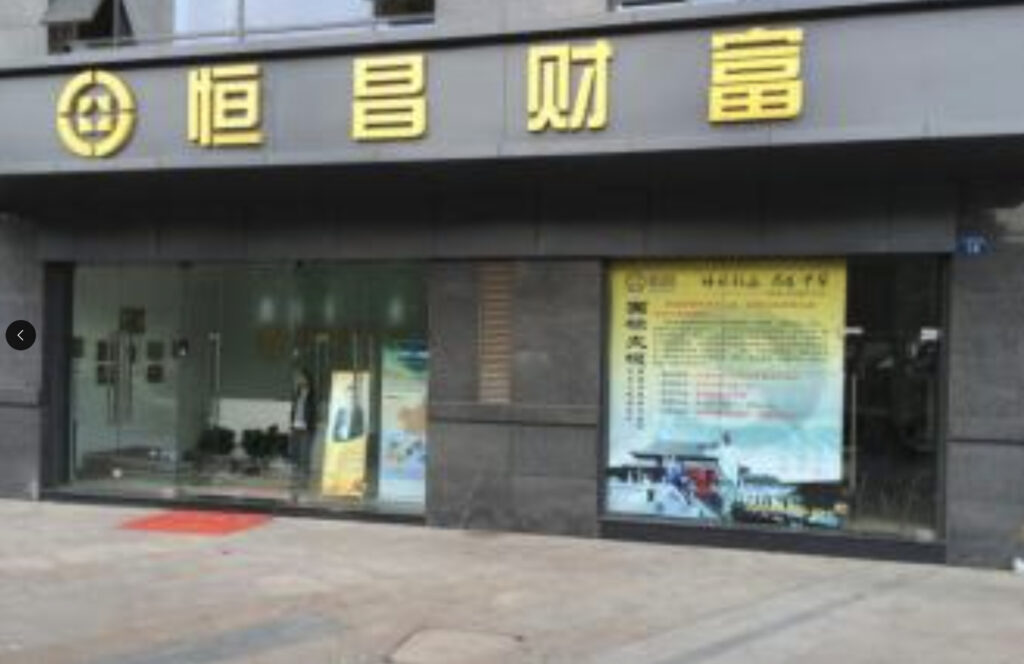
A recent financial crisis involving a prominent Chinese wealth management firm, known as “Hengchang,” has left numerous investors anxious about the future of their investments. One investor, who had planned to set aside 1.15 million yuan for his son’s wedding, is now grappling with the possibility of losing all his savings. The situation escalated when several companies affiliated with the Hengchang group became the subject of a police investigation, leading to the detention of the firm’s founder as well as several other suspects. This investigation comes just ten days after the platform ceased all withdrawals, rendering many investment products inactive and leaving countless investors in distress.
Various investors have come forward to share their harrowing experiences with Hengchang. Some have reported losing everything they had invested, with one individual declaring, “I just bought a house and now I’ve lost everything.” Others have expressed their frustration, questioning how a platform that had been operational for over a decade, undergoing multiple rounds of regulatory scrutiny, could collapse so suddenly and only now face law enforcement action. This poses a critical question: what has been the impact of the government oversight that was supposed to protect investors?
On the evening of November 22, it was reported that companies connected to Hengchang were under investigation for allegedly illegal activities by the Chaoyang Public Security Bureau in Beijing. Qin Hongtao, the founder and CEO of Hengchang Wealth Management, was among those detained for criminal interrogation. This police probe followed the firm’s abrupt halt of investment withdrawals on November 12, leaving many investors in the dark about the fate of their funds. Alarmingly, reports emerged that Qin had gone missing shortly after the firm ceased its operations.
An internal memo circulated among investors indicated that the company’s payment processes required Qin’s authorization. It noted that financial operations were suspended starting November 12 due to his unavailability, with the last transaction recorded on November 11. As of now, Hengchang has not issued a clear outline regarding any potential withdrawal plans, and the uncertainty surrounding the recovery of funds for investors remains significant.
One investor, identified by the pseudonym Chen Lin, expressed her concerns during an interview. She has been involved with the Hengchang platform for over a decade, contributing a total of around 1.15 million yuan, nearly all of her savings. Chen was only alerted to the platform’s withdrawal issues mid-November by a concerned friend, prompting her to log in and discover that the pages for reinvestment and product purchases had been wiped clean, leaving only her initial investment amount visible.
“I planned to use this money for my son’s wedding, but now I’m worried it will all be lost,” she lamented. The tide of despair surged as news of the withdrawal freeze spread, revealing many others who were equally unprepared and staggered by the losses. In response, investors from various regions have been filing police reports.
A female investor from Beijing recounted her story involving five colleagues who together had invested millions. “One of our colleagues even mentioned that he contemplated jumping off a building. He had just bought a home and invested that money, claiming it was only for a short three-month period, and now not even a penny has returned.”
Another investor’s family member shared their plight, stating that their father, who had invested in the Hengchang products, also went to file a report with the police. “The crowd was large. People were lining up in the lobby, submitting every piece of documentation they had.”
The ripple effects of this crisis extend far beyond individual financial losses; they highlight the extensive number of people affected and the vast scale of the finances involved. Hengchang, established in June 2011, initially focused on offline wealth management before branching out into the P2P lending sector around 2014. The company launched several platforms like Hengyirong and Henghuirong, rapidly expanding to over 47,000 employees and 1,200 offline stores across more than 300 cities at the peak of its success.
While ordinary investors face the stark realization of their financial risks, those in the sales chain have encountered even more immediate pressures. One investor named Jiang Li, who recently invested 500,000 yuan in October, described how her investment evaporated within days due to the platform’s collapse. “I invested in debtor bonds without telling my family, all because a friend who is a sales agent assured me of the returns,” she explained.
The troubling scenarios surrounding Hengchang unveil a broader web of financial risk in China. Reports indicated that at the peak, more than 6,000 P2P lending platforms operated nationwide, with the total volume of loans reaching a staggering 1.3 trillion yuan in June 2018. Hengchang has been referred to as a “living fossil” of the industry, having navigated the tumultuous changes from rampant growth to sweeping regulatory crackdowns.
Furthermore, despite ongoing regulatory actions and prior investigations—one revealing alleged illegal fundraising activities amounting to about 30 billion yuan affecting nearly 485,000 lenders—Hengchang has not fully vacated the financial market. Instead, it has rebranded and continued its operations under different names, raising further questions about the effectiveness of oversight mechanisms.
Investors like Chen Lin ponder why a well-established and heavily scrutinized firm could only now be facing legal action just as it precipitated a financial disaster. “If Hengchang had issues with illegal fundraising, why didn’t the regulatory authorities catch it sooner? Why were they still allowed to operate amidst multiple industry shakeouts?” she questioned, emphasizing that typical investors lack the means to discern complex financial operations and largely depend on what platforms and sales agents claim.
The recent chaos surrounding Hengchang has led to the company’s relaunch under new branding and a shift towards wealth management and lending, with various products marketed to affluent individuals. Meanwhile, investors have been left navigating a convoluted array of procedures for reporting their losses.
In the aftermath of the crisis, Chen Lin expressed concern over the lack of clear channels for recovering funds and the barriers that ordinary investors face. “What can we common folk do? It’s like being lambs waiting for slaughter. Is visiting the authorities as simple as it sounds? For an ordinary person, it’s not that easy,” she stated.
As the situation continues to unfold, many investors remain in the dark, uncertain about their financial futures or whether they will see any semblance of their hard-earned money returned. The eventual outcomes hinge on ongoing investigations and the results of asset recovery efforts, leaving the once-thriving investors caught in a web of unexpected despair.