
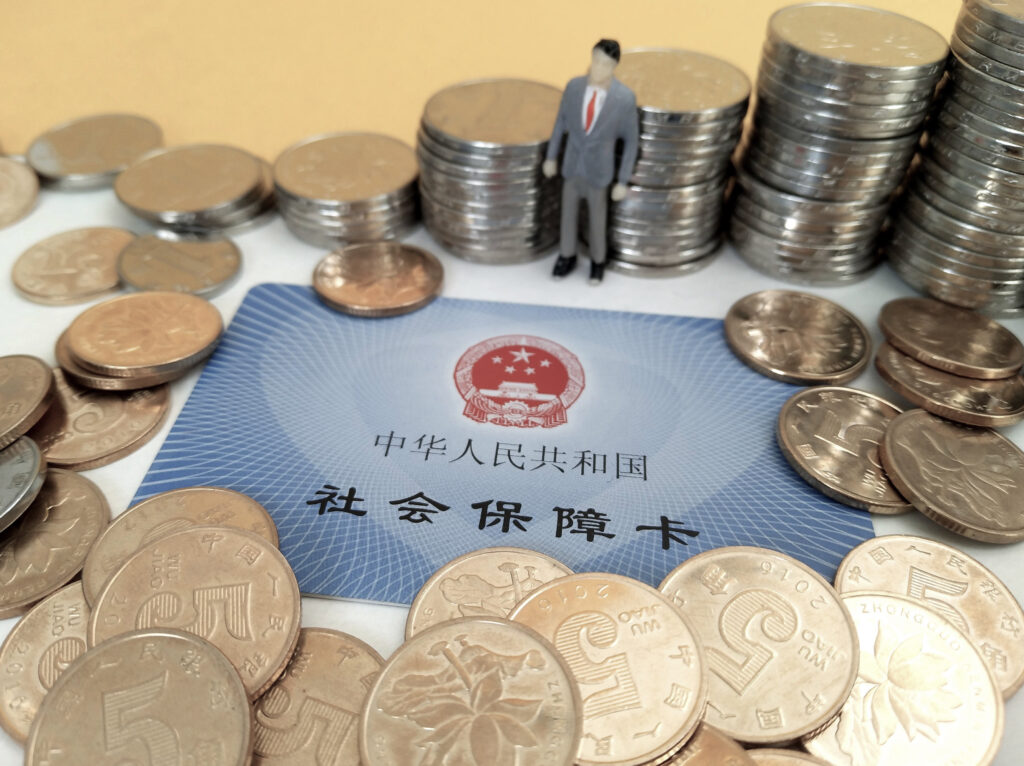
Due to the burst of the real estate bubble and the financial difficulties faced by local governments reliant on land sales, the Chinese Communist Party (CCP) has expanded the scope of social security collection from the general public. This has led to widespread discussions online, with sentiments expressed that the government is essentially “raiding officials’ homes, taxing the wealthy, and collecting contributions from the common people.” This approach has become one of the new strategies for fiscal growth under the CCP, alongside concerns that it may backfire.
Reports from both domestic and international media indicate a sluggish economic landscape in China. The collapse of the real estate market has significantly reduced local governments’ income from land sales, worsening an already heavy burden of local debt. The social security funds in China, which include pension insurance, are mainly collected from workers and employers but are managed by local governments, which also bear a portion of the expenditures. As financial strains tighten, some local governments have begun to eye pension funds, repurposing these resources for governmental payroll and debt repayments.
According to a report released by the National Audit Office of China in June 2025, 13 provinces allegedly misappropriated around 40.6 billion yuan (RMB) from pension funds, diverting these funds to pay government salaries and settle debts.
In tandem with these fiscal maneuvers, the CCP is increasing efforts to implement related social security policies. Recently, Premier Li Qiang led a special session of the State Council, where he emphasized the need for reforms to the social security system. These reforms aim to “expand the coverage of corporate annuities, increase the appeal of individual pension schemes,” and explore a “social security system for flexible workers, with the goal of gradually enhancing participation rates.”
An article from The Economist on November 19 highlighted that the CCP’s recent aggressive stance on collecting social security contributions and reinforcing the safety net has drawn considerable dissatisfaction from both employers and employees, with many perceiving it as a form of disguised taxation. Additionally, the existing pension system in China exhibits significant structural inequalities; disparities between urban and rural areas, as well as those within the system versus those outside it, have further eroded public trust in the system.
The article cites an example of Pan Kexin, a 25-year-old barista from Wuhan, who reveals that she is required to pay one-sixth of her monthly salary of 6,000 yuan into the national social security system. “Now forcing people to pay into social security is essentially the government admitting it has no money,” she remarks.
Pan notes a general lack of faith among her peers in these systems, acknowledging that most of her friends work as gig workers and do not participate in social security.
As of November 1, 2026, the “National Tax Administration Penalty Guidelines (2026 Edition)” went into effect, establishing unified penalty standards across regions. It states that if an employer fails to pay or underpays social insurance fees after being ordered by tax authorities to comply, they will face fines ranging from one to three times the amount owed.
Economist Xu Chenggang from Stanford University believes that the CCP’s vigorous expansion of social security collection will ultimately lead to counterproductive outcomes. In a recent podcast, he pointed out that the core issue in China’s economy is insufficient domestic demand. As the government increases pressure on ordinary citizens to fill financial gaps, it will only further dampen demand.
Xu elaborates, saying, “The actual level of social security in China is extremely low; the vast majority of people understand they cannot rely on social security for survival. In such dire circumstances, faced with the question of how he and his family will survive in the future, he will work harder to save money.”
Online discussions in China have circulated an article titled “Why Is the State Urging You to Contribute to Social Security?” that analyzes demographic shifts since the 1990s. Back then, the ratio was roughly five young people supporting one elderly individual, meaning less pressure on the social security system. However, by the end of 2025, the number of individuals over 60 reached 323 million, constituting 23% of the total population. The worker-to-pensioner ratio had fallen below 3:1 by 2024. In provinces like Heilongjiang, Jilin, and Liaoning, this ratio had plummeted to between 1.2:1 and 1.4:1, indicating that nearly the entire pension contributed by a working individual is needed to support a retired elder.
Calculations suggest that with an average life expectancy of 78 years in China and an average retirement age of 56.25 years, a sustainable system would require at least 1.67 individuals working for every one drawing from social security. By the end of 2025, the central government allocated a total of 254.6 billion yuan for redistribution of funds. Without nationwide coordination, a significant portion of pension payments could go unfulfilled, revealing the underlying truth behind the state’s insistent push for social security contributions.