
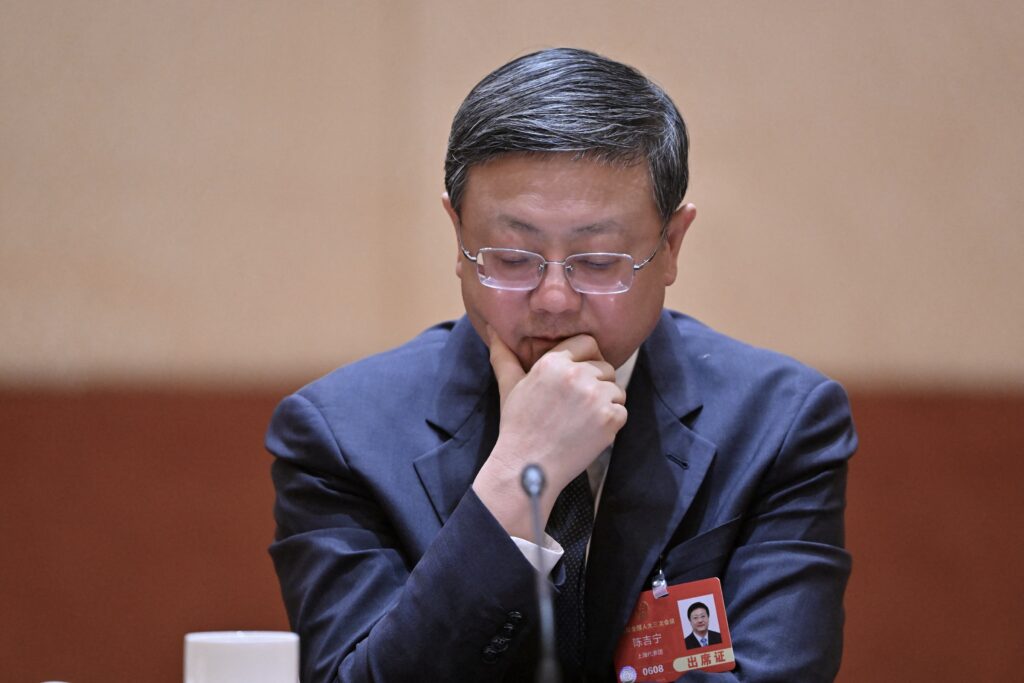
Intense power struggles are unfolding within the Chinese Communist Party (CCP) as it approaches the 21st National Congress. On November 24, it was reported that Chen Jining, a member of the Politburo and the Party Secretary of Shanghai, has been removed from his position. This marks the fourth current member of the Politburo to be investigated since the 20th Party Congress in 2022. Experts are analyzing the underlying reasons for Chen’s downfall, asserting that it signals a significant political reshuffle ahead of the upcoming congress, leading to ongoing instability within the ranks of power.
Veteran U.S. political commentator Chen Pokong described Chen Jining’s abrupt fall as a shocking incident within the Chinese political landscape. He stated, “This is even more astonishing than the downfall of Ma Xingrui. Unlike Ma, who was not in the line of succession, Chen was indeed considered a successor. This upheaval is only slightly less shocking than the ousting of Zhang Youxia and Liu Zhenli.”
Analyzing Chen Jining’s case, Chen Pokong suggested two primary reasons for his removal. The first reason seems to stem from President Xi Jinping’s desire to eliminate potential successors. There has been widespread speculation regarding Chen as a likely heir. Moreover, Shanghai is regarded as a political stronghold; historical precedents show that the Party Secretary of Shanghai often ascends to the highest positions, a legacy upheld by leaders such as Jiang Zemin and Xi Jinping himself. Therefore, Chen Jining was seen as precariously positioned, and his removal is viewed as a strategic move by Xi to pave the way for his continued leadership next year.
Secondly, Chen Pokong pointed out that notable incidents occurred during Chen Jining’s tenure, particularly during meetings with foreign guests where he could communicate effectively in English without relying on notes. This gained him a significant amount of praise, inadvertently escalating comparisons with Xi Jinping, which likely incited feelings of envy and concern within the president.
Additionally, there are connections between Chen Jining and Chen Xi, the longtime head of the Organization Department of the CCP, who wields substantial personnel authority within the party. Chen Jining was recommended to Xi by Chen Xi, building on their historical connections dating back to their time as students at Tsinghua University. Chen Jining emerged as a prominent representative of what is being referred to as the “Tsinghua Clique.”
Chen Jining has served as a member of the 19th and 20th Central Committees and a member of the 20th Politburo, having risen under Xi Jinping, who groomed him as a loyal confidant from the Tsinghua circle.
According to Chen Pokong, many individuals in Chen Jining’s position were elevated to their roles during Xi’s tenure, making this a situation where Xi can deflect responsibility, potentially attributing Chen Jining’s rise to Chen Xi’s recommendations.
Moreover, Chen Jining’s removal may also involve his ties to Han Zheng, known as the “Shanghai King.” It’s possible that an alliance existed between Chen Jining and Han Zheng, which could raise alarms for Xi Jinping.
Shen Mingshi, a researcher at Taiwan’s National Defense Security Research Institute and an associate professor at Tamkang University’s Institute of International Affairs and Strategic Studies, commented that Chen Jining’s career trajectory seemed to align with a typical model of grooming potential successors. Given his educational background as a PhD graduate from a UK university, he appeared to be an ideal candidate for succession. With his downfall, the surface-level justification might be corruption, emphasizing what is referred to as “elevation with illness” while ultimately reflecting on Xi’s governance.
“During the 20th Congress, it was said that Xi had interviewed everyone and there was a certain level of scrutiny in place. However, we now see multiple members of the Politburo falling,” Shen noted.
He further emphasized that internal power struggles are contributing to this atmosphere of instability.
A veteran Japanese journalist, Akio Yoshida, conveyed that the CCP has transformed into a “meat grinder.” After Xi subdued the Jiang and Hu factions, he has continued to purge his inner circle. Individuals rumored to be potential successors are regarded as threats to his authority. This mirrors historical parallels to Mao Zedong’s purges against Liu Shaoqi and Lin Biao, operating under the belief that his power is under siege.
“I believe that anti-corruption is merely a facade for power struggles; anyone could become a target for corruption charges,” Yoshida added.
Looking ahead, Chen Pokong speculated that the central government might appoint an official to temporarily assume control of Shanghai, reminiscent of the fallout from Bo Xilai’s ousting in Chongqing. He outlined several proposed strategies: one might involve an acting Party Secretary from within Shanghai, while another option could see a transfer of personnel from Beijing to maintain control. As Shanghai is a pivotal political hub, governing it positions an individual as a potential successor to leadership—essentially a stepping stone to power at the state level.
He presumes that turbulence within the CCP will persist leading up to the 21st Congress, noting that Xi aspires to emulate the autocratic model established by Stalin.
Yoshida remarked that the investigation into Chen Jining ties into broader preparations before the Congress. Following the recent Fifth Plenary Session, which expelled 32 members from the Central Committee in an effort to enforce stricter party discipline, a new round of purges appears to be starting, indicating that additional officials may soon face scrutiny.
Shen Mingshi added that Chen Jining had worked alongside current Politburo Standing Committee member Cai Qi in Beijing for about five years; thus, if Chen Jining faces allegations, Cai Qi might also become implicated. Past investigations might delve back many years, including scrutiny of early research funding or large-scale infrastructural projects, and could encompass former Shanghai Mayor Gong Zheng as well.
He believes that this situation sends out a significant political signal: there is likely to be a major reshuffling of personnel in the lead-up to the CCP’s 21st Congress. Figures associated with the Yuan family’s Chongqing establishment and Tianjin’s Chen Min’er may also be swept up in this political reckoning. The potential for comprehensive changes within the ranks of the Politburo Standing Committee looms, hinting at an extensive reshuffle that might reshape the power dynamics within the CCP.