
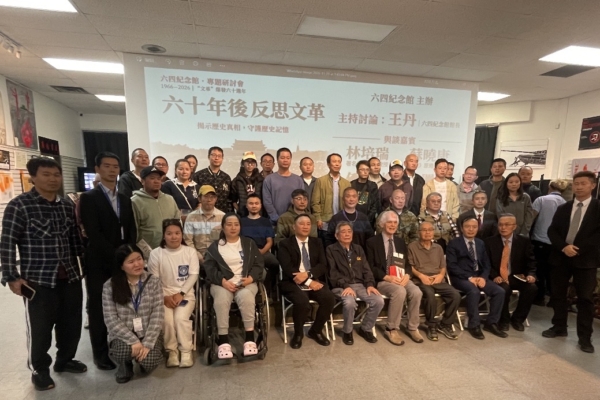
On November 21, a special seminar titled “Reflections on the Cultural Revolution After Sixty Years” was held at the “June Fourth Memorial Hall” in Los Angeles. The event brought together several experts and scholars who engaged in a profound discussion about the atrocities of the Cultural Revolution and the deep scars they left on the Chinese people.
Among the speakers was Dr. Ren Songlin, a Chinese-American physicist and expert on the Cultural Revolution. He shared his firsthand experiences and detailed a series of horrific massacres, including the Chongqing Big Violent Fight, the August Red incident in Beijing, the Daoxian massacre in Hunan, the Guangxi massacres, and the Inner Mongolia Incident. Ren candidly expressed his belief that “most of the deaths during the Cultural Revolution were due to massacres rather than armed conflict.”
Having endured the pains of the Cultural Revolution both personally and as an observer, Ren has dedicated many years to researching this dark chapter in history and has written memoirs documenting his experiences. Tragically, out of his family of six, four lost their lives due to unnatural causes during this chaotic period.
Before the Cultural Revolution commenced, Ren was still a child, but the events transpiring around him ignited a deep-seated fear. He recalls, “At that time, I had an overwhelming sense of dread.” The situation escalated after Communist Party leader Mao Zedong’s meeting with the Red Guards on August 18, 1966, which led to his family being targeted, their home raided, and them being expelled from Beijing.
Ren recounted the chilling atmosphere in which “cars and buses roared by on the streets with blood flowing beneath.” After many were killed, their families were often dragged along in vehicles shouting, “They got what they deserved!”
Through his research, he identified that the primary targets of the rebel factions were individuals categorized as “black five types” among 21 others. His father, once the chief prosecutor at the Military Tribunal in Beiping for Japanese war criminals, and his mother, who served as an interpreter for the court, both suffered immensely. His grandmother, parents, and aunt tragically died due to persecution, poverty, and illness during this time.
Among the numerous methods of studying the Cultural Revolution, Professor Wang Youqin, a former faculty member at the University of Chicago’s East Asian Studies Center, stood out to Ren. Wang’s approach emphasizes investigating the death toll of the era and the cause of these deaths, particularly distinguishing between fatalities from armed conflict and those from mass killings. Ren discovered that while many people did die from violent clashes, the majority succumbed to outright slaughter.
Between the latter half of 1967 and the summer of 1968, Chongqing experienced 31 bouts of violent conflict, with 24 of these being large-scale. Estimates vary, but some suggest that approximately 1,737 people were killed during this period, while other researchers believe the number could exceed 3,000. Of note, it is thought that 1,700 succumbed to mass executions while about 500 died in armed confrontations.
During the notorious “August Red” period from August 9 to the beginning of September 1966, official statistics recorded 1,772 unnatural deaths. However, Ren’s estimation indicates that the death toll was at least over 10,000 — within his own family, four relatives perished, none of whom were counted among those who died immediately. Notably, two teachers from Beijing’s Girls’ School lost their lives, including the principal, who was murdered during a public denunciation meeting.
The death toll in other regions was staggering as well. The Daoxian massacre in Hunan resulted in 4,519 deaths over 66 days, while grassroots reports from Guangxi suggest over 200,000 fatalities in just a year, contrasting sharply with official figures of 89,000. The Inner Mongolia Incident saw over 300,000 imprisoned, with mortality rates estimated between 20,000 to 100,000 in a single year.
Ren highlighted that the actual number of unnatural deaths during the Cultural Revolution far exceeds official figures, asserting that the authority of the Chinese Communist Party is built “on blood and bones.” From the purges at Jinggangshan to the Yan’an Rectification Movement, Mao Zedong’s relentless internal conflicts were marked by bloodshed. He remarked that the current party leader has continued this tradition of eliminating dissent under the guise of anti-corruption efforts, echoing Mao’s legacy.
Wang Dan, the director of the June Fourth Memorial Hall, endorsed the seminar, indicating its mission to remind attendees that contemporary events are built upon historical foundations. He expressed hope that the discussions would aid the public in “better understanding the current political landscape in China and anticipating its development by learning from historical memories.”
The seminar also featured contributions from notable figures, including Chinese writer Su Xiaokang, distinguished sinologist Professor Eugene Perry Link, Jr., and practicing lawyer Dr. Chen Chuang, among others. Their collective insights underscored the ongoing relevance of historical reflection in understanding present-day China.