
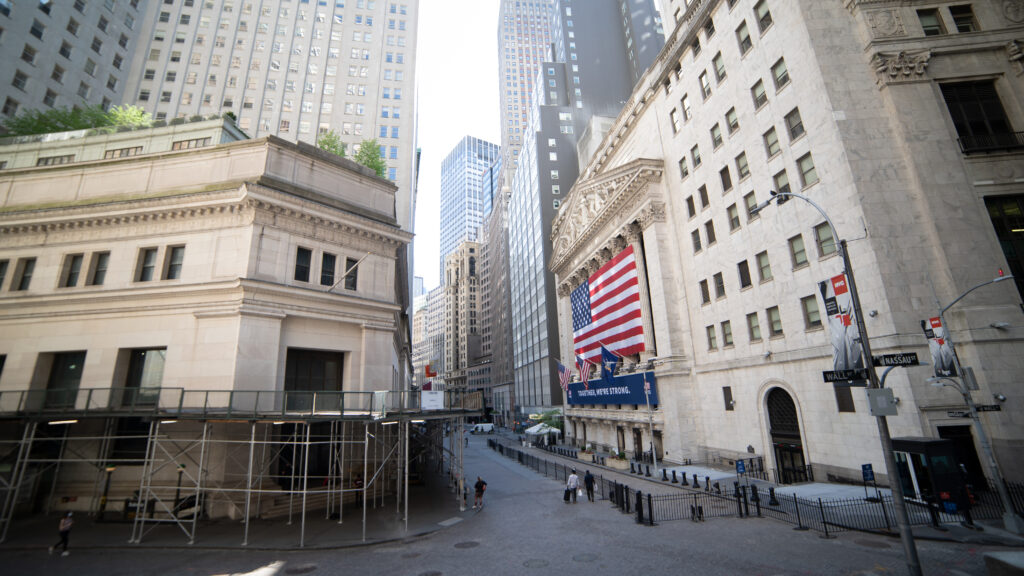
In recent developments, the U.S. stock market has experienced a notable downturn this week, marking its worst weekly performance since the onset of the pandemic. The Goldman Sachs Fear Index suggests that there may be further downside potential in the market. Nevertheless, Wall Street analysts maintain a positive outlook on the U.S. economy, projecting that the stock market could see significant gains in 2027.
The S&P 500 Index witnessed a technical correction this week, plummeting over 10% from its yearly highs. A primary factor contributing to this decline was the significant sell-off of stocks related to artificial intelligence (AI).
Similarly, the Dow Jones Industrial Average and the Nasdaq also fell into negative territory.
Energy and industrial stocks followed suit, experiencing declines as well. Crude oil prices have dropped, with investors closely monitoring the next steps in the conflict between the U.S. and Iran.
Prominent industrial companies like Caterpillar and GE Vernova, which benefited from the AI boom, have also shown a correction this month.
Over the past 30 days, the companies within the S&P 500 that have experienced the largest declines are predominantly those in the AI sector, including SanDisk, Marvell Technologies, and Lumentum.
This week, Goldman Sachs’ Fear Index climbed to 9, approaching its upper limit of 10. This index aggregates various indicators, including implied volatility and downside volatility costs, to assess market conditions. When panic prevails, stock prices tend to decline further.
In parallel, CNN’s Fear and Greed Index fell to 10, positioning itself within the “extreme fear” zone. Various sub-indicators, such as demand for junk bonds, safe-haven demand, the Volatility Index (VIX), options, and market breadth, predominantly reflect extreme fear as well.
It is essential to note that stock market rebounds typically commence once indexes enter the extreme fear territory.
From a technical perspective, the S&P 500 Index has closed at a critical support level this week, with the current reading of 6,910 points aligning with the Fibonacci 61.8% retracement level. Historically, stock prices tend to bounce back when they reach this position. However, if the index dips below this Fibonacci retracement level, it could signify that bearish sentiment has taken control, and the index might continue to decline toward the 78.6% retracement level at 6,642 points.
Despite the short-term pressure, Wall Street has begun to issue optimistic forecasts for 2027. According to a report from Fortune magazine, multiple analysts believe that the U.S. economy is expected to continue growing, bolstered by substantial investments from major cloud computing companies and resilient consumer spending. Some view the current stock market downturn favorably, referring to it as a “market de-bubbling.”
Viktor Shvets, Head of Global Equity Strategy at Macquarie Capital, stated in a report on Friday that the current panic does not resemble the bursting of an AI bubble.
Michael Monaghan, Portfolio Manager at Founder ETFs, also highlighted that the market often tends to “sell first and ask questions later.”
Earlier this week, Michael Wilson, Chief U.S. Equity Strategist at Morgan Stanley, predicted that the S&P 500 Index could reach 8,700 points by the end of 2027, reflecting a potential increase of 26% from current levels.
Goldman Sachs shares the same forecast of 8,700 points while also noting that volatility may remain elevated compared to recent years. Peter Oppenheimer, Chief Global Equity Strategist at Goldman Sachs, remarked, “We anticipate that the stock market bull run will persist.”
UBS Global Wealth Management and Wells Fargo have forecasted an index level of 8,200 points.
UBS has pointed out that risks associated with AI are increasing and that market expectations and index concentration remain high, making the market particularly sensitive to lower-than-expected earnings or rising discount rates.
The most optimistic forecast comes from Steve Chiavarone, Chief Investment Officer for Equities at Federated Hermes, who predicts the S&P 500 Index could soar to 10,000 points by the end of 2027, a remarkable 45% increase from its current value. He argues that the risks to AI infrastructure following the Democrat’s sweeping victory in this month’s midterm elections have been exaggerated.
Gaurav Mallik, Chief Investment Officer at Modera Wealth Management, referred to the current decline as a “regular pullback,” anticipating a high single-digit gain in 2027.
As inflation has consistently exceeded the 2% target for over five years, the Federal Reserve’s stance has turned hawkish, with Wall Street predicting further tightening of monetary policy in the coming months.
Some analysts suggest that if inflation cools and the conflict in Iran resolves by next year, the Federal Reserve might cut interest rates later in 2027.