
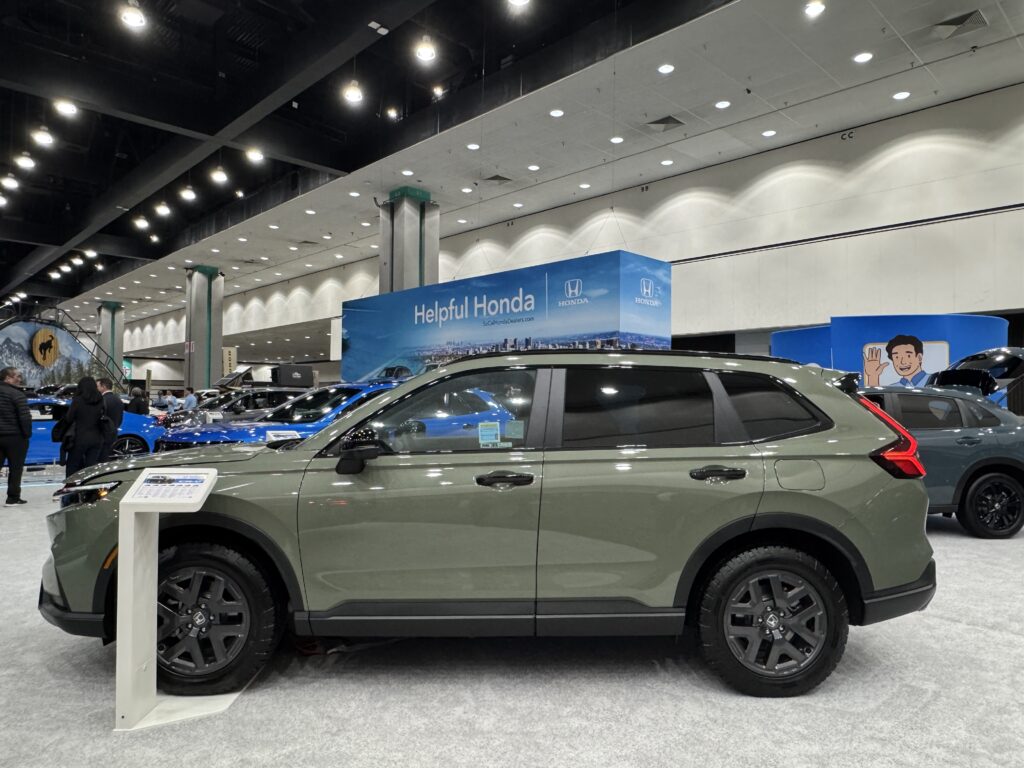
The rise of hybrid systems is becoming increasingly prominent in the automotive industry, with hybrid SUVs taking center stage. Although these vehicles typically come with a slightly higher price tag than conventional gasoline models, they offer long-term savings due to their superior fuel efficiency.
Japanese automakers Toyota and Honda have been pioneers in the hybrid sector for many years. The Toyota RAV4 has emerged as the best-selling SUV in the United States, and the 2026 model has undergone a comprehensive redesign, incorporating hybrid technology across all variants.
Recently, Honda announced its commitment to increasing investments in hybrid vehicle research and development, revealing plans for its next-generation 2028 Honda CR-V, which will exclusively offer hybrid versions.
While Honda is likely to develop a long-term electric vehicle strategy in the future, opting for a more rational hybrid-focused approach appears wise at this juncture. This strategy has proven effective for Toyota, showcasing the potential benefits of hybrid technology.
Apart from the RAV4, Toyota’s Camry sedan has also fully transitioned to hybrid systems. These vehicles not only significantly enhance fuel economy but do so without drastically increasing base prices, making them popular among consumers.
So, what distinguishes the Honda CR-V hybrid, and how does it compare with its long-standing competitor, the Toyota RAV4?
According to previous data, 55% of Honda CR-V sales are already hybrid models. While the hybrid system does add complexity and cost to the vehicle, it promises economic returns by reducing fuel costs in the long run. Given the current high fuel prices and the complicated global economic landscape, concerns about rising oil prices are unlikely to dissipate in the short term.
The transformation in the 2028 CR-V is far more than just aesthetic tweaks to the existing model and the elimination of gasoline versions.
Honda is developing a completely redesigned CR-V, marking the seventh generation of this vehicle line. The new model is built on a brand-new platform that is lighter in weight; with improved chassis rigidity, the driving performance is also expected to be more impressive. According to Honda, this vehicle’s structure will shed nearly 200 pounds (approximately 90.7 kg), a significant reduction that is likely to positively affect fuel efficiency and overall performance.
While the specific appearance of the new CR-V remains uncertain, Honda showcased a concept vehicle in May that embodied the “Acura” brand design style, hinting at the design direction for the next generation of hybrid models. It’s reasonable to presume that this concept vehicle foreshadows the next generation of the Acura RDX, which historically shares structural ties with the Honda CR-V.
If one were to incorporate Honda’s design elements into the basic shape exhibited in May, it would likely lead to a promising direction for the CR-V’s design evolution.
The 2028 CR-V will also utilize an upgraded version of Honda’s highly praised dual-motor hybrid system. In the current 2027 Honda CR-V hybrid, a 2.0-liter gasoline engine works in tandem with two electric motors, yielding a total output of 204 horsepower and a peak torque of 247 lb-ft (approximately 335 Nm). Unlike some other hybrid systems, Honda’s setup primarily drives the wheels through electric motors, with the gasoline engine mainly serving as a generator. While the gasoline engine can also deliver power directly to the wheels when necessary, the CR-V’s strategy focuses on electric power, resulting in smooth and linear power delivery, reminiscent of electric vehicles.
Honda is rebranding its next-generation hybrid system as “Honda Hybrid” and optimizing the operational strategy through a series of incremental improvements. The gasoline engine has been recalibrated to achieve optimal efficiency across a broader range of conditions, and other components of the hybrid system have also been upgraded to enhance energy efficiency further.
Although Honda has yet to provide specific quantitative data, the integration of a lighter chassis indicates that the 2028 Honda CR-V may achieve breakthroughs in either stronger performance or greater energy efficiency—possibly even both. The exact extent of these improvements remains to be revealed.
In addition, the new model will introduce an electric all-wheel-drive system, akin to the setup used in several Toyota hybrid models featuring all-wheel drive (AWD). The current CR-V hybrid conveys power to the rear axle through a physical driveshaft; in contrast, the Toyota RAV4 employs a different approach without a driveshaft.
For all-wheel-drive models, an additional electric motor is situated at the rear, thereby eliminating the need for a heavy driveshaft and instead utilizing lightweight power cables that extend from the battery to the rear motor.
This design also brings an added benefit: the potential reduction or complete elimination of the raised floor bulge within the cabin, thus freeing up more interior space.
The 2028 Honda CR-V will be manufactured in the United States, where its hybrid system and gasoline engine will be assembled. According to Honda, the official launch of the 2028 CR-V is slated for sometime next year.
As the 2028 model year Honda CR-V has yet to be released, comparisons with the RAV4 can only be made based on the current CR-V hybrid.
The base price for the Toyota RAV4 stands at $31,900, making it one of the most affordable hybrid SUVs on the market. Currently, the starting price for the Honda CR-V hybrid is $35,630.
According to J.D. Power ratings, the RAV4 holds an expected reliability score of 77 out of 100, which is categorized as “average.” In contrast, the Honda CR-V hybrid boasts a score of 83, placing it in the “great” category.
In terms of passenger comfort, both SUVs feature two spacious rows of comfortable seating; however, the CR-V offers more generous space. Additionally, the RAV4 has a smaller rear door opening angle compared to the CR-V hybrid, which could make it slightly inconvenient for adults entering and exiting, or when installing child safety seats.
U.S. News & World Report notes that both SUVs are on par regarding cargo space, and both come equipped with electric liftgates, allowing for lower floor areas in the cargo bay to facilitate loading.
The interior quality of both SUVs is commendable, with acceptable comfort levels and workmanship that meets their price ranges. However, the Honda CR-V hybrid’s interior quality exudes a more upscale feel, while Toyota seems to prioritize durability over visual or tactile aesthetics.
Both SUVs feature touchscreen infotainment systems, wireless device charging capabilities, and support for wireless Apple CarPlay and Android Auto. The Toyota model comes equipped with a 10.5-inch screen, while the Honda variant has a 9-inch screen. Moreover, the redesigned RAV4 highlights a significant advancement in its infotainment system.
The base model of the Toyota RAV4 utilizes front-wheel drive along with a 2.5-liter four-cylinder engine and two electric motors, yielding a combined output of 226 horsepower. The all-wheel-drive version adds an additional electric motor, raising the total output to 236 horsepower. Although these figures surpass those of the Honda CR-V hybrid—which combines a 2.0-liter four-cylinder engine with two electric motors for a total output of 204 horsepower—the CR-V hybrid still feels more agile during initial acceleration.
In fuel efficiency comparisons, the RAV4 emerges as the clear winner. In the front-wheel-drive configuration, city fuel economy is rated at 48 mpg, with highway figures at 42 mpg; the all-wheel-drive version achieves 45 mpg in the city and 39 mpg on the highway. The Honda CR-V hybrid, in front-wheel-drive form, delivers 43 mpg in the city and 36 mpg on the highway; opting for all-wheel drive brings these figures down to 40 mpg and 34 mpg, respectively.
Handling-wise, the RAV4 displays a robust performance when cornering, though may lack the nimbleness of the CR-V hybrid, resulting in slightly diminished driving enjoyment. Clearly, Toyota prioritizes ride comfort, while Honda seeks to enhance driving pleasure alongside comfort.
Although the CR-V surpasses the RAV4 in numerous areas, both hybrid crossovers exhibit exceptional quality and warrant thoughtful consideration. If budget constraints and fuel prices are factored in, the Toyota RAV4 may indeed emerge as the ideal choice purely based on fuel economy advantages.