
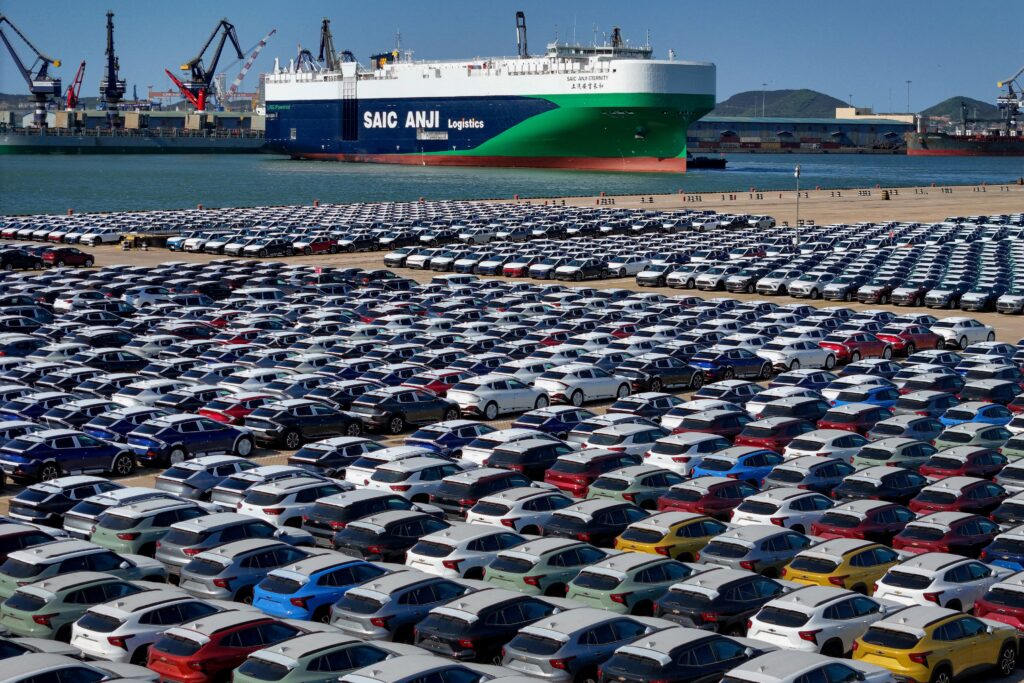
The European Union (EU) has taken significant steps to reinforce import restrictions on cars produced in China, a move aimed at safeguarding the domestic automotive industry and addressing the competitive pressure posed by the rapid expansion of Chinese automotive companies in the European market. The EU’s new measures include quotas on the importation of hybrid vehicles manufactured in China, prompting Chinese automotive firms to explore alternative approaches such as focusing on “Extended Range Electric Vehicles” (EREVs) to navigate these restrictions.
In October, the EU reached an agreement with China to implement a four-year quota system for the import of hybrid vehicles. During the first year, the import quota has been set at 350,000 vehicles. These measures are expected to take effect as soon as December 1, with the quota increasing by 6% each subsequent year. The primary goal of these restrictions is to limit the growth of hybrid vehicle imports and protect Europe’s automotive industry.
Reports from Nikkei Asia, published on November 20, cited sources familiar with the industry indicating that EREVs, which utilize a different powertrain configuration, might not fall under the new quotas. As a result, Chinese automotive manufacturers are planning to ramp up exports of EREVs in an attempt to evade these limitations.
Extended Range Electric Vehicles are primarily powered by electric motors, but they also feature a small gasoline engine that functions as a generator to charge the battery, thereby extending the vehicle’s range. This design aims to attract consumers who are concerned about the limitations of battery range and charging infrastructure associated with fully electric vehicles.
Chinese automotive companies are moving quickly to adjust their strategies. Xpeng Motors has stated that it is closely monitoring the EU’s regulatory developments. Li Auto is planning to introduce both fully electric and EREV models in Europe. Leap Motor, supported by Stellantis, has already launched the C10 and B10 Extended Range SUVs in the European market. Additionally, AITO, backed by Huawei, is evaluating the feasibility of introducing more models to Europe by 2027.
However, shifting focus to Extended Range Electric Vehicles does not guarantee that Chinese manufacturers can completely avoid EU tariffs. These vehicles may still be subject to existing anti-subsidy duties imposed by the EU.
Previously, Chinese automotive companies faced challenges due to the tariffs imposed on electric vehicles manufactured in China. Analysts suggest that merely changing the powertrain configuration may only provide a limited degree of relief from the new import quotas.
Commenting on the situation, Frederik Gollob, co-founder of the automotive consulting firm Qi Advisory, remarked that while the adjustments in vehicle models by Chinese automotive firms may be a short-term solution, a long-term strategy will still require an increase in local manufacturing capacity within Europe to effectively compete in this highly regulated market.