
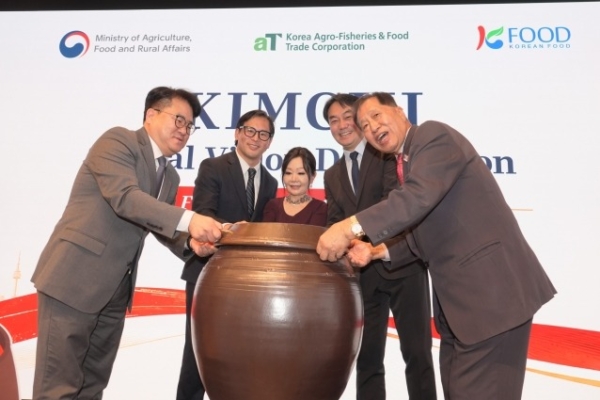
On November 20, the South Korean government hosted the “Global Kimchi Vision Ceremony” at the Korean Cultural Center in New York. This event marked a significant step towards the globalization of the kimchi industry, with aims to enhance the international competitiveness of this traditional fermented dish through technological innovation, cultural promotion, and strategic market expansion.
The ceremony drew a diverse crowd of attendees from the political, food industry, and cultural sectors of both South Korea and the United States. Among the notable guests were Jeong Kyung-Seok, the Director of Food Industry Policy from South Korea’s Ministry of Agriculture, Food and Rural Affairs; Mijung Yoon, Head of the Americas for the Korea Agro-Fisheries & Food Trade Corporation (aT); Kim Sang-ho, the Consul General of South Korea in New York; and Ron Kim, a New York State Assembly member. The event also welcomed Hooni Kim, a K-Food ambassador appointed by the South Korean government, alongside Jeongmi Lee, the Director of the Korean Cultural Center in New York, and Moon Joon-ho, President of the New York Korean Cuisine Globalization Committee.
During the ceremony, Jeong Kyung-Seok unveiled four key strategies for the global expansion of kimchi. These included strengthening the scientific validation of kimchi’s nutritional and health benefits, leveraging artificial intelligence and food technology to improve the quality of production processes, preserving and promoting the traditional Korean winter kimchi culture, and developing products that cater to the needs of overseas consumers. Jeong highlighted that currently, kimchi is exported to 102 countries worldwide and emphasized the commitment to further enhance international distribution networks and brand competitiveness.
Kim Sang-ho underscored that kimchi is not only a representative food of Korea but also embodies generational heritage, community bonding, and the spirit of sharing. Mijung Yoon added that as American consumers show a growing interest in natural fermented foods, kimchi has gradually found its way into local supermarkets and family dining tables. She stressed the need for enhanced industry collaboration to further heighten market penetration.
Another focal point of the event was a kimchi-making experience guided by Korean cuisine YouTuber and cookbook author Emily Kim. She demonstrated traditional pickling techniques and led participants in applying a special seasoning mix between leaves of napa cabbage. Emily also shared insights into the various flavors of kimchi from different regions of Korea and the family traditions surrounding its preparation.
Emily Kim expressed that for many Koreans, kimchi is not just a staple food; it also carries deep family memories and cultural significance. She hopes that consumers around the world will come to appreciate not only the delicious taste and health benefits of kimchi but also the cultural legacy behind it, fostered through the experience of making it themselves.
Through these efforts, the South Korean government aims to solidify kimchi’s place as a cherished food in households around the globe, turning it into an everyday dietary component enjoyed by all cultures.