
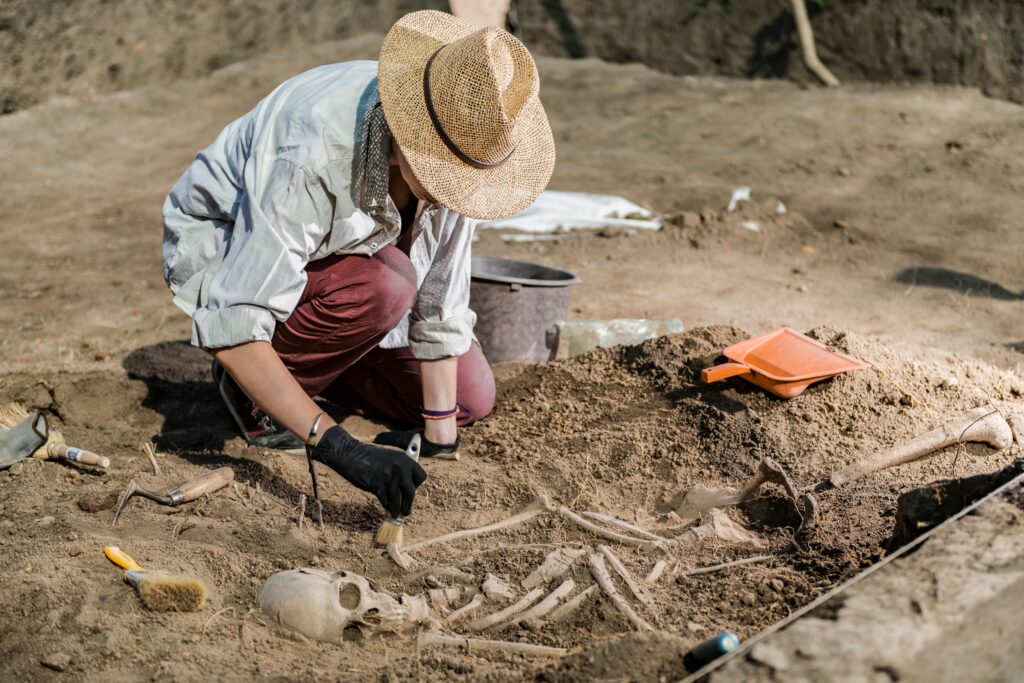
In a remarkable discovery near the Black Sea, archaeologists have unearthed a kidney stone the size of a grape from a burial site that dates back 5,300 years. The grave belongs to a bull herder from the early Bronze Age, who likely endured chronic urinary tract infections throughout his life. Research suggests that he may have experienced significant pain in his later years, and these infections might even be linked to his eventual death. The findings were published on September 30, 2026, in the journal “Archaeological and Anthropological Sciences.”
The burial site is nestled in the southwestern part of Russia’s Stavropol Highlands, and it is part of a “kurgan” cemetery, where ancient societies constructed earth mounds over burial chambers. The deceased was a man in his forties at the time of death. During the excavation, researchers discovered a brown, round stone with protrusions, roughly 2.1 centimeters in diameter, among the bones of his hand.
Chemical analysis of the stone revealed that its primary components are calcium and phosphorus, alongside the rare calcium phosphate mineral known as whitlockite. This mineral is often associated with urinary stones and is closely linked to bacterial infections. The research team concluded that the kidney stone was most likely caused by chronic upper urinary tract infections.
Natalia Berezina, the lead author of the study and an anthropologist at Moscow State University, indicated that the final years of the man’s life were likely marked by almost constant pain. In an era without antibiotics, the obstruction caused by such stones could lead to sepsis, a potentially fatal condition. However, it is also possible that the stone had moved to the bladder, with prostatitis or sexually transmitted infections being additional potential causes for his suffering.
Despite being muscular, the man exhibited signs of degenerative joint disease in his spine, shoulders, hips, and extremities. He had also suffered from four healed fractures in his right shoulder, ribs, and forearm, indicating a life of strenuous labor and frequent migrations. Berezina noted that life in the steppes, among herds of cattle and heavy carts, likely resulted in these types of injuries. Ultimately, the research team concluded that the chronic infection had a profoundly negative impact on the quality of his life.
This discovery not only sheds light on the health challenges faced by individuals in ancient societies but also emphasizes the significance of understanding how past lifestyles and ailments can inform our knowledge of human history and evolution.