
Recently, the Beijing Film Academy has established a Marxist Institute, aiming to integrate political education into the realm of film and television arts. This development has once again sparked public criticism regarding the imposition of Marxist-Leninist ideology in educational settings.
In recent years, the Chinese Communist Party has systematically promoted Marxist ideology within the education system. However, many university teachers have expressed their disdain for these political mandates, and some students have openly declared their discontent, stating “we do not like the Communist Party.” This attitude has raised concerns about political indoctrination and the potential waste of public resources.
According to a news update from the Beijing Film Academy’s WeChat account on November 19, the Marxist Institute was officially inaugurated on November 18. Zhang Jian, the secretary of the academy’s Party Committee, emphasized the goal of integrating Marxist theory into artistic education. They plan to develop a course and teaching resource database that combines “ideological and political education” with film studies.
The institute’s initiative to blend film studies with political education has stirred significant public debate. The Beijing Film Academy, originally a professional institution dedicated to nurturing directors, screenwriters, actors, and film production talents, is now facing scrutiny for intertwining its educational mission with political indoctrination.
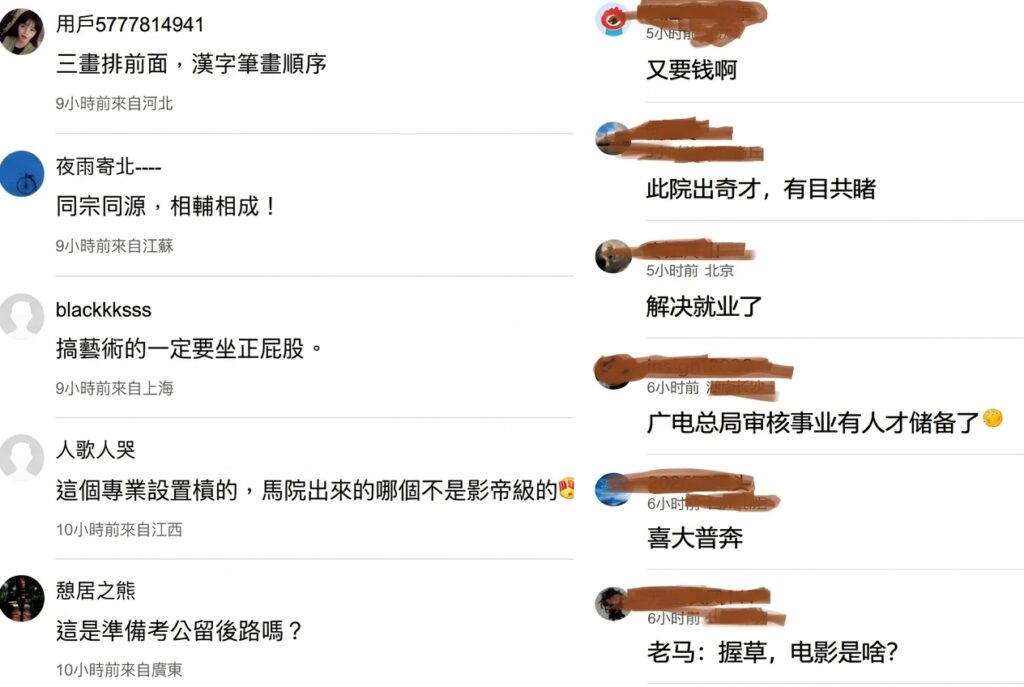
Social media users have engaged in lively discussions about this issue. Comments range from sarcastic remarks suggesting that “true actors are all in this” to questioning the efficacy of such an education system, stating, “In the land of China, there are only chaotic phenomena.”
Furthermore, some netizens voiced serious concerns about the implications of promoting a “failed theory,” which has historically led to the deaths of millions. They expressed dismay over the treatment of Marxism as an unquestionable truth, suggesting that Chinese citizens have been severely unfortunate as a result.
Data released by China’s Ministry of Education in 2022 indicated that by the end of 2021, over 1,440 Marxist institutes were operational across the country’s higher education institutions. More than 127,000 part-time and full-time educators were tasked with teaching these ideological courses, an increase of over 50,000 since 2018. The establishment of such institutes requires financial investments for faculty, administrative staff, office spaces, scientific research, and training budgets. For instance, the Jiangxi Fang Zhimin Cadre Institute projected an expenditure budget of over 32 million yuan for 2025.
This budget reflects only one local cadre academy and does not represent the average costs associated with Marxist institutes or Party schools nationwide. Currently, there is no comprehensive publicly released statistic regarding the total consumption of public resources by these institutions across China.
The expansion of Marxist ideology in education does not imply that faculty and students uniformly accept it. On the contrary, there is widespread resistance from both students and teachers throughout various regions.
In a report by Voice of America in 2024, it was noted that following the promotion of “curriculum ideology” by the Communist Party, university instructors are now required not only to teach their core subjects but also to incorporate political education into various courses.
An educator from a university in Ma’anshan, Anhui Province, commented on the pervasive nature of this political mandate, stating, “All social activities must interweave ideological elements; every educator is required to include these elements in their courses, and all projects must engage in ideological research. This has become a political task.”
Similarly, a professor from Fuzhou expressed that senior colleagues in his department are resistant to initiatives like “curriculum ideology” and “major ideological classes,” perceiving these as formalistic practices. Another educator from a university in Taiyuan shared that he had previously faced marginalization for expressing views that diverged from the official “main melody.”
From the students’ perspective, there have been notable indications of disinterest and disengagement during political education classes. A fourth-year student from Guilin, Guangxi, disclosed that in his class of over sixty students, only about ten are genuinely attentive to ideological classes, while the others are more preoccupied with their phones, completing assignments, or managing club activities. Some students have even categorized these political courses as “water classes,” implying that they lack substance.
Lai Xiaogang, a part-time assistant professor in history at Queen’s University in Canada, shared insights with Voice of America, pointing out that the political education system within Chinese higher education has fostered an extensive interest group. Certain individuals leverage these ideological disciplines to obtain degrees and seek employment, thereby depending on this system for their livelihoods. A scholar focused on public policy in Beijing described this education as coercive, forcing students to accept the Communist Party’s political theories rather than promoting independent thinking skills.
The students’ aversion to political education has been overtly expressed in classroom settings. For instance, on August 27, 2024, a student at Northwest University in Xi’an publicly declared during a Marxist theory class, “I do not believe in communism, and I do not like the Communist Party. I find it tiresome to study these foolish theories.” This statement incited a wave of online discourse, with many netizens urging that if more individuals voiced their opinions courageously like this student, the educational and societal climate might gradually transform into something genuinely positive.
Commentators have critiqued such initiatives, with instances like the establishment of a Marxist Institute at Zhejiang Hangzhou No. 2 High School in 2021 drawing particular attention. At that time, the school’s Party Committee Secretary and principal claimed the initiative aimed to instill Marxist ideas in students at an early age.
Critics have questioned the appropriateness of educational institutions focusing on indoctrination rather than imparting knowledge and fostering independent critical thinking skills. The recent move by the Communist Party to establish a Marxist Institute within an arts academy, such as the Beijing Film Academy, raises concerns about how political education will be specifically woven into the fabric of scriptwriting, acting, and film creation. Public sentiment suggests that this may ultimately lead to the degradation of the institution’s integrity.