
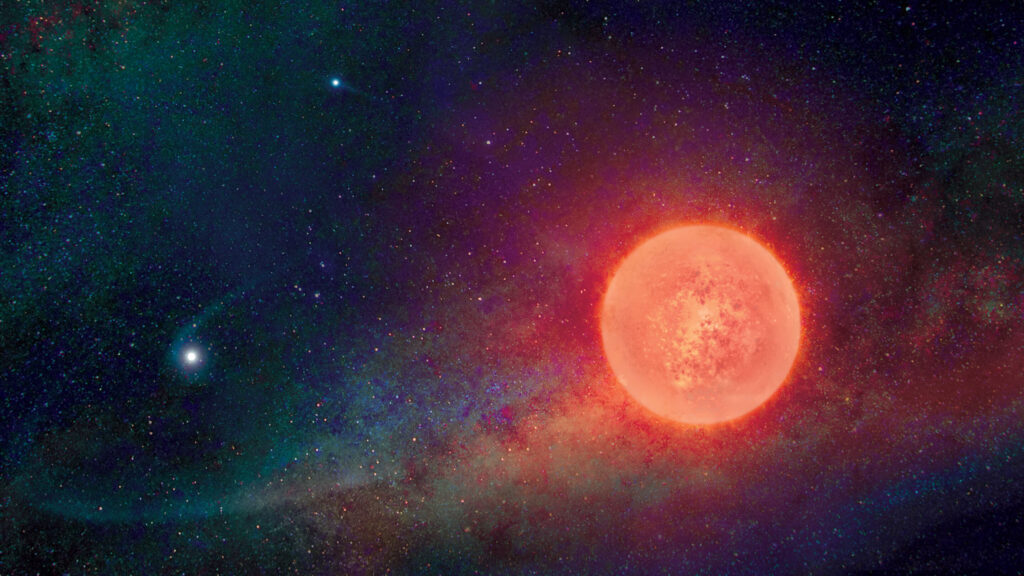
Scientists have made an astonishing discovery just 28 light-years away from Earth, uncovering a remarkable star system consisting of three stars, a phenomenon previously deemed impossible. This groundbreaking finding challenges existing notions of stellar evolution, encompassing the life cycles, deaths, and interactions of stars with one another.
A press release issued by the University of Montreal on November 19 announced that an international research team led by the university’s Trottier Institute for Research on Exoplanets (IREx) has identified this unusual three-star system, which has been named Welopōʻai.
The Welopōʻai system contains two white dwarfs and one red dwarf. White dwarfs are the high-density remnants left behind when stars similar to our Sun exhaust their fuel, while red dwarfs are considerably dimmer stars than the Sun.
Researchers originally set out to search for planets orbiting the red dwarf but unexpectedly discovered this unique stellar arrangement. Such a configuration has never been observed in the vicinity of our solar system.
To detect the presence of these planets, the team employed the Canada-France-Hawaii Telescope located in Hawaii to measure minute changes in the velocities of the stars caused by exoplanets orbiting them. However, the behavior of the red dwarf exhibited unusual characteristics.
The researchers detected changes in the velocity of the red dwarf approaching nearly 16 kilometers per second, a value exceeding the expected amount by over 1,000 times. After several years of follow-up observations, they confirmed the existence of two stellar remnants, which are the white dwarfs, surrounding the red dwarf.
Specifically, this red dwarf orbits in conjunction with one of its companion stars (a white dwarf), while the second white dwarf orbits the pair of stars. Remarkably, astronomers have yet to discover a similar system within a 100-light-year radius of Earth.
Prior to evolving into a white dwarf, the mass of this companion star was about 40% greater than that of the Sun. As it transformed into a giant star, its size expanded to hundreds of times its original volume. Given the proximity of the red dwarf’s orbit at that time, intense interactions between the two stars were almost inevitable.
In most similar stellar systems, the expanding star would likely engulf its companion or even merge with it. Surprisingly, however, the red dwarf in the Welopōʻai system seems to have survived, currently maintaining a relatively wide and stable orbit.
One of the authors of the study, Patrick Dufour, a professor in the university’s physics department, emphasized, “This system shouldn’t exist.” He noted that researchers currently lack a clear explanation for how it evolved into its present state, which raises further questions for future research.
The lead author of the study, Étienne Artigau, a researcher at IREx, remarked, “This discovery reminds us that there are still astonishing things hidden in the nearby regions of our universe. Even as we search for planets, there are entirely unexpected phenomena in the cosmos waiting to be unveiled.”
The findings of this research were published on November 19 in the journal Astronomy & Astrophysics, marking a significant advancement in our understanding of stellar systems and the complexities of the universe.