
Conjoined Twins Get Chance at Better Life After Historic Separation Surgery in St. Louis Hospital
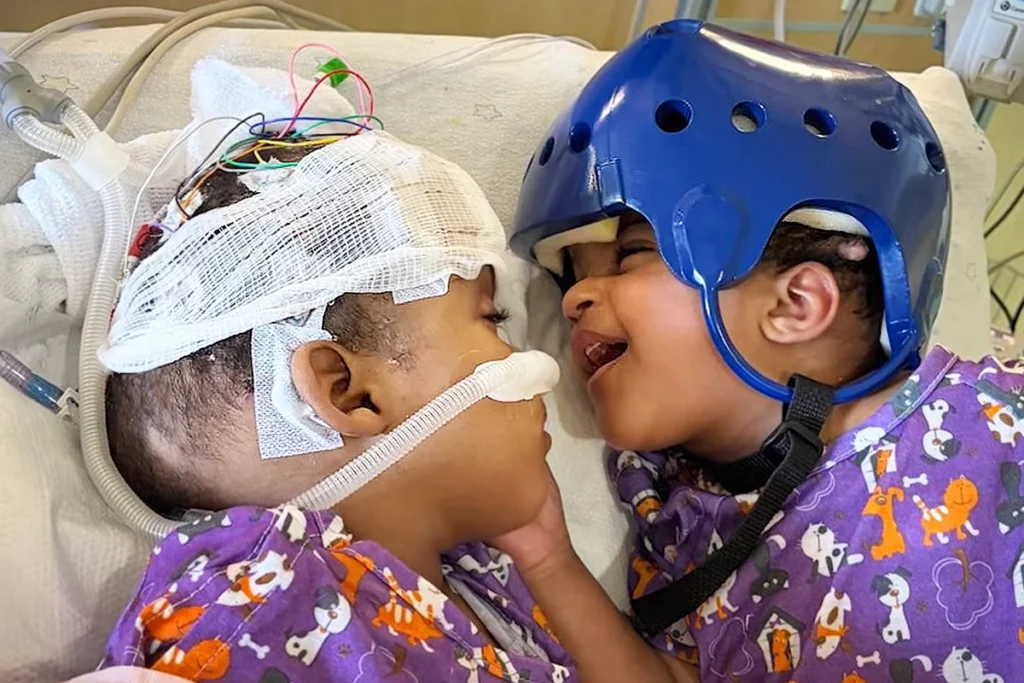
In the early years of their lives, twin sisters Hiyab and Wuhbto shared an existence that was both intimate and limiting. Born in Aksum, Ethiopia, the sisters were craniopagus twins, a rare form of conjoined twinning where individuals’ skulls are fused at the top. This condition prevented them from ever directly gazing into each other’s eyes, despite the playful interactions they shared, such as tugging at each other’s hair and touching one another’s faces.
Their unique situation changed dramatically in February 2026, when a groundbreaking 24-hour separation surgery was performed at the SSM Health Cardinal Glennon Children’s Hospital in St. Louis, Missouri. Hospital officials announced the success of the surgery on September 16, marking a significant milestone not only for the sisters but also for the medical community.
Currently, Hiyab and Wuhbto are undergoing rehabilitation therapy, learning essential skills they were previously unable to master. They are beginning to lead independent lives, practicing sitting upright in their chairs, eating without assistance, and engaging face-to-face with others.
Dr. Hossain Marandi, the hospital’s director, expressed the profound significance of the separation surgery, noting that it represents more than just a remarkable medical achievement. He highlighted that it embodies the possibilities that arise when world-class pediatric expertise, compassion, innovation, and a sense of mission come together in the service of children.
According to the hospital, craniopagus cases occur in approximately one out of every 2.5 million live births, representing only 6% of all conjoined twins. The last surgery of this nature performed in St. Louis took place in the 1980s, and globally, attempts to separate such twins have been limited to 62 cases.
The operation to separate Hiyab and Wuhbto was led by Dr. Joanna Kemp, who directed a 60-member medical team, providing the sisters with opportunities for independent living and breaking new ground in medical history. Upon their birth in March 2024, their parents hoped for a chance at normality for their daughters, but the extreme complexity and cost of the necessary surgery made it an unattainable goal in their home country.
Dr. Andrew White, the hospital’s chief medical officer, learned about the twins through a colleague and swiftly initiated plans for their overseas care. Acknowledging the rare nature of such cases, he expressed confidence in the hospital’s capability to manage the surgery after consulting with the medical teams that had previously performed similar operations in the 1980s.
The surgical procedure was highly intricate, involving nearly every field of pediatric medicine. Diagnostic imaging revealed that while the twins’ brains were structurally separate, their skulls were fused, sharing a complex and interconnected venous system. Performing a single, immediate surgery could have resulted in catastrophic bleeding or stroke.
To mitigate these risks, the surgical team devised a plan involving six separate surgeries over the course of a year, progressively separating the venous network and assigning each vein to one of the sisters. Furthermore, plastic surgeons placed balloon-like tissue expanders under their scalp to gradually stretch the skin, ensuring adequate growth of tissue to close the cranial wounds after separation.
In the spring of 2025, just days before their first birthday, the twins arrived in St. Louis. The World Pediatrics organization arranged their transatlantic flight and overseas care, while their hospitalization was managed by Ranken Jordan Pediatric Bridge Hospital. The multimillion-dollar medical expenses were covered through partnerships, charities, and private donations. Unfortunately, due to visa complications, their parents remained in Ethiopia.
Linda Norman, president of World Pediatrics, commented on the critical importance of providing cutting-edge medical care to children, stating that advanced facilities alone cannot change a child’s fate if they are not accessible. She expressed deep appreciation for the organization’s partners who contributed to the twins’ care.
In St. Louis, Dr. Kemp’s team faced a critical situation with little room for error, spending over 300 hours meticulously planning and rehearsing the surgical procedure. Utilizing advanced 3D printing technology, the hospital created high-fidelity models of the twins’ anatomical structures, enabling surgeons to practice navigating and cutting through intracranial structures using virtual reality systems.
On February 24, the day of the surgery, the twins lay together on the same surgical table, and after 24 hours of intense surgical procedures aided by a surgical microscope, the successful separation was achieved. Following the operation, they were moved to separate tables, each rotated 180 degrees from the other, and continued to receive postoperative care from two independent surgical teams.
Once the surgery concluded, both beds were wheeled from the operating room into the recovery area, where caregivers ensured Hiyab and Wuhbto would wake up facing each other.
As the potent effects of surgical sedation wore off, the twins opened their eyes to a new reality, now able to connect visually for the first time. Their distinct personalities began to emerge; Hiyab, once the twin who would turn her conjoined sister to greet friends, now prefers to welcome them with a smile, while Wuhbto remains vibrant and unreserved, happily showcasing her toys to the medical staff.
During a press conference on September 26, Dr. Kemp clarified the team’s mission, emphasizing that their objective was never limited to the successful separation of the twins but rather to create opportunities that would allow them to thrive and fulfill their potential for growth.
Now, as the twins continue to develop essential skills for a normal, independent life, they remain bonded in playful ways, pulling each other’s hair and touching one another’s faces, but now, with the added joy of sharing laughter and eye contact.
In the coming months, Wuhbto is set to undergo a cranial reconstructive surgery, while Hiyab is planning her own surgical procedures later in the fall, as they both eagerly embrace the future that awaits them.