
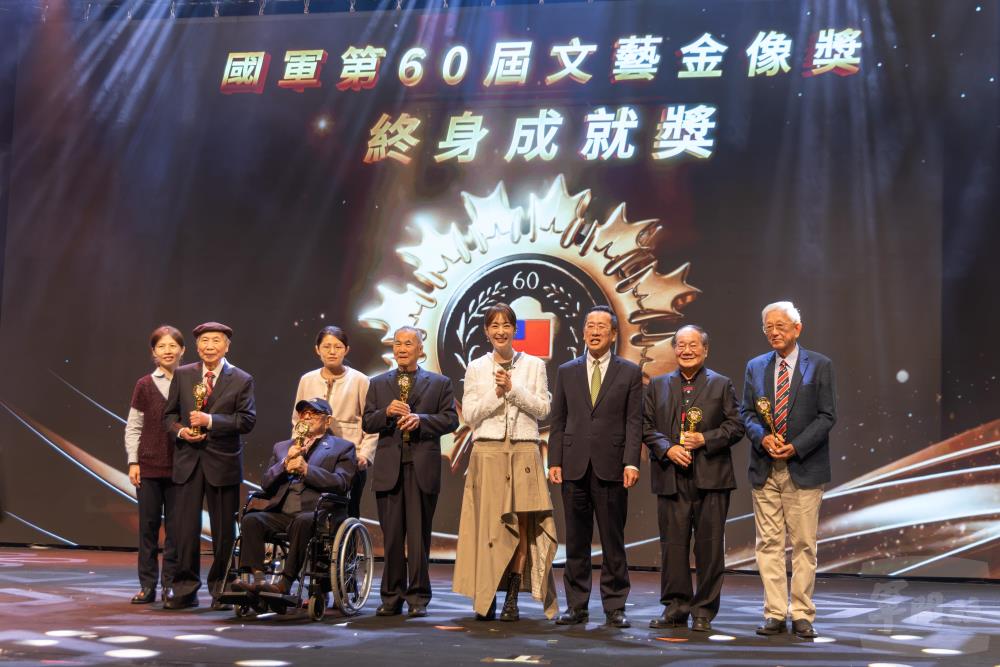
On the evening of November 19, the Ministry of National Defense of the Republic of China organized the “60th Military Literature and Arts Golden Statue Awards” ceremony at the Taipei International Convention Center. The event was presided over by Minister Gu Lixiong, who expressed his hope that through the soft power of military arts and culture, the morale and spirit of the armed forces could be bolstered, reinforcing their commitment to safeguarding the nation. He further emphasized the importance of conveying Taiwan’s dedication to the values of freedom and democracy, as well as its resolve for self-defense to the international community.
According to military news reports, the theme of this year’s awards ceremony was “Cultivating Artistic Brilliance, Honoring Sixty Years of Glory.” The event featured historical imagery, performances from artists, folk art groups, and the Ministry of National Defense’s performing arts troupe. These performances highlighted the history of military cultural competitions, which began in 1953, showcasing the evolution of the new literary movement into the prestigious Golden Chime Awards, along with contemporary multimedia initiatives, cultural creations, and inspirational music.
The ceremony commemorated the rich achievements of the military in promoting arts and culture over the past six decades, awarding various Golden Statue Awards for the year. The National Defense University achieved the overall championship for multiple categories. Minister Gu, alongside the chairman of Taipei 101, Jia Yongjie, presented the “Lifetime Achievement Award in Military Arts,” honoring five recipients: Deng Zhenxiang, Lai Qianhua, Li Gumo, Tang Jianfeng, and Wang Lizhen, for their contributions to music composition, dramatic education, ink brush calligraphy, military documentaries, and aviation literature.
In his speech, Gu Lixiong highlighted that the military had initiated the new literary movement in 1965, encouraging service members to document their military lives through literature, music, visual arts, and drama, thereby nurturing their spiritual resilience. As the military literature and arts golden awards celebrate their 60th anniversary, they stand as a testament to the continuity and innovation of military culture, preserving precious historical memories for future generations. The awards have also played a crucial role in fostering notable artists and performers in Taiwan.
Minister Gu noted that in recent years, the military literature and arts awards have evolved and embraced innovation, broadening their participant base to include not only military personnel but also members of the community and international friends. The categories for selection have expanded from traditional fine arts and military songs to include multimedia, creative cultural works, and military models.
He expressed his aspiration to harness the soft power of military arts and culture to consolidate the morale of the armed forces, strengthening their commitment to defending the nation. This in turn would facilitate a better understanding of the military among the public, fostering recognition for national defense while communicating Taiwan’s commitment to freedom and democracy to the global community.
The award ceremony commenced with a dramatic opening, featuring drumming and dance performances from the Ministry of National Defense’s performing arts troupe and the “Art Sound Taiwan Theatre Troupe.” Star performers Zhou Dingwei and Lu Xuerui captivated the audience with the stage play “That Year, Senior Taught Me to Sing Military Songs,” incorporating classic military songs like “Veteran” and “Heroic Spirit” into the narrative. The “Ren Shan Ren Hai Art Initiative” showcased a blend of traditional Taiwanese opera, Hakka opera, Peking opera, and contemporary dance, reflecting the rich tapestry of Taiwan’s diverse cultural elements. The ceremony reached its peak as award-winning singer Hsiao Huangchi delivered moving performances of songs such as “Flying Against the Wind” and “You Are My Eyes.”
The Ministry of National Defense reported that this year, the literature and arts golden awards attracted a record total of 1,842 entries across five categories: fine arts, literature, music, cultural creation, and multimedia. Out of these, 174 works received awards. Over the past sixty years of promoting the new literary movement within the military, the Ministry expressed gratitude to service members and civilian creators for their invaluable contributions in documenting military life through words, music, visual arts, and media, allowing society to gain a deeper understanding of the military through these works.
Looking ahead, the Ministry of National Defense reiterated its commitment to continuously encouraging artistic creation and exchange, showcasing the spiritual strength of the military, and deepening national defense education among the public.