
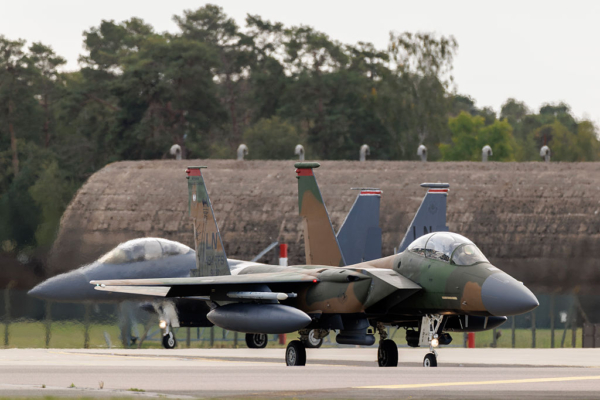
Recently, the United Kingdom has heightened security measures at key military installations, including airforce bases and nuclear facilities. This precaution aims to thwart potential drone attacks orchestrated by supporters of the Iranian regime against U.S. military bases stationed in the UK and other military assets.
On the evening of November 13, an incident was reported involving what seemed to be unauthorized drone activity over the RAF Lakenheath Air Force Base located in Suffolk. A spokesperson for the U.S. Air Force stated that the occurrence did not affect personnel, aircraft, or infrastructure at the site.
Local residents noted that alarms sounded from the base, accompanied by announcements instructing individuals within the base to remain indoors. Following the incident, the base communicated that the situation had been resolved.
In light of the deliberate threats posed by Iran, British authorities are deploying elite forces to ensure the security of sensitive military and nuclear installations from potential drone strikes.
According to reports from security sources highlighted by the Daily Mail, Iran appears to be preparing to adopt guerrilla tactics similar to those used in Ukraine, with plans to target these critical sites.
The UK Ministry of Defence is investing £500 million to enhance security measures across various bases throughout the country, coupled with an alert issued to the 43 Commando Fleet Protection Group Royal Marines, which is responsible for safeguarding these locations.
Prominent locations currently under heightened protection include the Clyde naval base in Faslane, the Glen Mallan ammunition jetty in Loch Long, and Coulport base, all of which play crucial roles in the UK’s military infrastructure.
The Clyde naval base serves as the home port for the UK’s nuclear submarine fleet, while the Coulport naval ammunition depot is dedicated to storing, maintaining, and loading nuclear warheads.
The Glen Mallan jetty facilitates the loading of conventional (non-nuclear) weapons from the Glen Douglas ammunition storage facility onto naval vessels. Nearby, the Finnart Oil Terminal acts as a fuel reserve for the Royal Navy.
The 43 Commando Fleet Protection Group, tasked with protecting Britain’s strategic nuclear deterrence forces and associated military facilities, comprises 460 personnel stationed in Faslane. Among them, two squadrons focus specifically on maritime nuclear security, undergoing specialized training to address challenges posed by Iranian sabotage teams.
As stated by the Ministry of Defence, their skill set includes close-quarters shooting and hand-to-hand combat, nighttime operations, actions in industrial and underground environments, and small boat handling.
Drones present an unprecedented threat to the UK’s military installations. To mitigate the risks of unauthorized drone intrusions, British air force bases have implemented GPS geo-fencing technology. This software instructs drones that approach the prohibited airspace to either automatically land or return to their point of origin.
However, the drones utilized by Iran and its proxies can circumvent or jam these software constraints, enabling them to disregard electronic boundaries and force their way into sensitive military airspace.
What heightens the danger further is that military aircraft parked at air force bases contain large amounts of aviation fuel in their wing tanks. Even when stationary, these tanks are filled with highly flammable fuel vapors.
If a drone were to land on the wing of a military aircraft and detonate, the resulting flames could immediately ignite the accumulated fuel vapors within the tank. This could trigger a severe chemical explosion, completely destroying the aircraft, which may be worth tens of millions or even up to a billion dollars, and potentially affecting surrounding aircraft.
Due to these concerns, the U.S. recently evacuated aircraft from the RAF Mildenhall base in the UK. Among those evacuated were two Boeing KC-135 Stratotanker refueling aircraft; one appeared to head toward Germany, while the other was spotted landing at Prestwick Airport near Glasgow.