
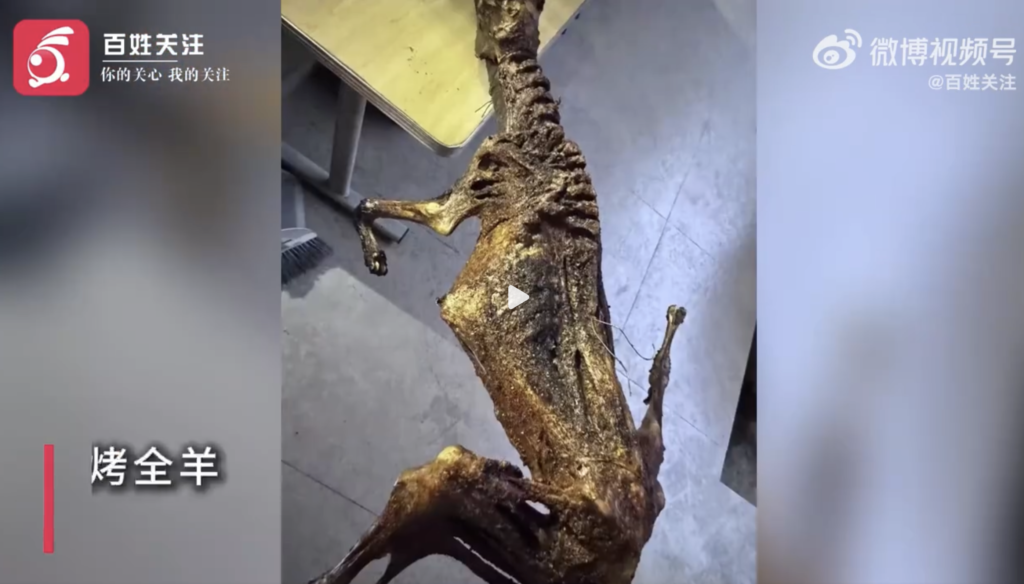
In a recent incident in Mianyang, Sichuan, a tourist spent 1,600 yuan (approximately $230) on a whole roasted lamb at a local guesthouse, only to be disappointed when the dish was served mostly as a skeleton with barely any meat. This situation arose during a visit by a woman, Ms. Zhang, and her friends on November 17, when they checked into the guesthouse in Pingwu County and ordered the highly anticipated dish.
Upon their meal’s arrival, Ms. Zhang was shocked to find that the roasted lamb consisted primarily of bones, yielding less than one tael (about 37.5 grams) of meat. The experience starkly contrasted with her expectations of enjoying a hearty meal.
The guesthouse’s management responded to the complaints, explaining that the lamb served was indeed a whole lamb but unfortunately had been overcooked, resulting in a dry product. As a gesture of goodwill following the incident, they offered the guests a complimentary roasted chicken valued at 300 yuan as well as several side dishes. The owner further stated that Ms. Zhang did not voice any complaints during the meal and had even taken home the leftover food. After the news broke, the owner proactively offered to compensate the tourists with 500 yuan, but this offer was declined.
As this consumer dispute gained attention, local cultural and tourism authorities in Pingwu County confirmed they had received reports regarding the situation and are currently investigating the matter to verify the claims.
The incident quickly became a trending topic on various media platforms, with numerous netizens expressing skepticism regarding the guesthouse’s assertions. Many pointed out that a typical roasted lamb has a natural loss rate of about 30% to 40%, making it implausible for an entire lamb to emerge as merely a skeleton.
A certified blogger remarked that footage released showed the lamb’s joints appearing completely white and devoid of any connective tissue, raising questions about the guesthouse’s claims of it simply being overcooked. Other commentators humorously noted the impossibility of a lamb having a 0% body fat ratio prior to cooking, further implying that the lamb had likely been stripped of its meat before the serving. Speculations also included that the lamb could have been leftover from previous customers, being repurposed and overcooked in the process.
One notable lawyer with a following of nearly 9.6 million on social media slammed the situation, stating that the real issue at hand was not merely the meat but rather the integrity and trustworthiness of the establishment. He questioned how a once-whole lamb could shrink down to just a skeleton, calling for a thorough investigation into the supply records, slaughter documentation, weight measurements during marination, and surveillance footage from the kitchen, as well as checking the condition of dishes served to other customers during that time.
Consumers have the right to be informed about the true nature of the services they receive, as well as to expect quality assurances, fair pricing, and accurate measurements. The transformation of 1,600 yuan worth of lamb into nothing but a bare framework suggests not merely overcooking but a severe shortfall in product quantity.
If it is established that the guesthouse knowingly misrepresented the weight and quality of the lamb while charging the full price, this could constitute fraud. Under such circumstances, consumers may be entitled to seek triple the amount in damages, with a minimum compensation of 500 yuan being applicable even if the calculated damages fall short. Therefore, the potential threefold amount for the 1,600 yuan translates to 4,800 yuan, which far exceeds the offered 500 yuan.
As the investigation unfolds, it remains to be seen what conclusions will be drawn and how this incident will impact local businesses and customer trust in the hospitality industry in the region.