
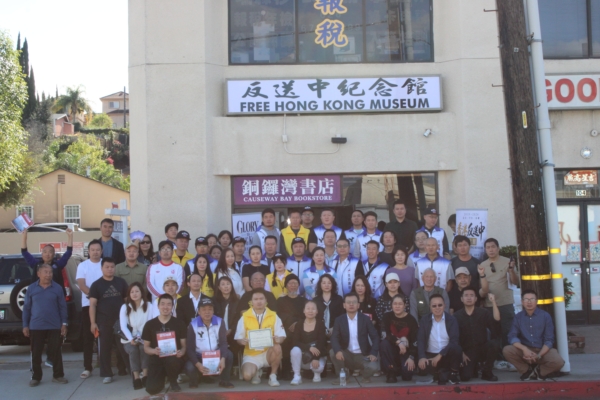
The “Free Hong Kong Museum,” dedicated to commemorating the 2019 anti-extradition protests in Hong Kong, has recently established its presence in Los Angeles County. Last Saturday, a significant gathering took place in Monterey Park, where pro-democracy activists, human rights advocates, and individuals concerned about the future of democracy in Hong Kong came together to unveil the new museum.
Monterey Park is known as the “first suburban Chinatown” of the United States and has historically attracted a large number of immigrants from Guangdong and Hong Kong. The new museum is located at 300 South Garfield Avenue, Suite 111.
Participants highlighted that the 2019 anti-extradition movement marked a pivotal chapter in the struggle of Hong Kong residents for freedom, democracy, and the rule of law. It also stands as a symbol of resistance against autocracy for Chinese people around the world. The establishment of this permanent memorial in the Western United States aims to preserve this historical moment, honoring the sacrifices made by the people of Hong Kong in their quest for freedom. Moreover, it seeks to inform the international community about the Chinese Communist Party’s betrayal of its “one country, two systems” promise and its ongoing human rights violations. The museum is a commitment to ensure that the memories of these struggles are not forgotten and that the spirit of resistance is passed down through generations.
The museum’s opening coincides with renewed attention on the situation in Hong Kong. On November 5, a Hong Kong court handed down a harsh ten-year prison sentence to prominent pro-democracy figure Joshua Wong for “conspiring with foreign forces to endanger national security.” This verdict has drawn condemnation from multiple foreign ministries across Europe and North America, who have urged the Hong Kong government to cease its unjust prosecutions under the National Security Law. Amnesty International has also warned against normalizing the criminalization of peaceful activism.
Dr. Cheung Tsun-chu, the museum’s director, articulated the perspective that freedom is not a privilege bestowed by the powerful; it must be fought for through sustained effort and struggle. He asserted, “The struggle of the people of Hong Kong serves as a model for all Chinese people: if we do not fight back, authoritarian powers can strip away our democratic freedoms at any moment.” He emphasized that the museum serves as a reminder to the world of the sacrifices made by the people of Hong Kong, ensuring that the spirit of “Liberate Hong Kong, Revolution of our Times” continues to inspire the Chinese community across the globe.
Vice Director Lau Kwong-hin noted that the museum provides a platform for remembering history and passing on the spirit of freedom, enabling more people to understand the anti-extradition movement and to appreciate the importance of the rule of law, freedom of speech, and judicial independence.
Simultaneously, a “Support Joshua Wong” event was held at the venue, reflecting on Wong’s journey, from his early involvement in social movements as a youth to his current imprisonment while remaining steadfast in his beliefs. The organizers affirmed that the Chinese Communist Party and the Hong Kong government aim to create a chilling effect through prolonged incarceration, attempting to erase the memory of the protests. The establishment of this overseas museum serves as a powerful counter to these oppressive tactics.
Designer Leung Ching-ching, who lived in Hong Kong for ten years, personally witnessed the city’s transition from freedom to a state of repression. During the anti-extradition protests in 2019, she observed people of all ages—elders, students, and children—taking to the streets to demand the fulfillment of the promised “one country, two systems.”
Leung expressed sorrow over the many individuals who have been arrested, imprisoned, or forced into exile as a result of their activism. She voiced a strong sense of injustice regarding the heavy sentence imposed on Joshua Wong and hopes that more people will raise their voices for him. Her involvement in the museum’s creation stems from a desire for people to remember the sacrifices made for freedom: “As long as we do not forget and do not give up, there is still hope for Hong Kong.”
Volunteer Fung Ying emphasized that the museum will preserve the memory of the Hong Kong people’s struggle for freedom, allowing more individuals to understand Hong Kong’s past and future, while collectively advocating for human rights, democracy, and liberty. Lu Qian-kun, who admires the resilience of the Hong Kong people, also hopes that the museum will serve to keep the spirit of their struggle alive.
In conclusion, attendees urged the international community to continue paying attention to the plight of political prisoners in Hong Kong, calling for concrete actions to pressure governments worldwide to demand the immediate and unconditional release of Joshua Wong and all political prisoners incarcerated for their beliefs.