
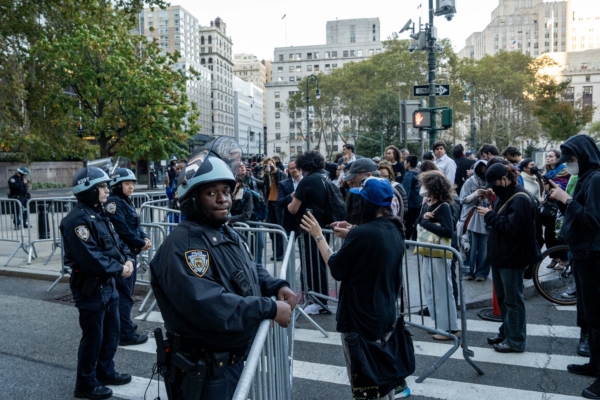
New York City Mayor Mamdani has announced the disbandment of the Strategic Response Group (SRG) within the police department, which has been in charge of managing protest-related law enforcement activities. This decision has sparked significant concerns among members of the Chinese community regarding public safety. Many individuals have taken to social media platforms like WeChat to voice their anxiety, expressing fears that such measures could severely compromise residents’ security.
In light of the mayor’s decision, discussions have erupted within various community groups, where individuals question the ability of law enforcement to swiftly regain control if mass protests were to escalate into violent riots. They are asking, “Who will protect innocent citizens, pedestrians on the street, shop owners, and our property?”
Concerns have been raised about New York potentially witnessing scenes of street violence similar to those seen in Paris and other major cities, leading to chaos filled with looting and vandalism. Many believe that ensuring the safety of citizens and their property is a fundamental responsibility of the government, underscoring the importance of addressing such issues before tragedies unfold.
Members of the Chinese community have also called on residents to pay close attention to these policy changes, urging them to communicate their opinions to their city council representatives. They are advocating for public hearings where residents can learn more about the proposed reforms and their possible implications. Some critics argue that the police reforms promoted by Mamdani carry a distinctly leftist political slant, potentially exposing New York to even higher risks concerning public safety.
Former Mayor Eric Adams, who served for four years, publicly opposed the disbandment of the SRG on social media. He pointed out that New York has historically avoided the large-scale violent riots that have plagued cities like Paris, attributing this success in part to the presence of the SRG. This specialized unit, composed of professionally trained officers, has the capability to intervene quickly before protests spiral out of control, thereby protecting citizens, businesses, peaceful demonstrators, and law enforcement personnel.
Adams emphasized that “peaceful protest is a constitutional right, but violent riots are criminal behavior. Confusing the two is a dangerous dereliction of duty on the part of leadership.”
Regarding the city’s plans to introduce unarmed civilian conflict resolution teams and restrict police resources, Adams expressed his personal support for conflict de-escalation measures. However, he made it clear that “conflict de-escalation is a strategy; it cannot replace the police’s ability to confront violence.” He strongly asserted, “You cannot reason with a brick flying through a storefront window, negotiate with a Molotov cocktail, nor can you send social workers in place of trained law enforcement officers to deal with violent offenders.”
Adams raised critical questions that he felt the city government had failed to address: Without a specially trained team to handle such dangerous situations, how can the safety of New York City residents be guaranteed? When peaceful protesters are attacked, shops are vandalized, and officers are surrounded and assaulted, “who will respond? At what speed? What kind of training do they have? What equipment are they equipped with?” He noted that these are not hypothetical questions; rather, they are essential in determining whether dangerous situations can be controlled or if the entire community risks descending into chaos.
With 22 years of experience in law enforcement, Adams is keenly aware of the fine line between protecting the public’s right to protest and allowing individuals to exploit that right as a cover for violent activities. “The right to protest does not include the right to intimidate. Safeguarding citizens’ freedoms should never come at the expense of public safety.”
In closing, Adams issued a stark warning: While city hall may view the disbandment of the SRG as a political victory, should violence erupt, the cost will not fall on politicians and activists; it will be borne by the attacked police officers, small business owners whose livelihoods are destroyed, peaceful demonstrators caught in chaos, and innocent citizens simply wishing to return home safely. “Public safety in New York City should not be a venue for ideological experiments. Our police are not expendable, and city hall needs to retract this decision before New York residents pay a heavy price.”