
Despite being millions of kilometers away from Earth, scientists have developed a considerable understanding of Mars’ geological conditions. They have largely identified the types of minerals present and the geological processes that have shaped the planet over time. Yet, every so often, a simple scrape of the surface can reveal an entirely new enigma.
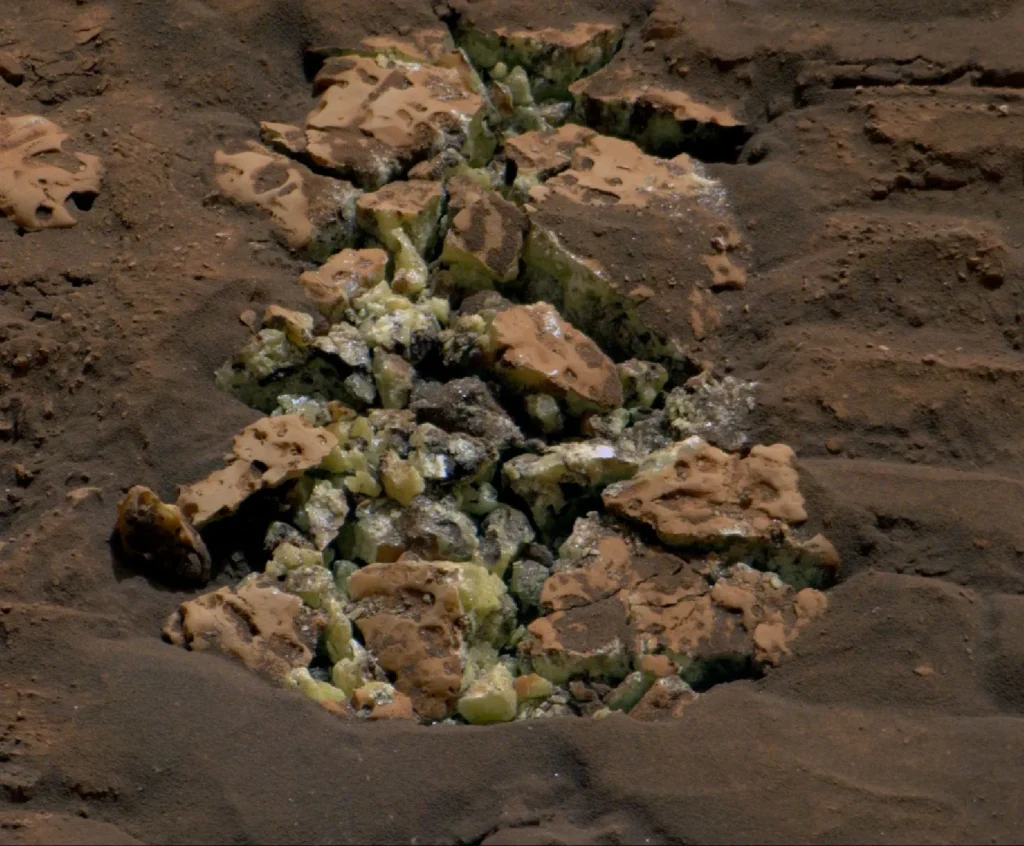
In 2024, NASA’s Curiosity rover, weighing 899 kilograms, rolled over a seemingly unremarkable rock in the Gediz Vallis waterway. When the rock cracked under pressure, it unexpectedly emitted a faint yellow glow, surprising NASA scientists. Inside the rock was found high-purity elemental sulfur crystals, commonly known as sulfur.
This unexpected finding confounded the scientific community for a time. However, two recent studies have finally provided critical clues about the origin of this rare mineral.
According to official data released by NASA’s Jet Propulsion Laboratory (JPL), while sulfates containing sulfur and oxygen are relatively common on Mars, this marks the first time that pure elemental sulfur has been discovered on the red planet. Furthermore, numerous similar rocks were scattered throughout the surrounding area.
Ashwin Vasavada, a project scientist for Curiosity at NASA’s Jet Propulsion Laboratory, remarked, “Discovering a stone formation made entirely of pure sulfur is akin to finding an oasis in the desert.” On Earth, large deposits of pure sulfur are typically associated with high-temperature volcanic or hydrothermal activities. However, there is no evidence that such high-temperature environments ever existed in Gediz Vallis, raising questions about the mineral’s origins.
In 2026, significant studies were published to piece together clues about ancient Martian conditions related to these unique deposits of pure sulfur.
**Ancient Volcanic Gases and Erosion:**
In a paper released in June 2026 in the journal Science, a team led by planetary scientist Scott VanBommel from Washington University in St. Louis, alongside geochemist Jeff Berger from NASA’s Johnson Space Center, analyzed observational imagery and chemical data from a region about 2,100 square meters in size.
Due to Mars’ lower gravity, the Curiosity rover is equivalent in weight to a 341-kilogram object on Earth. Even so, it was able to easily crush these rocks, indicating that their composition is quite fragile and likely of local origin. Researchers hypothesize that sulfur-containing gases released by ancient volcanic activity were trapped in ice-crystal structures called “clathrates” beneath Mars’ surface. As erosion sculpted Gediz Vallis, the pressure was released, allowing gases to escape and react chemically, ultimately forming pure sulfur without the need for high temperatures.
Geological evidence suggests that these sulfur deposits formed between 3.1 billion and 2.8 billion years ago.
**Room-Temperature Acidic Water Chemical Reactions:**
In another study published in July 2026 in Geophysical Research Letters, a team led by atmospheric scientist Jiawei Wang from Cornell University discovered through experimentation that mixing dissolved sulfides with hypothesized ancient Martian perchlorates in room-temperature acidic water could also produce tiny yellow crystals of elemental sulfur.
The experiments indicated that lower concentrations of perchlorates are favorable for the formation of pure sulfur, and the hydrogen sulfide required for the reaction could also originate from underground gas reservoirs.
Sulfur is an essential element for all life forms; many organisms on Earth utilize sulfates to produce amino acids that make up proteins. Though microbial activity on Earth can produce elemental sulfur, Wang’s experiments demonstrated that on Mars, pure sulfur can form through abiotic chemical reactions without biological participation.
Currently, scientists have yet to find any definitive signs of life on Mars; however, the emerging array of chemical substances, hydrological evidence, and past habitable conditions offer valuable insights into the early evolution of the planet. As co-lead researcher Berger stated in a press release from Washington University in St. Louis, “Mars provides us with a frozen snapshot from billions of years ago. We can examine and reflect on the long geological epochs in ways that are not possible on Earth.”