
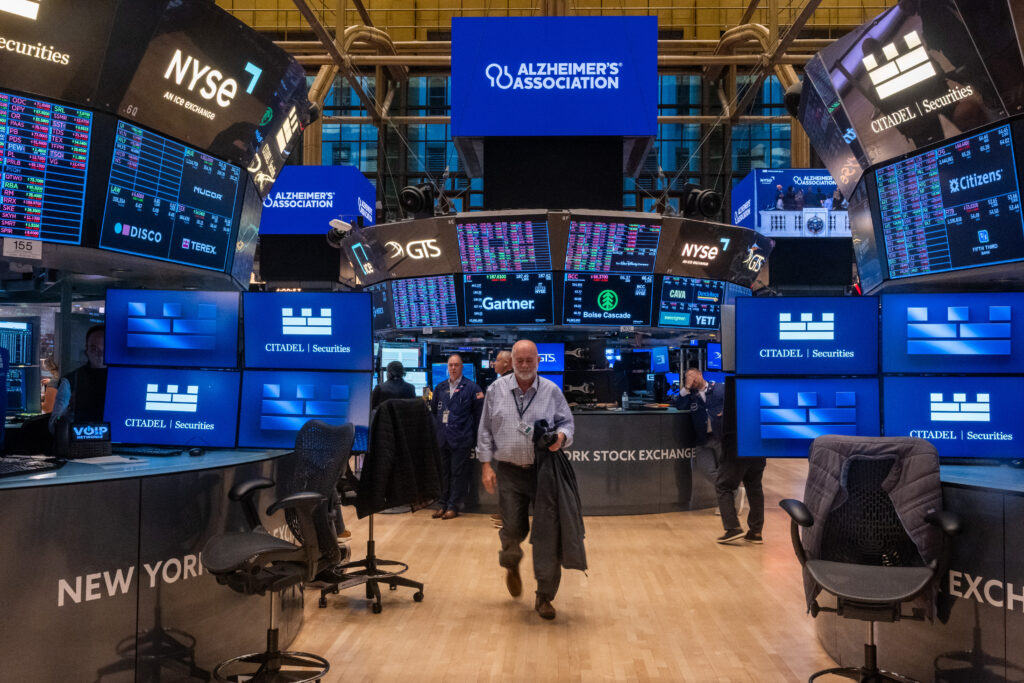
On November 16, the U.S. stock market experienced a significant downturn, with the Nasdaq index falling by 2.49% and the Philadelphia Semiconductor Index plummeting by 5.3%. The turmoil stemmed from ongoing personnel issues at Nvidia along with the tightening of regulations governing U.S. exports of artificial intelligence (AI) chips to China. This combination has resulted in a state of continued market instability. On the following day, Taiwan’s stock market briefly dipped below the 40,000-point threshold, while markets in South Korea and Japan also faced declines.
The recent sell-off has extended beyond individual companies. The Nasdaq has retreated over 10% since its record closing high on October 6, officially entering a corrective phase. Investors now face two critical challenges: Nvidia’s upcoming earnings report and the initial public offering (IPO) of Anthropic.
On Monday, the Dow Jones Industrial Average suffered a decline of 739.38 points, or 1.41%, closing at 51,608.17 points. Meanwhile, the S&P 500 dropped by 1.92% to finish at 7,416.59 points, and the Nasdaq Composite closed down 2.49% at 24,509.76 points. Both the S&P 500 and the Nasdaq recorded their third consecutive day of losses.
The semiconductor sector was hit hardest, with Nvidia’s stock falling by 4.1%. Other major players in the industry also suffered, with Intel and Micron Technology each down over 7%, Advanced Micro Devices (AMD) dropping 5%, and Sandisk experiencing an approximately 8% decline.
AI cloud computing firm CoreWeave saw its stock decline by 6.1%, while Nebius fell by 7.6%. Major tech companies such as Dell and Super Micro Computer reported drops of 7% and 6.9%, respectively, while Oracle’s stock was down about 5%. Alphabet, Amazon, and Meta all witnessed declines ranging from 2.4% to 4.1%.
In Taiwan, stocks associated with the semiconductor supply chain also came under pressure. The American Depository Receipts (ADR) of Taiwan Semiconductor Manufacturing Company (TSMC) fell by 6.34%, while ASE Technology’s ADR dropped by 7.74%, and United Microelectronics Corporation’s (UMC) ADR was down by 6.88%.
The sell-off spread to the financial sector, affecting major firms like Morgan Stanley, Goldman Sachs, and JPMorgan Chase, which all reported declines of over 2%. In the Nasdaq market, 3,697 stocks declined, while only 1,131 advanced. The volatility index, or VIX, which measures market expectations of future volatility, spiked by 25% during trading on Monday, reaching a one-week high of 24.05.
Analysts from Baird noted that the situation has been rapidly evolving over the past few weeks, stating, “Some days, AI-related stocks surge significantly, but then they plunge the next day.” They suggested that investors are not engaging in a panic sell-off, but rather are searching for other investment opportunities.
The technology sector in Asia was not immune to the selling pressure either. On Monday, the Taiwanese market plummeted by 2,635.04 points, or 6.03%, closing at 41,040.08 points. Early trading on Tuesday saw further declines, with the index dropping as low as 39,786.45 points, breaching the critical 40,000 mark.
However, buying activity in major stocks such as TSMC later helped the market rebound temporarily. By 10:09 AM local time on Tuesday, the weighted index had climbed to 40,565.82 points, just 474.26 points below the previous close, reflecting a decline of 1.16%.
During Tuesday’s early trading session, South Korea’s KOSPI index fell by 2%, while Japan’s Nikkei index dropped 1.3%. The MSCI Asia-Pacific index, excluding Japan, declined by 0.63%.
Goldman Sachs analysts remarked that sentiment surrounding AI investments has shifted notably over the past month. They indicated that discussions with clients have revealed a level of pessimism about AI that hasn’t been seen in many years, signaling that such sentiments are now more pronounced in investment allocations and valuations.
The performance of semiconductor stocks, which had seen impressive gains earlier in the year, has also notably cooled. The Philadelphia Semiconductor Index experienced a year-to-date increase of 106.6% in mid-June but has since tapered to approximately 43%.
On Monday, the U.S. Department of Commerce introduced new measures limiting Chinese companies’ access to advanced AI chips through offshore data centers. The new restrictions affect the export of advanced chips to data centers in countries such as Thailand and Malaysia, which had previously allowed Chinese firms to lease the computing power necessary for training AI models.
Meanwhile, Nvidia continues to grapple with issues at the leadership level. Founder Jensen Huang resigned from his role as CEO last week following allegations of extramarital activities and reports implicating one woman in suspected espionage activities linked to the Chinese Communist Party. Sources quoted by CNBC indicated that Nvidia’s board of directors is currently not considering Huang’s return to his former position and is focused on investigating whether his actions pose a risk to national security or the confidentiality of the company.
U.S. Treasury Secretary Scott Bessent also called for Nvidia to undergo significant restructuring and seek a new CEO from outside the company. Nvidia is set to release its third-quarter earnings report after the U.S. stock market closes on November 17. Analysts project that the company’s revenue will reach $109.1 billion, reflecting a year-over-year increase of 90.4%.
However, market participants are concerned not only about the quarterly results but also about the operational outlook following Huang’s departure, along with the potential risks posed by investments in AI infrastructure, financing issues, and export controls.
Jay Woods, Chief Market Strategist at Freedom Capital Markets, told CNBC, “Strong earnings cannot address all the questions surrounding Jensen Huang’s departure.” He pointed out that Nvidia has been led by the same CEO for 33 years and must now demonstrate that the company can continue to achieve results even without its founder’s leadership.
UBS analysts similarly believe the market will pay closer attention to Nvidia’s future growth, AI industry financing, and risks associated with export controls rather than focusing solely on the quarterly earnings report.
Meanwhile, AI company Anthropic is expected to go public later this week. According to CNBC, the company is aiming for a valuation of approximately $14 billion, with an anticipated share price between $70 and $78. This IPO will serve as another gauge of the market’s acceptance of high valuations for AI companies.
The policy outlook of the Federal Reserve also remains a key factor influencing the market. According to the CME’s FedWatch tool, market participants estimate a 95.7% chance that the Federal Reserve will raise interest rates by 25 basis points in December.
The U.S. dollar index rose slightly to 103.61 on Tuesday, nearing a high not seen since April 2025. The Japanese yen came under pressure around the critical exchange rate of 160 to the dollar as the market remained attentive to potential interventions by Japanese authorities in the foreign exchange market.
In the commodities market, concerns regarding the outlook for AI investments led to a drop in copper prices, which fell to a four-month low overnight.
U.S. crude oil futures traded down 0.41% at $85.37 per barrel during early Asian trading on Tuesday. Signs of restored oil transportation through the Strait of Hormuz have fueled expectations of a supply surplus, although recent attacks on oil tankers emphasize the risks facing Middle Eastern oil exports.
Spot gold also saw a slight decline of 0.1%, settling at $3,852.62 per ounce.