
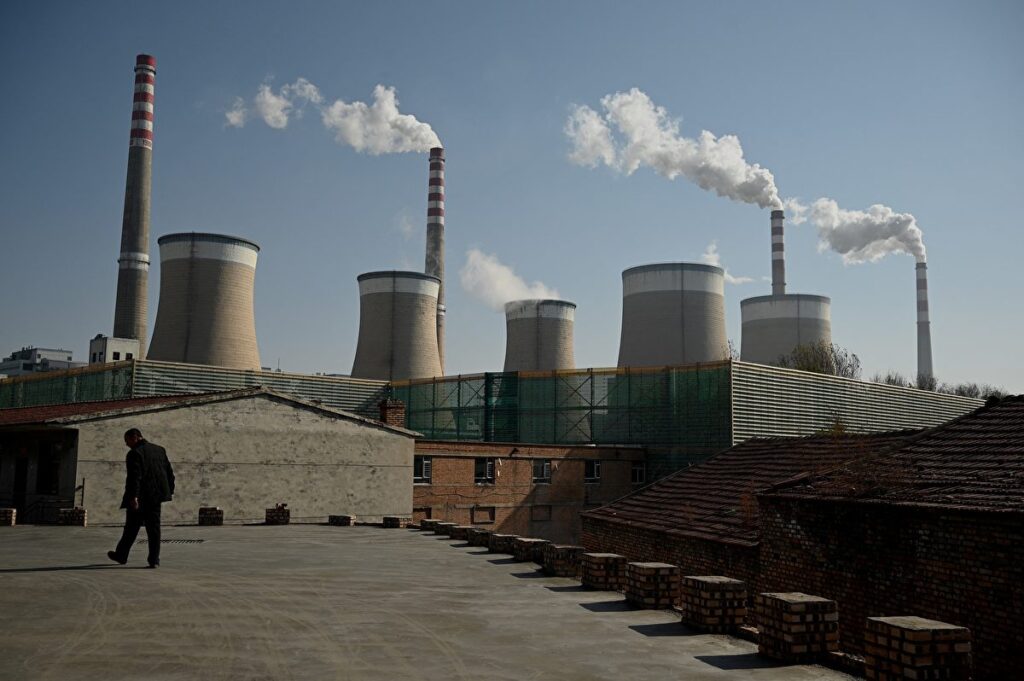
On November 4, the Chinese government’s intervention in Guangdong Province’s state-owned enterprise Zhuhai Huafa Group has raised alarm over the increasing accumulation of debt among state-owned enterprises (SOEs) without significant profit growth.
This rescue operation illustrates the implicit state guarantees that allow SOEs to incur rising debts while the returns on these investments remain stagnant. Investors tend to lend money under the assumption that the Chinese government will prevent the companies from defaulting on their obligations. In instances where corporations are unable to repay, the government distributes the losses across trust investors, banks, and other state-owned entities, rather than acknowledging these losses directly.
In late October, reports emerged concerning overdue repayments on trust products associated with Huafa Group, as well as applications for loan extensions from banks. This triggered the most severe credit sell-off in China in two years. As the largest state-controlled enterprise in Zhuhai City, Huafa Group has incurred an interest-bearing debt of approximately 404.7 billion yuan (around $61 billion).
The director of the Zhuhai State-owned Assets Supervision and Administration Commission, Zou Hui, announced on November 4 that the city has already provided over 40 billion yuan (about $6 billion) in financial support to Huafa Group. Moreover, they are coordinating an additional 70 billion yuan (approximately $10.5 billion) in financing.
Huafa Group had previously engaged in significant borrowing to expand beyond Zhuhai but failed to keep pace with growth in profits. Under the leadership of Chairman Li Guangning, who took office in 2012, the group ventured into major cities and diversified into six business sectors. Between 2019 and 2023, Huafa Group’s assets more than doubled, reaching 729.6 billion yuan (about $109 billion), and revenues also increased by over 100%, amounting to 179.5 billion yuan (around $27 billion).
However, net profits attributable to the parent company’s shareholders only rose by a modest 36%, increasing from approximately 1.3 billion yuan to 1.77 billion yuan (around $195 million to $265 million). By 2023, Huafa Group was generating only about 1 yuan of profit attributable to shareholders for every 100 yuan in sales—a slim profit margin insufficient to sustain a debt load exceeding 400 billion yuan.
In a market economy, even if a company’s assets and revenues double, a minimal increase in profits is unlikely to convince profit-driven private banks to finance further expansion. Nevertheless, in China, state-owned enterprises, despite offering low returns, often secure loans because lenders expect government support.
China’s Joint Credit Rating Agency has assigned Huafa Group a high rating of “AAA.” However, this domestic credit rating system has come under scrutiny for its serious overpricing—by March 2026, 27% of over 6,000 bond-issuing organizations in the country held an AAA rating. Notably, China Vanke Group, headquartered in Shenzhen, retained its domestic AAA rating even after seeking payment extensions from bondholders at the end of last year.
On the other hand, Fitch Ratings, one of the three largest international rating agencies, has assessed Huafa Group’s creditworthiness at “BBB,” a drop of eight rating levels from AAA, edging closer to the lowest tier of investment grade. Although this classification is still viewed as secure enough for conservative investors such as pension funds and insurance companies, it is based on Fitch’s expectation of “very likely extraordinary support from the government.”
When a rating reflects anticipated government bailouts rather than the company’s intrinsic ability to repay debt, it cannot accurately assess whether borrowers can honor their obligations through their own profits. Consequently, capital continues to flow into projects that cannot sustain themselves, shedding light on the numerous highways, high-speed rail lines, “ghost cities,” and heavily-indebted local governments across China.
In 2025, Huafa Group reported a loss of 16.9 billion yuan (around $2.5 billion). By the end of June 2026, its unrestricted cash reserves were down to 50.1 billion yuan (about $7.5 billion), while its debt coming due within a year amounted to 154.1 billion yuan (around $23 billion). This rescue plan mainly involves the acquisition of Huafa Group’s assets by other state-owned enterprises.
Furthermore, a special task force in Zhuhai is ensuring that the company meets its obligations regarding publicly traded bonds while extending repayment terms and lowering interest rates on its trust products and bank loans, shifting the cost burden to trust investors and banks.
Zhuhai’s strategy depends heavily on Huafa Group’s abilities in developing and financing infrastructure and social housing projects. Across China, local governments have entrusted this task to entities known as Local Government Financing Vehicles (LGFVs). In 1994, China’s Budget Law prohibited most local governments from borrowing directly, leading them to create these SOEs to secure funding for roads, industrial parks, and housing projects.
Unfortunately, many of these projects fail to generate adequate returns to repay their loans. The International Monetary Fund (IMF) has found that many LGFVs exhibit weak debt repayment capacity structures, estimating that between 39% and 46% of their debts require restructuring.
The persistence of lending to these entities stems from the belief that the government will step in to avert defaults. State-owned companies and LGFVs account for over 90% of the recent issuance of corporate bonds in China, with banks holding approximately 75% of LGFV-related debt.
In November 2024, Beijing approved a plan to convert 10 trillion yuan (about $1.5 trillion) of hidden local debt into official local government bonds. However, IMF officials contend that this plan does not fundamentally resolve the debt repayment challenges facing borrowers.
Reports indicate that by the end of 2025, over 82% of LGFVs will be removed from local financing platform lists, with operational debts declining by more than 74%. Many LGFVs are exiting the market through name changes, mergers, and debt swaps.
Despite some restructuring, these companies still carry the burden of debt without developing sustainable profitability to service it. Even post-restructuring, the IMF projects that total LGFV debt will increase from 64.4 trillion yuan at the end of 2023 to 71.4 trillion yuan by the end of 2025 (approximately $10.7 trillion).
Chinese banks are hastening the absorption of losses. In the first nine months of 2026, the banking sector wrote off 1.27 trillion yuan (about $190 billion) in loans, representing a 23.3% increase compared to the same period the previous year. This has assisted in maintaining the officially reported low rates of non-performing loans.
The Industrial and Commercial Bank of China (ICBC), the country’s largest bank, allocated 81.9 billion yuan (approximately $12.3 billion) in the first half of the year for bad debt write-offs, marking the largest scale in recent years.
According to a report from the China Joint Credit Rating Agency, some banks still possess substantial amounts of overdue loans and new loans used for old debt repayment, indicating an underestimation of actual risks in their loan classifications. As of June 30, 2026, China’s total debt represented 308.2% of its economic output.
The revenue from land sales in Zhuhai has plummeted by 94% over five years, while Huafa Group’s debts have surged to 8.2 times the city’s annual budget income. The staggering debt burden of Huafa Group, amounting to $61 billion, illuminates the cost of state guarantees at all levels of government. The ability of China’s state-owned enterprises to rely on debt preservation is entirely dependent on the financial strength of local governments. Unfortunately, these governments are now unable to repay their debts, yet the loans continue to flow unabated.