
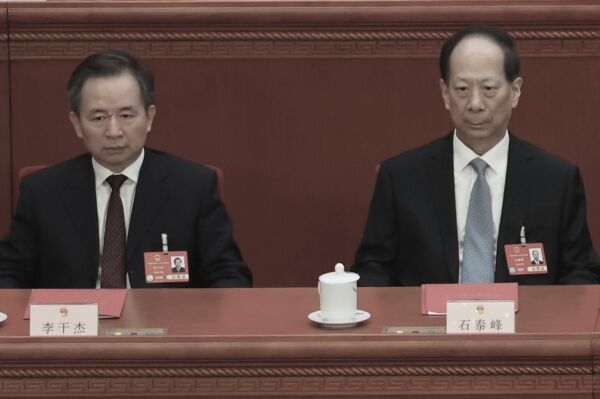
On November 11, 2026, China’s state-run media, including the People’s Daily and Xinhua News Agency, published an article by Li Ganjie, a member of the Chinese Communist Party’s (CCP) Political Bureau and Minister of United Front Work. This article, titled “Strictly Implementing Democratic Centralism,” is part of a series interpreting the essence of the Fifth Plenary Session of the 20th Central Committee of the CCP.
Since Xi Jinping ascended to leadership at the 18th National Congress, he has significantly consolidated power, establishing himself as the “core” of the party and breaking tradition during the 20th National Congress to seek a prolonged dictatorship. Unexpectedly, Li Ganjie’s article extensively discussed “democratic centralism,” emphasizing the need to enhance supervision of the “top leader.” The usage of sensitive phrases such as “eliminating the practice of making decisions without prior discussions” and “preventing individuals from rising above the organization” has drawn substantial attention due to its implicit references to Xi Jinping.
The article consists of nearly 4,950 words and mentions the term “democracy” 75 times, including 54 references to “democratic centralism” and six mentions of “intra-party democracy.” According to Li, democratic centralism is the fundamental working system of the leadership group, and collective leadership is its specific manifestation. He insists that the adherence to the Party Central Committee’s centralized and unified leadership must be treated as the highest principle. Additionally, he advocates for the implementation of a system requiring the “top leader” to express their opinions last, stating that major decisions, important personnel appointments, significant project allocations, and large financial expenditures must undergo collective discussions and resolutions, thereby preventing the “top leader” from imposing personal views on the team.
Interestingly, while the article mentions “General Secretary Xi Jinping” six times and references “the Party Central Committee with Xi Jinping at its core” twice, it notably omits phrases like “the four consciousnesses” and “the four confidences,” which are often used to bolster Xi’s authority.
The article also emphasizes the importance of reinforcing oversight of the “top leader,” focusing particularly on whether they adopt a “one-man rule” or a “patriarchal style” leadership, and whether the system for expressing opinions in reverse has been implemented. Li argues for a lifetime accountability system for major decision-making, which he claims would compel leaders to respect power and be cautious in their decisions.
Li’s heavy focus on “democratic centralism” and the necessity of enhancing oversight over the “top leader” has led to speculation about its relation to Xi Jinping. Following Xi’s rise to power, he effectively marginalized the functions of the Political Bureau Standing Committee and the State Council through a system of “group governance” to further centralize authority. During the Sixth Plenary Session of the 18th Central Committee, he became known as the ‘Xi Core.’ Moreover, the so-called “two establishings and four consciousnesses” solidified Xi’s position of “unilateral control.”
Xi has promoted the “Belt and Road” initiative, engaging in extensive foreign aid and investment, and frequently announced substantial aid packages and debt relief programs at various international forums, often referred to as his “money-splashing” strategy. Projects such as the Xiongan New Area and ambitious investments in semiconductor manufacturing have ultimately faced significant challenges, labeled as “unfinished projects.”
Li specifically highlights the requirement for collective decisions regarding “major project arrangements and large financial expenditures,” which may hint at criticism of Xi’s expansive and often criticized spending strategies.
The Fifth Plenary Session concluded on October 29, 2026. Compared to the communiqués from previous plenary sessions following the 20th National Congress, the Fifth Plenary Session’s report displayed significant anomalies. It notably lacked references to the “two establishings and four consciousnesses.” Instead, it reiterated the concept of “democratic centralism” five times, whereas the Fourth Plenary Session’s report from October 2025 and the Third Plenary Session’s report from July 2024 made no mention of it.
On November 1, 2026, Xinhua News Agency released the so-called “Decision on Persistently Promoting Comprehensive Strict Party Governance” passed by the Fifth Plenary Session. This decision stated the need to establish supervisory regulations regarding the “top leader” and leadership teams, forbidding practices of “one-man rule” and “patriarchal style” leadership, while also emphasizing that there should be no pressure to maintain the personal authority of the “top leader.”
The persistent emphasis on monitoring the “top leader” within the Decision inevitably raises concerns about Xi Jinping’s power crisis, who had previously been referred to as the one in control. Since mid-July 2024, rumors about Xi’s health and power uncertainties have circulated, resulting in multiple purges of senior officials connected to the Xi family. The media’s promotion of Xi and the “core” narrative has noticeably diminished.
Moreover, military media outlets have echoed dissenting views, stressing democratic centralism, collective leadership, and intra-party democracy, explicitly opposing the idea of “one-man rule,” while also refraining from mentioning the accountable system of the Military Commission chairmanship. Alongside this, the Political Bureau and the party’s media have emphasized the need for centralized and unified leadership.
The Central Committee claims to be the highest organ of power within the CCP. The Fifth Plenary Session broke from tradition by not affirming “two establishings and four consciousnesses,” instead underscoring “democratic centralism,” which, along with the Decision to supervise the “top leader,” signals potentially sensitive shifts in the political landscape within Zhongnanhai.
Li Ganjie’s writing underscores the importance of strictly adhering to reporting to the Party Central Committee regarding significant decisions, major issues, and important circumstances, while striving to eliminate the practice of making unilateral decisions without prior consultation. This focus draws parallels to Xi’s handling of senior military officials, such as Zhang Youxia and Liu Zhenli, who faced investigations after being absent from a key meeting.
The circumstances leading to the investigations of Zhang and Liu were shrouded in controversy, involving rapid government announcements and allegations of violating leadership accountability. Suggestions arose that Xi may have bypassed traditional decision-making processes to adopt unconventional means of control.
Li Ganjie himself has a background in nuclear reactor engineering and has risen through the ranks with the support of Chen Xi, a close ally of Xi Jinping. He has held several prominent positions, including Minister of Ecology and Environment and Governor of Shandong Province, eventually being promoted to the Political Bureau during the 20th National Congress.
Now at 62 years old, Li Ganjie was a popular candidate for the Politburo Standing Committee during the 21st National Congress. However, following unexpected changes in his role, the influence of the Shandong and Tsinghua factions within the CCP has been facing scrutiny, leading to speculation regarding infighting at higher levels.
Regardless of any internal dynamics, Li Ganjie’s article resonates with the communique of the Fifth Plenary Session and the accompanying Decision, once again highlighting the precarious nature of Xi Jinping’s hold on power, which may be more complex than external perceptions suggest.