
Not every story of scientific discovery resembles an adventurous thriller like “Indiana Jones.” Sometimes, a prehistoric fossil can lie undisturbed for a staggering 63 years, only to unexpectedly resurface and challenge the long-held scientific consensus.
When the fossil in question has the potential to reshape our understanding of dinosaur history, the excitement surrounding the discovery is amplified tenfold.
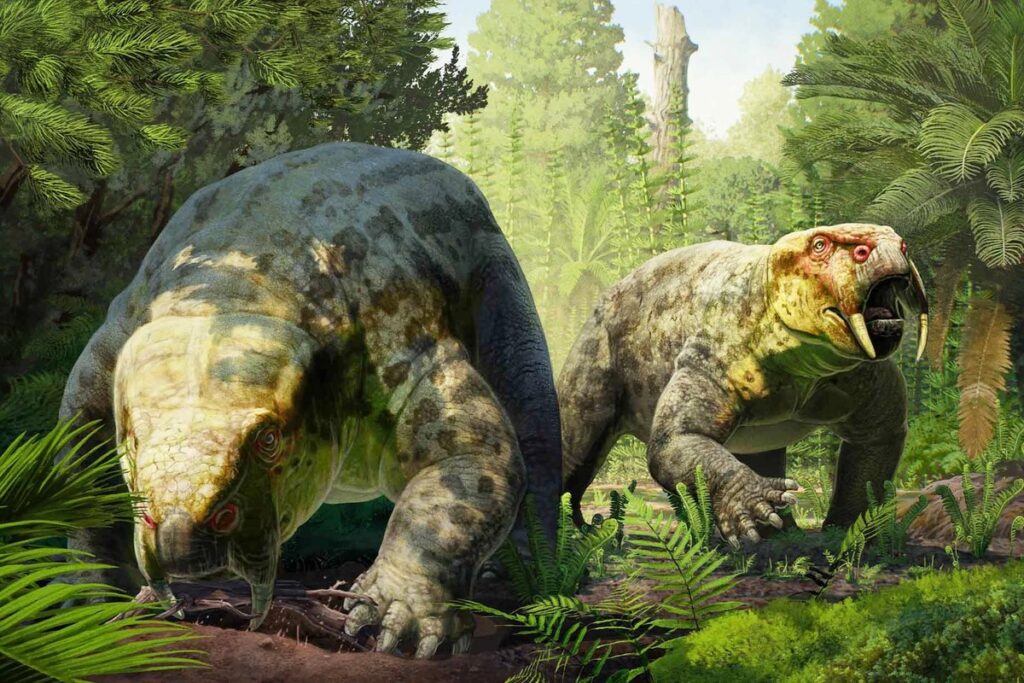
This particular fossil, however, does not belong to a dinosaur but to a synapsid, a group of early relatives of mammals that roamed the Earth around 240 million years ago. These creatures were herbivorous and possessed massive tusks. Over sixty years ago, a skull from this large prehistoric animal was uncovered in a rugged valley in East Africa. It has only recently begun to unveil its secrets to scientists.
In September, researchers at the University of Bristol in the UK announced the discovery of an entirely new prehistoric species, naming it Dinodontosaurus isiyavamanda (Dinodontosaurus meaning “terrifying tooth lizard,” with isiyavamanda translating to “land of the Wamanda people”). This creature hails from Tanzania and lived during the Triassic period, approximately 240 million years ago, which is considered by scientists to be the time when dinosaurs first emerged.
The story takes us back to 1963 when British paleontologist Barry Cox led a research team to Tanzania, where they discovered a trove of ancient skeletal fossils in an area previously thought to be one of the oldest habitats of early dinosaurs. These fossils were identified as belonging to a close relative of prehistoric mammals.
Subsequently, the researchers collected these bones and sent them to the Natural History Museum in London. Unfortunately, for decades, the identity of these fossils remained uncertain and they underwent minimal study, ultimately being set aside. Meanwhile, the scientific community’s understanding of this ancient African habitat went unchallenged.
A turning point came in 1994. At that time, a student from University College London, Nigel Larkin, revisited this long-forgotten fossil specimen while writing his master’s thesis. He found this unique creature, with a turtle-like beak and tusks reminiscent of a wild boar. Larkin named this mammal-like relative Ruhuhuungualasaurus, a rather unusual name. However, his findings were never formally published and the thesis was relegated to a library shelf, gathering dust, and fading from scientific memory for another thirty years.
With the advent of advanced technology, the research now faced a resurgence. Hady George, a PhD student from the University of Bristol, reignited the investigation by employing advanced techniques that the 1963 expedition team could not have imagined. Utilizing a micro-CT scanner, George continued the work that Larkin had left unfinished. Through X-ray scanning of the rock, he successfully reconstructed an accurate three-dimensional model of the internal structure of the skull.
The scanning technology peeled away the layers of rock from the fossil’s surface, revealing an intriguing biological structure: a unique, ball-like ridge at the center of the animal’s upper jaw. This specialized internal feature acted like a powerful plant-cutter, enabling the creature to shred tough Triassic vegetation, providing it with a feeding capability distinct from other herbivores in the same ecosystem. This subtle yet significant adaptation indicated that this species did not need to compete for food with its contemporaries but carved out its own unique niche.
“Over the past thirty years, significant advancements have been made in relevant technologies. Today, we can perform in-depth studies on such fossil specimens using techniques like micro-CT scanning, which we could hardly have imagined in the 1990s. Additionally, international collaboration has become much more feasible,” stated Larkin in a press release. “And what’s thirty years when compared to the age of this prehistoric specimen? It’s merely a blink of an eye.”
The unusual skull also led to a groundbreaking discovery. Its internal structure matched that of a prehistoric creature known as the “terrifying tooth lizard,” which once inhabited regions across the Atlantic, in present-day Brazil and Argentina. This revelation prompted researchers to draw a remarkable conclusion.
Since this robust herbivore inhabited both Tanzania and South America at the same time, it suggested that the geological strata from which the fossils were sourced formed during the same period, marking them as geological “twins.” In ancient times, these two landmasses were part of the supercontinent Gondwana, adjoined, allowing these creatures to migrate freely between them.
“This discovery links the fossil layers of Tanzania and South America, indicating they share the same geological age,” noted George. “This helps confirm that the earliest dinosaur candidate fossils found in Tanzania may not predate similar fossils discovered in South America, further clarifying the timeline of dinosaur origins.”
George’s finding also challenges longstanding historical perceptions contained in textbooks. Scientists had already established the precise ages of the South American strata but discovered that the Tanzanian layers were actually up to 10 million years younger than previously believed.
Even more surprising, this revelation could change humanity’s understanding of dinosaur history. The Tanzanian strata house some of the oldest dinosaur fossils known to exist. However, the presence of this peculiar mammal-like relative—characterized by a pig-like snout and turtle beak—suggests that these layers are significantly younger than once thought. This infers that many renowned early dinosaurs may have existed much later than previously accepted.
The timeline of dinosaur origins has suddenly been profoundly rewritten.
The creature identified by Larkin was later renamed Dinodontosaurus isiyavamanda in tribute to the local indigenous people of Tanzania.
“This discovery underscores that re-examining museum collections of fossil specimens can also transform our understanding of the past, equally significant as discovering new fossils in the wild. It highlights the importance of properly preserving these invaluable records of Earth’s history,” remarked Mike Day, director of the Natural History Museum in London.
Reflecting on the journey over these decades, it becomes evident that this groundbreaking discovery is, in fact, a relay race of scientific inquiry spanning several generations. The specimens collected from the expedition 63 years ago, utilizing rudimentary equipment and enduring harsh conditions, ultimately had to wait patiently on the museum shelves until technological advancements could unlock the secrets of the fossil.
In 1963, Cox and his team pitched tents in the challenging conditions of the Ruhuhu Basin in Tanzania, conducting fieldwork for several months. To safely transport the fossils back, they wrapped the bones in wet newspapers and plaster. At that time, they had no idea what they had truly discovered.
Thirty years later, Larkin opened that long-sealed box, and with his keen observational skills, he discovered the skull contained structures that had never been documented scientifically before. Yet, with his findings not formally published, the fossil remained an obscure specimen, all but forgotten by the scientific community.
Now, this prolonged scientific journey has finally culminated in a satisfying conclusion. This is not a repudiation of past research but rather a continuation and enhancement of the work of previous scholars. George built upon the findings derived from the fossils discovered by Cox, merging them with Larkin’s earlier hypotheses, eventually confirming the discovery through rigorous research.
Most gratifyingly, this month, when the research was published in the Journal of Vertebrate Paleontology, Larkin was also listed as a co-author alongside George.
Waiting thirty years is undoubtedly long, yet sometimes a delayed revelation is better than none at all.