
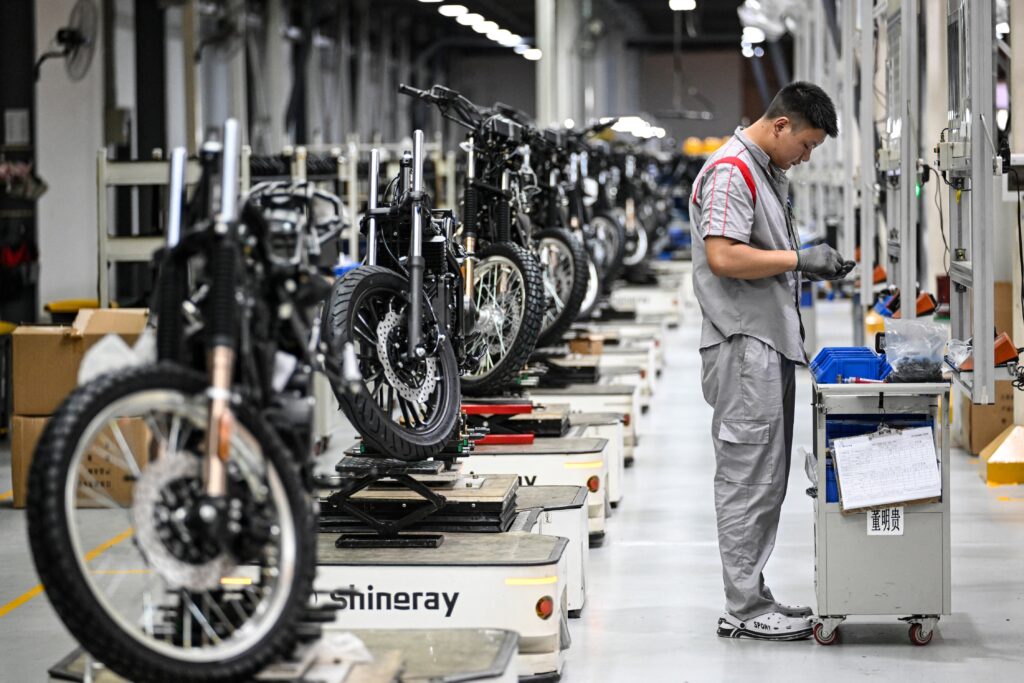
Recently, the Chinese Communist Party’s official publication, “Qiushi,” has published a series of articles acknowledging the “strong supply and weak demand” issues plaguing China’s economy, as well as the fundamental structural contradiction of focusing heavily on production while neglecting distribution. While the CCP is starting to recognize the root causes of these problems, it continues to prioritize industrial upgrading in its policy focus. Scholars have pointed out that genuine reforms in income distribution would go to the heart of the current system’s interest structure and resource allocation power. This approach, which could potentially undermine the regime’s stability, is something the CCP is unwilling to undertake.
On November 10, the General Administration of Customs of the CCP released data indicating a staggering 35.2% year-on-year growth in exports for October, bringing the trade surplus for the first ten months of the year to over $1 trillion, surpassing last year’s milestone by a month.
While China’s export numbers hit record highs, domestic consumption has not kept pace, leading to significant discrepancies that have become a focal point of international economic debate. Economic entities such as the United States and the European Union have characterized the phenomenon of China’s manufacturing sector outstripping market demand as a form of “structural overcapacity” resulting from insufficient domestic demand.
The official narrative from the CCP has consistently rejected such characterizations, arguing that foreign countries use these claims as a pretext to impose trade protectionism. Nevertheless, the “Qiushi” journal has published a series of articles indicating that the economy is indeed facing “strong supply and weak demand.” However, these articles emphasize that the issue is not due to insufficient policy intensity but rather reflects a transition in the development stage.
On November 3, “Qiushi” featured an article by Guo Chunli, the deputy director of the Chinese Academy of Macroeconomic Research, who highlighted “strong supply and weak demand” as a prominent issue currently restricting the operation of China’s economy.
The article further identified four major contradictions affecting the Chinese economy: First, the persistent orientation towards heavy production while neglecting distribution has not fundamentally changed. Second, the export-oriented characteristic remains prominent. Third, an investment-driven mindset continues to function. Fourth, there remains an inertia towards scaling up operations.
Moreover, the article acknowledged that the long-standing focus on production over distribution has made it difficult to increase the proportion of labor remuneration in the primary distribution process. Consequently, burdens related to pensions, medical care, and education have weakened consumer willingness.
An article published by Hong Kong’s “Sing Tao Daily” on November 12 pointed out that the party media has implicitly admitted to the existence of “overcapacity,” merely rephrasing it as “strong supply and weak demand” to create a distinctive term in economic discourse that aligns with CCP ideology.
Data from the National Bureau of Statistics of China also indicate that growth in resident income has not been effectively translated into consumption. In the first three quarters of 2026, the nominal growth of per capita disposable income nationwide was 5.3%, and after deducting price factors, the real growth was only 4.4%. During the same period, nominal per capita consumption expenditure grew by 3.6%, with a real increase of 2.7%. In both nominal and real terms, income growth exceeded consumption expenditure by 1.7 percentage points.
The situation among urban residents is even more pronounced, with income increasing by 4.5%, while consumption expenditure grew by only 3.0%. Additionally, the growth rate of the median income for residents was 4.6%, which falls below the average income growth rate of 5.3%.
Regarding the inability of income growth to adequately translate into consumption, Sun Guoxiang, a professor at the Department of International Affairs and Business at South China University, analyzed the situation, noting that for low- to middle-income families, limited wages and high living costs lead to insufficient disposable income. For the middle class, even if income remains stable, concerns regarding falling housing prices, job insecurity, and worries about retirement and medical expenses cause them to delay consumption.
He asserts that current insufficient income is a fundamental reason for weak consumption, and a lack of confidence in future income further suppresses consumer spending. Without improvements in income distribution, the employment environment, and social security, even short-term measures aimed at stimulating consumption are unlikely to foster sustained domestic demand growth.
The impressive export figures for October do not necessarily mean that all exporting companies are reaping significant profits. According to a Reuters report, Chen Lifeng, head of a clothing export company in Ningbo, stated, “We are almost left with no profits at all,” indicating that some export companies, despite relying on overseas orders to sustain operations, may still face squeezed profit margins.
Sun Guoxiang pointed out that increasing exports does not automatically correlate with rising profits for businesses; the core issue is overcapacity, which leads firms to lower prices in a competitive race, thereby continually compressing profit margins. Local governments may offer land, tax incentives, and industry subsidies to support companies in expanding production. However, there is no effective mechanism to translate corporate performance into employee salaries. He remarked, “China’s export prosperity does not necessarily equate to an improvement in the living standards of residents.”
Although Guo Chunli’s article in “Qiushi” identifies four structural contradictions within the Chinese economy and recognizes the issue of prioritizing production over distribution, it centers its policy recommendations on adjusting industrial structures, enhancing supply quality, and developing new productive capacities.
The article also proposes measures such as increasing the share of resident income in national income distribution, improving the proportion of labor remuneration, and perfecting social security systems. However, in comparison to the emphasis on adjusting industrial structures and enhancing supply quality, the discussion of income distribution and residents’ welfare reforms appears to be somewhat cursory.
In July of this year, Yin Yanlin, vice chairman of the Economic Committee of the National Committee of the Chinese People’s Political Consultative Conference, openly admitted in an interview that the phenomenon of “strong supply and weak demand” indeed exists, but fundamentally, it reflects an issue of “insufficient effective demand.” He reiterated that demand weakness precedes supply strength.
Yin Yanlin contended that consumption subsidies are not a fundamental solution, as the key lies in income growth. He advocated for economic growth to create more high-quality, high-income job opportunities to elevate resident income.
Sun Guoxiang further elaborated that while the CCP is not completely oblivious to income distribution problems, genuine reforms would challenge the current interest structure and resource allocation power of the economic system. He believes this presents a significant systemic barrier to reforms in income distribution.
If labor remuneration is substantially increased, along with expansions in social welfare and increases in resident income, resources that currently flow into government investments, corporate subsidies, and strategic industries will need to be reallocated. This could potentially affect corporate profits, local finances, and established interest relationships.
Sun Guoxiang noted that the CCP tends to treat the expansion of resident consumption and the improvement of resident income as separate issues. Policymaking often resorts to short-term measures like consumption subsidies and trade-in incentives to stimulate immediate purchasing behaviors rather than implementing income distribution reforms that would enhance long-term consumer capacity.
“Consumption subsidies may serve as a short-term stimulus tool, but they cannot replace the need for raising wages, improving income distribution, and strengthening social security,” Sun Guoxiang stated.
In addition to the existing interest structure, the government’s capacity to finance expanded resident welfare also poses a challenge for income distribution reforms.
Li Hengqing, director of the US Institute for Information and Strategic Studies, pointed out in an interview that the CCP government currently faces heavy fiscal burdens, with financial resources being quite tight and insufficient to support large-scale, sustained resident welfare expenditures.
Li Hengqing analyzed that expenditures in military and national security domains, foreign aid, and the extensive party and government system contribute to long-term fiscal expenditures. He noted that the CCP has continued to expand aircraft carriers, nuclear arsenals, and naval vessels in recent years, with spending on police and national security systems potentially exceeding military expenses.
Additionally, he highlighted that with over 100 million party members, the large-scale party and government structure creates ongoing fiscal responsibilities. Simultaneously, some local governments are experiencing declines in fiscal revenue, resulting in grassroots employees facing delays in salary payments and receiving limited subsidies.
Li Hengqing argued that given the government’s tightening finances, any attempt to enhance resident welfare and income through large-scale fiscal expenditures will confront funding source limitations. Without adjusting existing fiscal expenditures and reallocating resources, mere policy propaganda is unlikely to lead to sustainable improvements in residents’ welfare.
Regarding the economic governance strategies of the CCP, an article from Hong Kong’s “Sing Tao Daily” suggests that if external observers expect China to follow mainstream international practices, such as reducing or eliminating excess capacity, or as a means of increasing public income and consumption demand through measures like monetary easing and distribution reforms, they may find themselves disappointed once again.
Expert on Chinese issues, Yue Shan, stated to the Epoch Times that the CCP’s prescription for what they effectively consider “overcapacity” remains a contradictory logic that simply promotes further capacity production. The so-called Chinese-specific rationale they prepare is difficult to reconcile. However, the CCP fears disturbing the foundations of its authority, thereby rejecting reform; in doing so, they have missed opportunities for genuine reform. Consequently, it is not surprising that China’s economy remains trapped, possibly regressing over the next few decades.