
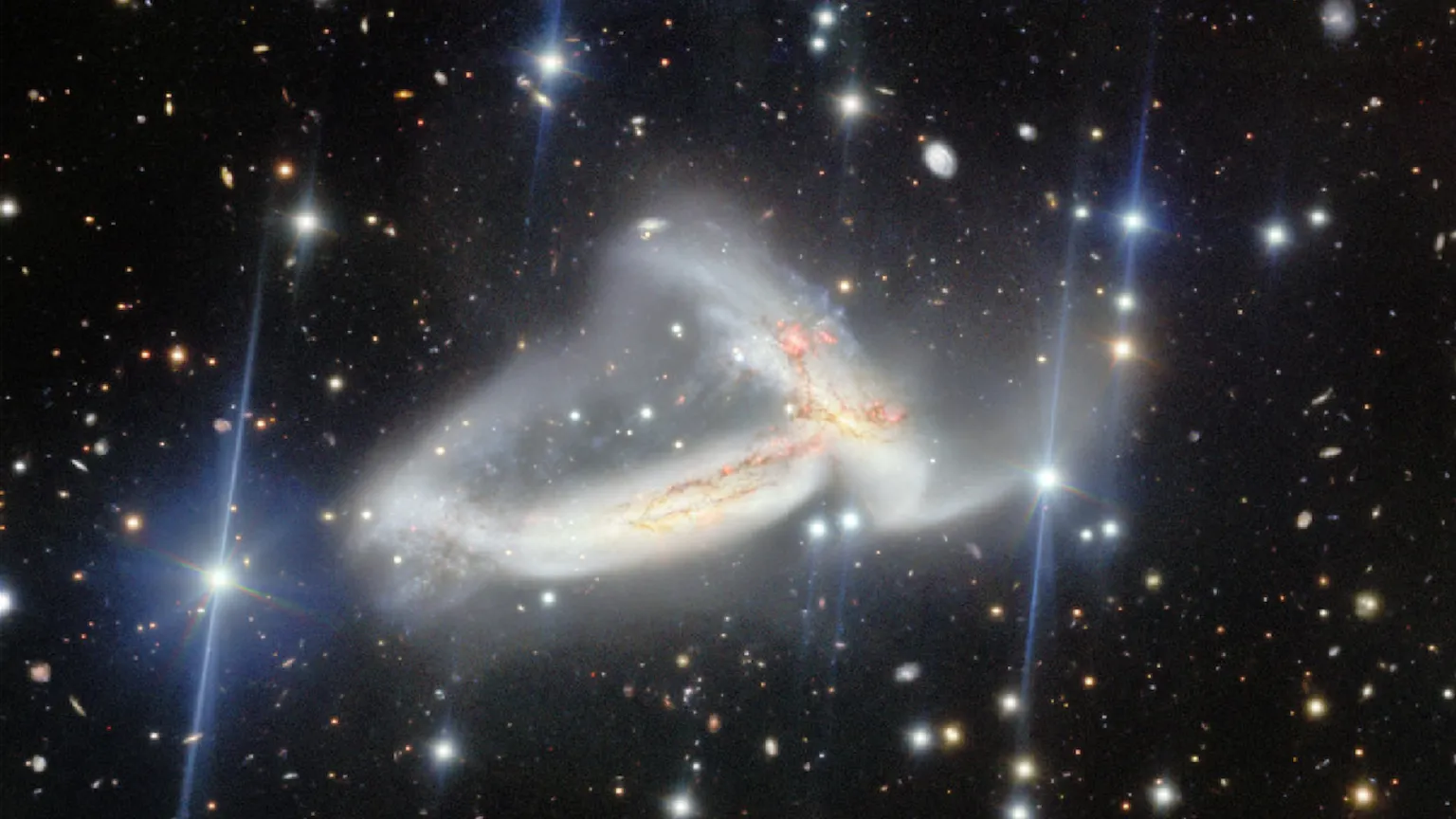
A group of high school students interning at the Hawaii Observatory have successfully captured through cutting-edge telescopes a pair of spiral galaxies undergoing a gravity collision over 200 million light-years away from Earth. The celestial bodies are identified in the astronomical community as NGC 7253, coincidentally positioned in the night sky at the overlap of the Pegasus constellation and traditional Hawaiian navigation constellation.
These students from Waiākea High School and Volcano School of Arts and Sciences participated in the local “Project Hōkūlani” in the fall of 2025 during their internship at the Gemini North Observatory facility in Hilo. They spent a week learning about observatory operations and astrophysical knowledge, and were granted the opportunity to select a deep space target for actual observation.
“NGC 7253 is a fascinating celestial body as it depicts the merging of two galaxies over billions of years,” intern Raiyan Rahman said. “But we specifically chose this target because it is one of the few that falls within the traditional Hawaiian constellation range.”
NGC 7253 (consisting of NGC 7253A and NGC 7253B) lies within the Western astronomical Pegasus constellation range and also falls within the traditional Hawaiian navigation constellation “Ka Lupe o Kawelo” (meaning “The Kite of Kawelo”). Throughout generations, Hawaiian navigators have relied on this sky to guide their way across the Pacific.
Despite being labeled a “galactic collision,” during the lengthy merging process, direct stellar collisions are rare due to vast spaces between stars. The intense reactions arise from the massive gas clouds and dust within the galaxies themselves.
Pulled by each other’s strong gravitational force, these neighboring spiral galaxies are inevitably drawn towards gradual merger. Under tidal forces, the gas clouds undergo intense compression triggering a large-scale “star formation burst.” The newly formed massive hot stars emit intense ultraviolet light, ionizing surrounding hydrogen gas, generating abundant H II regions. In the high-resolution images synthesized by the students, these regions where new stars are forming appear as bright and dazzling pink patches.
Astrophysicists estimate that these two spiral galaxies will completely merge into a single elliptical or irregular galaxy in around 1 billion years in the future.
This summer, three students from Keaʻau High School and Kamehameha Schools continued this research. Apart from image processing and data analysis, they integrated Hawaiian cultural insights, naming the colliding galaxies as “Nā ʻUhane Māhoe Huki Pū i ke Ola” (Roughly translated as “Twin Souls Collaborating to Create Life”).
This name perfectly encapsulates the essence of astrophysics: the collision of galaxies is not merely destruction, but the ionized hydrogen regions triggered by tidal forces are nurturing tens of thousands of new stars and planetary systems – truly a cosmic feast where life is co-created amid collisions.