
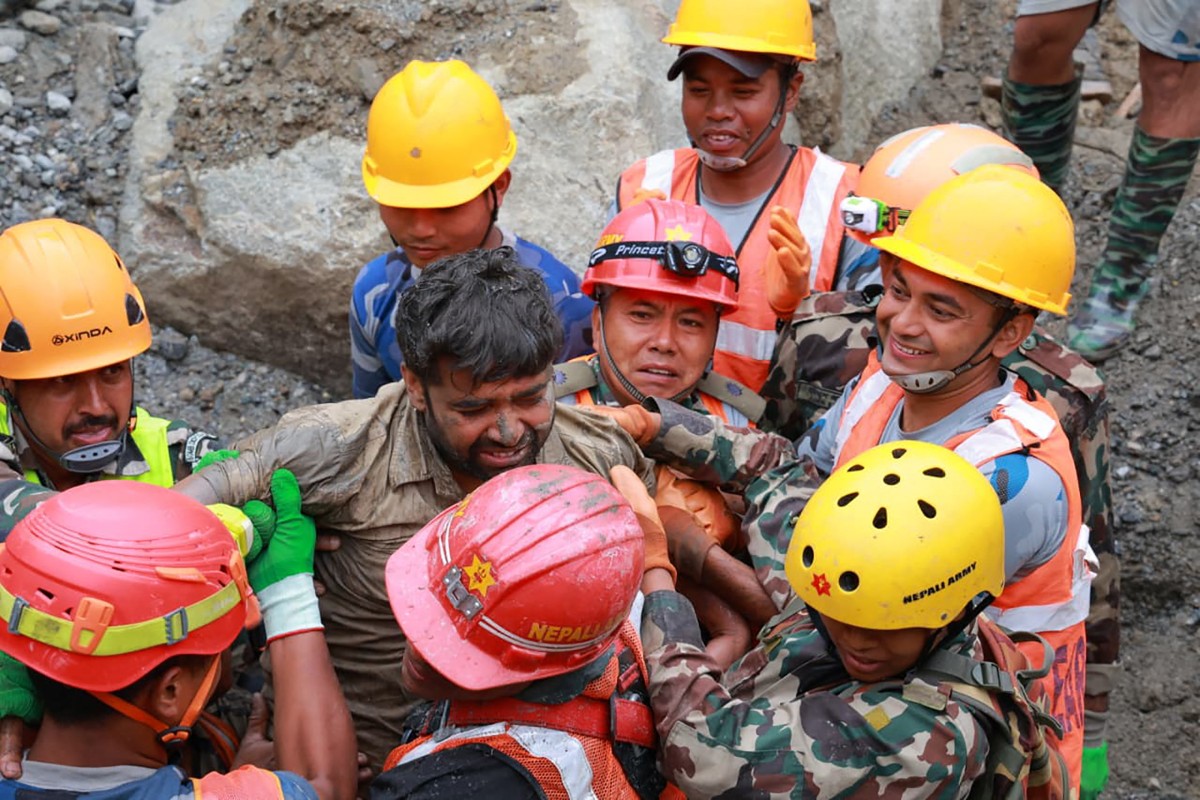
On September 4, 2026, the Bhotekoshi River in the Rasuwa region of Nepal was hit by destructive floods and mudslides. Both Nepal and the Tibet Autonomous Region of China have confirmed that at least 1300 people have lost their lives, with over 5300 individuals still missing.
According to reports from Reuters, Sanjay Sah was trapped inside a tunnel at the Trishuli-3A hydropower project. He is one of the two survivors who were rescued.
This 30-year-old man is currently recuperating at his sister’s home in Kathmandu. Prior to the disaster, he worked as a mechanical foreman at the Upper Trishuli 3A run-of-the-river hydropower plant operated by the Nepal Electricity Authority, where he had been working for over three years.
For the majority of the nine days following the mudslide, he was trapped in a multi-story building at the hydropower plant, located deep in the mountains.
After being discharged from the hospital last Friday, Sah shared in an exclusive interview with Reuters, “It was pitch dark, I couldn’t see anything. Most of the time, I kept my eyes closed. I was afraid that if I slipped or accidentally hit something, my eyes would get hurt, so I kept them closed for a long time.”
He mentioned that during his ordeal, he had no food and survived by drinking floodwater and water seeping from the rocks.
At times of despair, Sah turned to reciting scriptures. “I thought, even if death is inevitable, what’s the use of giving up easily?” Sah explained that by consistently chanting the name of God and reciting scriptures, he found a different kind of feeling, almost a spiritual experience. “I no longer felt fear, but rather inner peace and relaxation.”
In the six-story power plant building, there was an opening on the fifth floor where he could look down and shout, trying to confirm if there were other survivors, but there was no response.
He expressed, “Initially, I was very confident that rescue would come. Even as the days passed, that confidence never wavered. I kept telling myself I wasn’t alone, that I had family outside who must be going through agonizing moments.”
As a father of a two-year-old girl and married to a 26-year-old wife, he found strength in missing them and it boosted his morale. “I thought, even if death is certain, what’s the point of giving up in panic? So I kept chanting the name of God and praying.”
He shared his surprise at being rescued only on the tenth day. “I had completely lost track of time, feeling like I was living in another world. I thought only two or three days had passed. When I learned that it had actually been 10 days, I was shocked.”
In the darkness, he often bumped into things, getting cut and scratched by rubble, with broken light tubes and other debris scattered around, some of which even injured his feet.
The thick mud and debris brought by the flood buried the tunnel, rendering it unrecognizable. “Prior to the flood, I knew this place like the back of my hand, effortlessly navigating deep into the tunnel. But after the flood, the entire structure had changed, equipment washed away, boxes scattered, walls collapsed, rubble heaped into mounds, and the ground uneven. My familiarity with the tunnel was now pointless.”
Initially, he attempted to move around but realized he may end up in a more dangerous situation, so he opted to stay put. “So I retraced my steps, stayed where I thought was safest. And eventually, that’s where they found me.”
During the final hours before his rescue, he could hear sounds from outside. “I knew they would come, I knew the rescue operation would surely take place. I could hear some noises, sounding like drums beating.”
“I could hear the sounds of excavators working and the clanging of ladders. About 10 to 12 hours before being rescued, I could clearly hear people working outside. It gave me a glimpse of real hope.”
Kabir Maharjan, aged 45, was also trapped in the tunnel, currently receiving treatment alongside Sah at a military hospital due to more severe injuries. Shortly before the flood struck, Sah had encountered him.
“We didn’t have much time left, so we decided to climb higher instead of escaping downwards,” Sah recalled. “We believed that even in a major flood, the water level wouldn’t rise that high. When we reached the sixth floor, water started surging in from below. First, there was an air pressure impact, then the flood. In the chaos, we got separated, my phone was washed away, and I don’t know what happened to Kabir in the end.”