
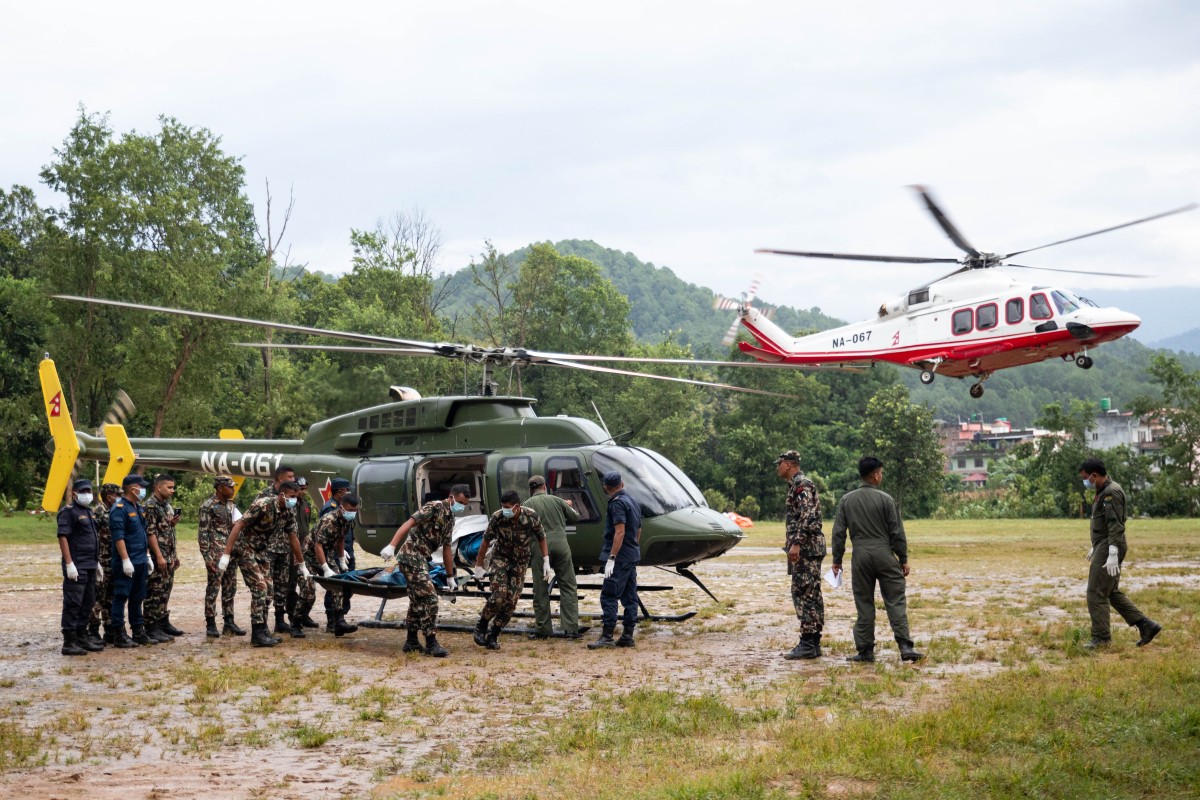
On Saturday, August 29th, the rescue work at the Nepal-Tibet border flood entered its fourth day. In the rescue center, many people anxiously await news of their loved ones. Currently, approximately 3,000 people are still missing, and the “golden window” for search and rescue has been closed.
The flood broke out abruptly on Wednesday, August 26th, sweeping in like a tsunami, instantly engulfing vehicles, houses, and people, creating a heart-wrenching scene. As of Saturday, the confirmed death toll on both sides of the Nepal-China border has risen to 676.
In the Nepalese capital of Kathmandu, relatives gather outside a government hospital, desperately seeking news of their missing family members.
Many people hold photos of their loved ones, frantically navigating between the service desk and the hospital notice board, carefully checking the list of injured patients, hoping to find any trace of their whereabouts.
Due to the steep terrain and narrow gorges in the disaster area, rescue operations face significant challenges. In such natural disasters, the 48 to 72 hours after the event are referred to as the “golden window” for rescue. It is during this critical period that rescue teams are most likely to find and save those still alive, trapped under rubble.
According to reports from The Associated Press, Dil Maya Lama stood outside the hospital service desk in tears, hoping to find news of her missing 26-year-old brother. Her brother worked as a driver for a hydroelectric company in Rasuwa. Following the disaster, she rushed from Ramechhap, approximately 130 kilometers (80 miles) away.
“I came here with a glimmer of hope, hoping to find him,” she said. “But there is still no word of him.”
In Nuwakot, military personnel posted lists of missing persons on the walls of the rescue center, with families gathering around.
Some people browse through the lists of missing and deceased individuals, taking photos, wiping away tears as they search for names.
Rajesh Kumar Ram anxiously searches for his son’s name on the list.
“I hold on to a shred of hope that my son is somewhere out there,” he said tearfully. “Maybe they will find him somewhere. I’m just waiting for that moment.”
Outside the rescue center, people walk along muddy streets, with traces of the disaster visible everywhere. On one street, a truck is stuck deep in the mud, with its cabin raised high.
CNN reported that local officials are struggling to deal with the increasing number of bodies. Decomposing bodies are being recovered, with morgues full to capacity. In Chitwan, a region in southern Nepal, authorities have had to collectively bury hundreds of unidentified bodies.
As heavy rainfall looms, experts and local officials warn that there could be another flood near the initial flood zone. A UK researcher told CNN that steep terrain, melting permafrost, the damage caused by the first landslides, and deposited debris are forming lakes, which could trigger another catastrophic flood.
On Saturday, the Nepal Tourism Board announced that the whereabouts of 187 foreign citizens have been determined, including 114 Indians, 27 Chinese, 20 Koreans, and others from the US, Europe, and the Gulf region. The announcement also stated that 420 foreign nationals are still missing.