
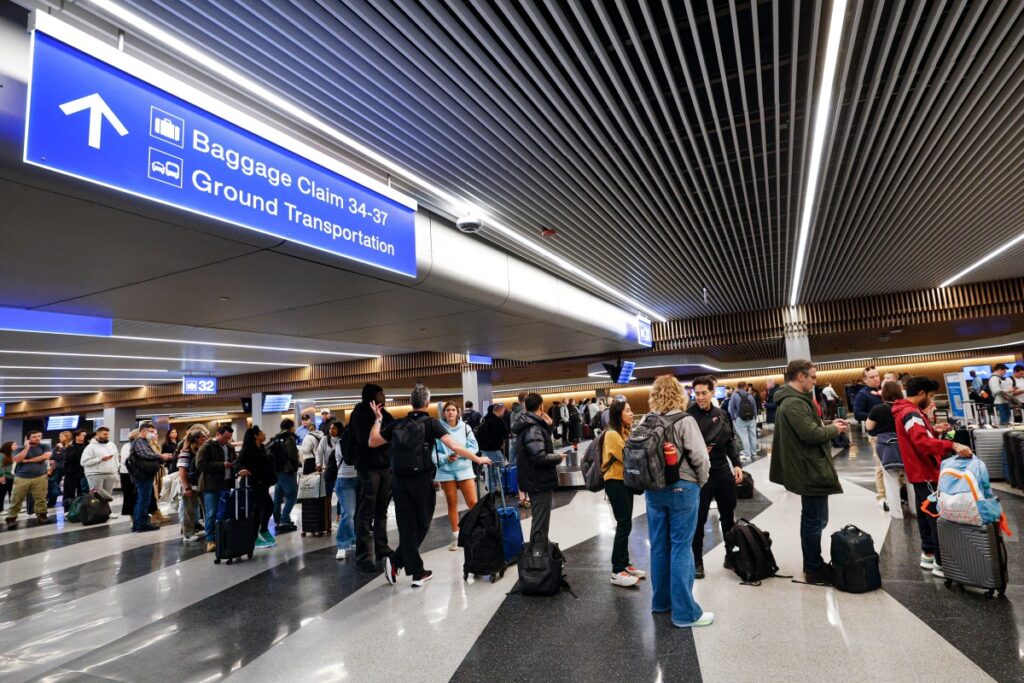
On Friday evening, around 8:15 PM Eastern Time, the nationwide ground stop in the United States was lifted, allowing some flights to resume operations from airports across the country. However, officials have warned that full recovery of air traffic after experiencing one of the most severe flight stop incidents in 25 years will take time. On Saturday alone, over 3,400 flights were canceled.
Transportation Secretary Sean Duffy announced during a press conference that outdated air traffic control equipment experienced a malfunction due to data overload, prompting authorities to implement a nationwide flight ban to ensure aviation safety. The Federal Aviation Administration (FAA) reopened U.S. airspace shortly after the ground stop was lifted, permitting airlines to resume their operations.
Nevertheless, the ripple effect stemming from the flight stoppages may continue for several days. Flight data tracking platform FlightAware reported that on Saturday, a significant number of flights were still canceled. By the time of reporting, 3,490 domestic and international flights had been canceled, along with 1,333 delayed flights.
Markwayne Mullin, the U.S. Secretary of Homeland Security, stated that international flights are currently being managed on a case-by-case basis. At the FAA’s request, European aviation authorities temporarily halted all flights to the United States from 5 PM to midnight Eastern Time on Friday.
For travelers wishing to continue their journeys, airlines are obligated to offer free rebooking onto alternative flights. If a flight is canceled and a passenger decides not to travel, airlines must provide a refund.
On Saturday morning, Terminal 3 of Heathrow Airport, the busiest airport in the UK, displayed at least three flights to the U.S. marked as “canceled,” including those to Dallas, Los Angeles, and Chicago.
Arrival displays indicated that many flights arriving from the U.S. faced cancellations or delays. One flight from San Francisco was expected to land at Heathrow around 12:50 PM local time on Saturday, nearly two hours later than originally scheduled.
Major airports across Europe were also impacted by the ground stop incident; however, the effects on the United States were particularly pronounced.
A travel expert told CNN that after the U.S. implemented a multi-hour nationwide flight ban on Friday, it might take “days, rather than hours” for air travel to return to normal.
“Air travel is incredibly complex. Air traffic control is like playing a three-dimensional game of chess,” Simon Calder, a travel reporter for the Daily Telegraph, explained to CNN. “Every link in the chain must operate flawlessly, especially during peak times.”
He elaborated that Friday afternoons represent the busiest period across U.S. airports throughout the week, resulting in “massive chaos” in transatlantic air traffic.
“There is no doubt that some people will have to wait until early next week to travel,” he said, noting that some passengers might even abandon their travel plans altogether, “simply canceling their trips.”