
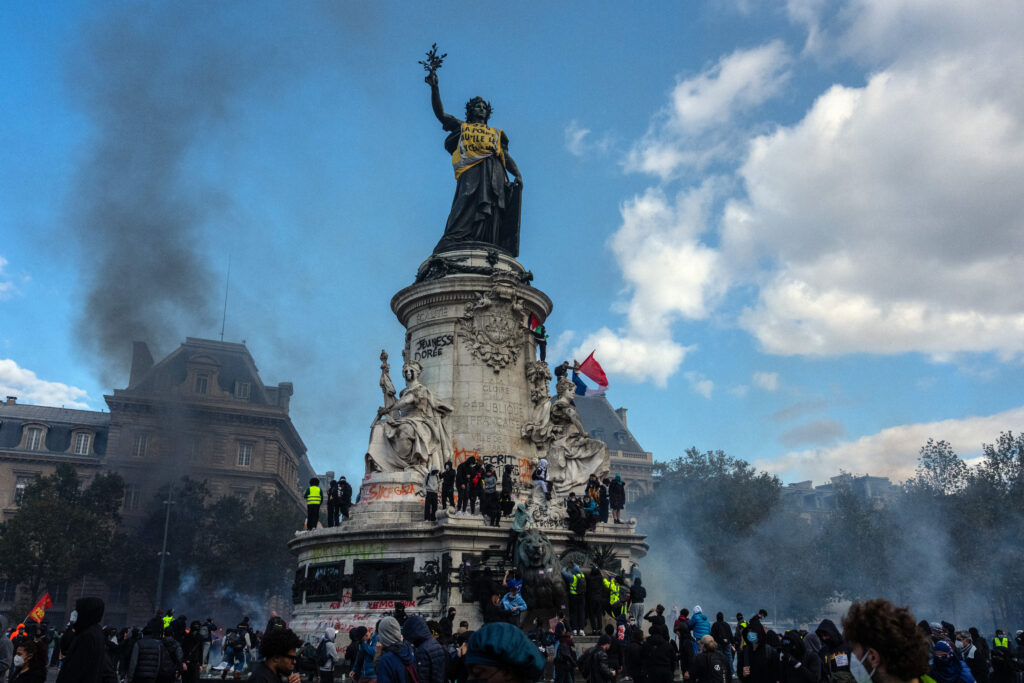
On November 14, the French Ministry of the Interior announced that over 100,000 people took to the streets nationwide to protest. This marked the fifth consecutive Saturday of large-scale demonstrations across France.
According to reports from news agencies, the Interior Ministry’s data indicated that approximately 106,000 individuals participated in the protests this Saturday, with around 24,000 of those in Paris, making it one of the least attended demonstrations in recent weeks.
However, student unions claimed that the total number of protesters across the country reached 200,000, with nearly 100,000 gathered in the capital alone.
The Ministry of the Interior also noted that roughly 70,000 police officers and gendarmes were deployed nationwide to oversee between 50 to 60 planned marches.
For more than a month, France has been engulfed in significant demonstrations, involving various groups including students, union members, and participants of the Yellow Vests movement.
On Saturday, protesters in Paris gathered at Place de la République, where some climbed statues to wave the French flag in a display of frustration over rising living costs and a police protection bill.
Despite the overall peaceful nature of the protests, police in Paris, Bordeaux, and Nantes resorted to deploying tear gas following instances where fireworks were set off by some attendees.
In Lyon, local officials reported that police intervened to protect a team of television reporters who were attacked by demonstrators.
Kenza, a 28-year-old asylum law expert from Toulouse, criticized the government’s response to the social unrest, deeming the suppression of demonstrators as unacceptable, particularly if the victims are children.
A primary demand from the protesters is opposition to a new police bill currently under parliamentary consideration. This legislation would provide increased legal protections for police and gendarmes using weapons in the line of duty.
Supporters, including political figures from the far-right party led by Marine Le Pen, argue that the bill aims to safeguard police defensive actions, ensuring they are not easily accused of excessive force.
Conversely, unions and activists warn that the bill would effectively serve as a “license to kill” for police, hindering the ability to launch investigations and making it more challenging to hold law enforcement accountable. In France, very few cases of alleged police violence actually make it to criminal court.
Sabrine Kharbach, a spokesperson for the student union, stated that the bill is set to be voted on next week, contending that it presumes that police who discharge their weapons are acting within the law.
Adrien, a 20-year-old cellist with a volunteer orchestral group in Paris, shared that tear gas was deployed near musicians participating in protests last month. He expressed that if police impunity is further broadened, the public would only grow more fearful.
While most of the recent gatherings have been peaceful, instances of violence and allegations of police brutality have surfaced, including claims of violence against vulnerable youth.
A lawyer representing at least 18 injured individuals announced plans to sue the Ministry of the Interior over police violence. The lawyer indicated that the aggression displayed by police during recent demonstrations has caused severe injuries to protesters’ hands, feet, and eyes.
The unions have rejected the government’s pledge to raise the minimum wage by 0.6%, characterizing it as mere “leftovers,” and have called for another strike on Tuesday, November 17. A member of the Yellow Vests movement expressed that the government is only offering crumbs when the people are seeking an entire bakery.
The largest demonstrations in recent weeks occurred last Thursday, led by unions that organized a strike resulting in over 500,000 participants taking to the streets across France according to official figures.
Recent polls indicate that President Emmanuel Macron’s approval ratings have fallen to their lowest since he took office in 2017, limiting the government’s ability to respond to protester demands while also aiming to reduce national debt.
As for the upcoming presidential election, polls suggest that the far-right is currently leading, with the hard-left candidate Jean-Luc Mélenchon in second place.