
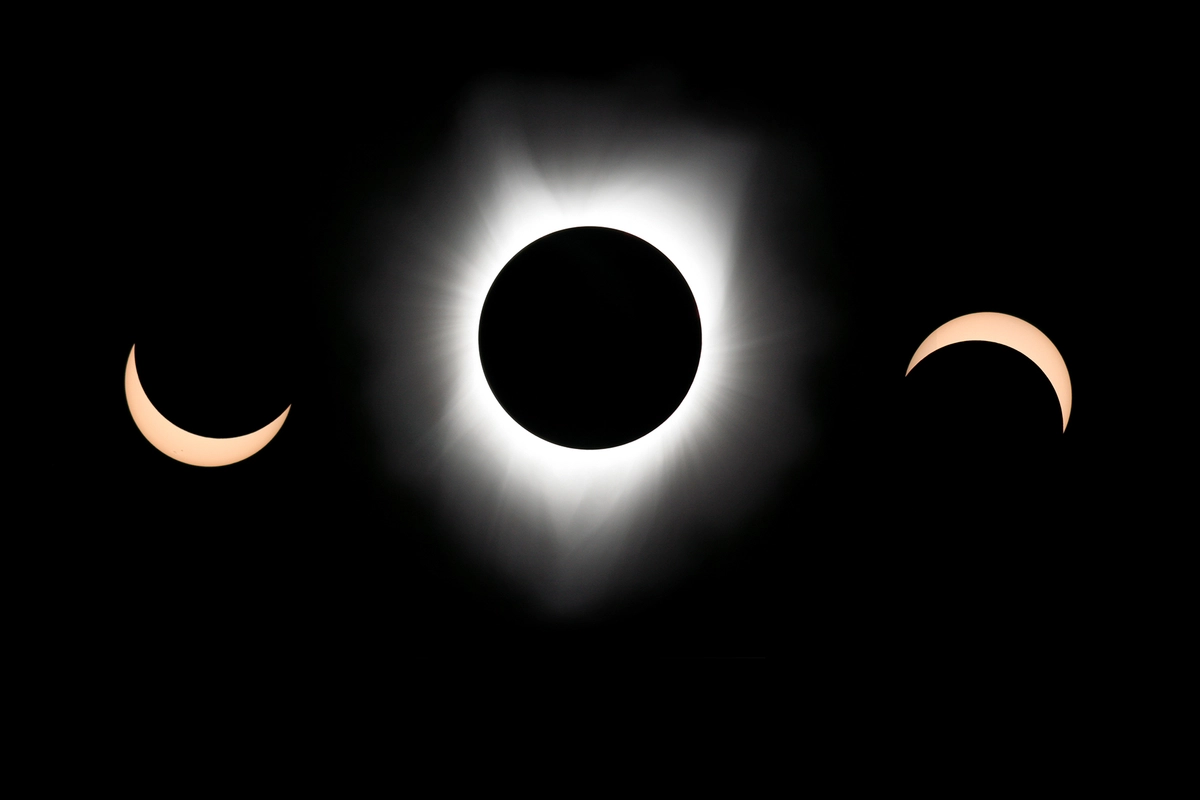
Jamie Carter is a seasoned astronomy writer and tour guide. To him, witnessing a total solar eclipse for the first time felt like the universe had a malfunction. The entire sky took on a twilight hue as if the sun were setting, animals abruptly ceased their activities as if night had fallen, and the sun turned into a black disk surrounded by a halo of light.
On August 12th, Carter will embark on another journey to chase a total solar eclipse, boarding a ship to the world’s largest island, Greenland, to serve as a guide and lecturer for the astronomical tour itinerary. This will be Carter’s ninth time witnessing totality—the brief moments when the moon completely obscures the dazzling disk of the sun.
“The total eclipse has the power to change people,” he told The Epoch Times, “I’ve seen people burst into laughter, others well up with tears, some left speechless in awe, and some just staring incredulously at the sky. Your brain struggles to comprehend what it’s seeing in that moment.”
At times, you might experience a sense of illusion that the sun will never return.
“Of course, the sun always reappears, but in those precious few minutes, you feel as though the universe has momentarily revealed a side that was never meant for us to see,” Carter said. “After experiencing a total solar eclipse, chasing eclipses suddenly becomes the most natural way to explore the world.”
The iconic silvery halo that appears during a total solar eclipse is the solar corona, the elusive outer atmosphere of the sun. Normally masked by the dazzling glow of the photosphere, this ring of hot pearly-white plasma is invisible to the naked eye—only visible during a total solar eclipse. It hangs in the dark night sky, shaped as if it were a dream by the sun’s powerful magnetic field.
The physics behind this spectacle relies on a remarkable cosmic coincidence. Although the sun’s diameter is about 400 times that of the moon, its distance from Earth is also about 400 times that of the moon. From our perspective, this makes the volumes of the sun and moon roughly equal, allowing the moon to completely obscure the sun’s surface while unveiling the solar corona.
The sudden disappearance of this celestial phenomenon coincides with the annual peak of the Perseid meteor shower, so observing in dark places beyond the night’s darkness may even provide a glimpse of meteors streaking through the twilight. Meanwhile, a new moon will also add to the beauty of the dark night sky.
In August, the upcoming astronomical spectacle will sweep across the Far North. The moon’s shadow will traverse 5,157 miles in just over four hours, spanning from the Arctic Circle and across Eastern Europe. The darkest part of the moon’s shadow—the umbra—will first touch the remote wilderness of northern Russia, sweep over the eastern coast of Greenland and icy fjords of Iceland, reaching the airspace above Spain at sunset, and finally dissipating over the Mediterranean.
Approximately 15 million people globally will witness at least a partial solar eclipse—the moon’s penumbra will form a crescent shape over a vast dim area. Only hundreds of thousands will stand within the narrow strip, about 180 miles wide (about 290 kilometers), to witness a true total solar eclipse.
Audiences in North America last witnessed a total solar eclipse on April 8, 2024, and will miss out this time. Alaska, most parts of Canada, and the northernmost regions of the continental US will only see a partial solar eclipse. The farther north, the better the viewing effect.
In contrast, Europe will have the opportunity to witness at least a partial total solar eclipse. The European mainland has not experienced a total solar eclipse since 1999, a record that dates back to 1905 for Spain.
For solar eclipse observation, location is crucial as the eclipse’s appearance varies greatly depending on the location. In the remote North Atlantic, the total solar eclipse will last 2 minutes and 18 seconds. For teams of eclipse chasers like Carter’s in Scoresby Sund, Greenland, partial eclipse will begin at 3:34 PM local time, with totality starting at 4:34 PM. In Reykjavik, Iceland’s capital, as dusk approaches, the total solar eclipse will occur at 5:48 PM.
When the moon’s shadow reaches Zaragoza in northeastern Spain, the sun will be setting, shortening the total solar eclipse to less than two minutes. The partial phase will begin at 7:34 PM, with totality arriving at 8:29 PM. This rare “sunset eclipse” will make Zaragoza and other inland cities in Spain prime viewing locations.
Of course, the greatest danger in watching a solar eclipse lies in protecting the eyes from the glare of the sun. Directly looking at the sun during partial eclipse can cause permanent retinal damage. Ordinary sunglasses, regardless of their UV protection or lens color, cannot effectively shield against the sun’s intense radiation. During the eclipse, viewers must use certified solar filters or specialized eclipse glasses, whose lenses are thousands of times darker than regular sunglasses.
Before the sun completely disappears, “the last sunlight will flash through the valleys of the moon, creating Baily’s Beads phenomenon; when only a glimmer of light remains, the ‘diamond ring effect’ appears.” Only when this halo of light disappears and the sun’s light is completely obscured can you safely remove your protective eyewear to view with the naked eye. After the total solar eclipse ends, protective eyewear must be re-worn.
For Carter and his fellow adventurers aboard the New Scientist Discovery Tours ship, the journey to Scoresby Sund in Greenland will be a significant voyage. They hope for clear polar skies to experience 2 minutes and 17 seconds of twilight.
“Even after witnessing eight solar eclipses before, there is nothing else on Earth that can compare to those extraordinary moments in just a few minutes,” Carter said.