
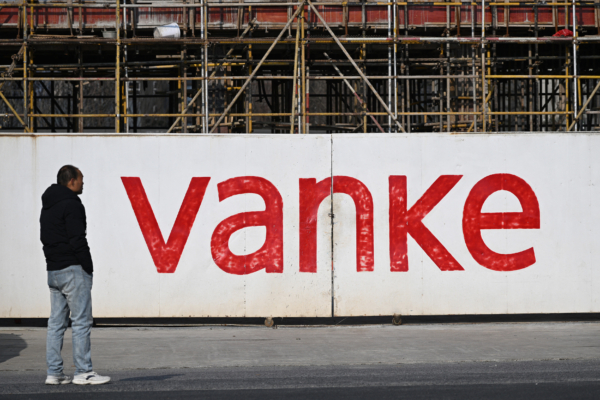
China’s real estate giant Vanke’s risk of default on debt has further increased. All three debt extension proposals for the “22 Vanke MTN004” with a payment date of December 15 have been rejected. The news triggered a chain reaction in the capital market, with Vanke’s stocks and bonds plummeting on Monday (15th). Failure to reach an agreement with investors within the next 5 working days will constitute Vanke’s first debt default.
On Monday (December 15), Vanke announced the results of the 4th tranche of the 2022 midterm bond “22 Vanke MTN004” extension meeting, where all three proposal options failed to receive approval from bondholders, with the closest proposal garnering 83.40% of the vote, falling short of the 90% threshold required for approval.
This news quickly caused a chain reaction in the capital market. On Monday, both Vanke’s A-shares and Hong Kong stocks fell. By the end of the afternoon trading session, Vanke’s A-shares had dropped by 2.99%, while Vanke Enterprise’s Hong Kong stocks widened their decline to 5.16%.
In the bond market, several of Vanke’s domestic bonds saw significant price drops. By the end of the afternoon trading session, “21 Vanke 02” plummeted by over 26%, “21 Vanke 04” fell by over 11%, “23 Vanke 01” dropped by over 7%, “21 Vanke 06” fell by over 6%, “22 Vanke 02” dropped nearly 6%, and “22 Vanke 04” and “22 Vanke 06” both fell by over 5%.
It was disclosed that the “22 Vanke MTN004” was originally scheduled to mature and be paid out on December 15, 2025, with a remaining balance of ¥2 billion and a coupon rate of 3.00%.
Vanke also announced in the notice that they plan to hold a second bondholders’ meeting on the morning of December 18 to review matters related to the bond extension.
According to the prospectus of the “22 Vanke MTN004,” although the bond interest payment date has passed, Vanke still has a 5-day grace period. If Vanke fully repays all principal and interest due (including interest accrued during the grace period) within the grace period, it will not be considered a default.
Industry experts believe that the rejection of Vanke’s bond extension proposal is not surprising for two main reasons: the long-term downturn in the Chinese real estate market and the excessively high approval threshold for the bond extension.
Yang Yuejin, deputy director of the Shanghai E-House Real Estate Research Institute, stated in an interview with “Jiemian News”: “From the perspective of the industry’s overall environment, the current real estate market is still in a deep adjustment phase, with tight overall liquidity and strict controls by financial institutions on real estate financing. Even Vanke as an industry benchmark cannot completely avoid the impact of this challenging environment.”
Analysts at JPMorgan Chase recently stated that almost all Chinese real estate developers seeking debt extensions over the past four years have ultimately defaulted and faced debt restructuring.
A real estate executive who has completed domestic debt restructuring told “Caixin Financial” that “Vanke’s extension proposal is difficult to pass because the terms are too challenging, requiring 90% approval. Additionally, different bondholders have varying interests, with some holding smaller positions acquired later at different costs, and possibly holding only one bond issuance, leading to a stronger insistence on prior payment arrangements.”
Standard & Poor’s analyst Chen Linghua said in an email to “Caixin Financial” that between December 2025 and May 2026, Vanke will face approximately ¥11.4 billion in bond maturities. The risk of restructuring in the next six months is rising for Vanke. Due to weak liquidity, Vanke’s financial commitments are unsustainable.
While Vanke’s debt risk is on the rise, the company’s operating conditions are deteriorating. According to Vanke’s “2025 Third Quarter Report,” as of the end of September, Vanke’s revenue was ¥161.39 billion, a year-on-year decrease of 26.6%; net profit attributable to shareholders was a loss of ¥28.02 billion, an 83% year-on-year decline, which was a further widening from the first half of the year.
According to “21st Century Economic Report,” in the first 10 months of this year, Vanke accumulated a total sales amount of ¥115.28 billion, with an average monthly sales of around ¥11.53 billion, compared to the monthly sales of around ¥20 billion in 2024, indicating nearly a halving of sales performance.
On December 5, Pufa Bank disclosed the aforementioned three extension proposals representing the demands of all parties, all of which mentioned delaying the principal payment by 12 months to December 15, 2026, with the coupon rate remaining unchanged at 3.00% during the extension period. The key difference lies in the structure of interest payments and credit enhancement measures.
The first proposal involved postponing the payment of both principal and interest generated before and after the extension by 12 months, with no additional credit enhancement measures during this period. The voting results showed that the proposal did not receive support from bondholders, with a total effective votes of 0; while 16 holders or proxies opposed the proposal, with a total effective votes of 15,340,000, accounting for 76.70% of the total votes.
The second proposal requested additional credit enhancement measures, including but not limited to full, irrevocable joint responsibility guarantees or other pledge measures provided by Deep Iron Group or other Shenzhen state-owned enterprises acceptable to investors, with interest before the extension due to be paid on December 15 of this year. This proposal received support from 7 holders, with a total effective votes of 16,680,000, accounting for 83.40% of the total votes.
The payment arrangements for principal and interest in the third proposal were identical to the second proposal, with the only difference being the requirement to provide corresponding credit enhancement measures. Proposal three was supported by only 1 institution, with an effective vote of 3,790,000, accounting for 18.95% of the total vote.
According to the regulations of the “Interbank Bond Market Non-Financial Corporate Debt Financing Instrument Holder Meeting” and the issuance documents of this bond, the approval of the three proposals must be obtained from holders representing over 90/100 of the total voting rights of this debt financing instrument before they can take effect. None of the three extension proposals met this 90% threshold.